Mining still anchors South Africa’s economy — but 2025 exposes deep cracks beneath headline gains
The South Africa mining 2025 outlook presents a mixed picture of resilience and fragility. While the sector remains a cornerstone of the national economy, new data from the Minerals Council South Africa (MCSA) and Statistics South Africa (StatsSA) reveal that mining’s contribution to GDP, production stability, and employment are under renewed pressure. For mining companies, professionals, and analysts, South Africa mining 2025 is shaping up to be a year of recalibration rather than resurgence.

Mining GDP Contribution Declines in 2025
According to official figures, the South Africa mining 2025 GDP contribution contracted by 4.1% quarter-on-quarter in Q1, shaving 0.2 percentage points off total national growth, which registered just 0.5% year-on-year. Mining’s share of GDP hovers near 6%, but its real value-add continues to slide. StatsSA data shows mining output declined 2.7% in the first four months of 2025, offsetting earlier gains from load-shedding relief and improved logistics efficiency.
For the industry’s financial analysts, this underscores a hard truth: South Africa mining 2025 remains dominated by price-driven revenue, not productivity-led expansion. As cost pressures from energy and transport persist, the sector’s long-term competitiveness hangs on structural reform rather than commodity cycles.
Commodity Performance: A Year of Divergence
The South Africa mining 2025 production landscape reveals sharp contrasts between winners and laggards:
- PGMs: Output fell 13.2% for the three months ending April, dragging sectoral performance by -4.1 percentage points.
- Iron Ore: Rose 10.3% in the same period and continued upward momentum through mid-2025, posting +12.2% year-on-year by July.
- Gold and Coal: Both declined due to weak international demand and export constraints.
- Nickel and Manganese: Delivered moderate gains, buoyed by the global battery materials boom.
These variations highlight how South Africa mining 2025 is evolving into a two-speed industry — with critical minerals outperforming traditional commodities like coal and PGMs, yet failing to offset national revenue loss.
Sales Value vs Volume: A Profitability Paradox
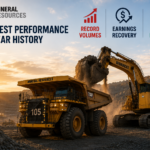
Total mineral sales at current prices grew just 0.7% year-on-year by April 2025, despite strong gains in gold (+57.6%) and manganese ore (+66.6%). Iron ore (-25.9%) and PGMs (-20.1%) saw steep value declines.

This imbalance in South Africa mining 2025 data signals a profitability paradox: higher commodity prices in some segments cannot compensate for production drops and rising operational costs elsewhere. For mining companies, sustained margins will depend on logistics efficiency and cost discipline, not speculative pricing.
Employment and Export Resilience
Despite subdued conditions, the South Africa mining 2025 employment outlook remains cautiously stable. Formal mining jobs rose slightly to 468,000 in Q2 2025, driven by recruitment in iron ore and manganese operations. Mining still accounts for under 3% of total formal employment but remains a major export driver — particularly in gold, coal, and PGMs, which together contributed more than 60% of total export receipts in 2024–2025.
The government’s newly released Critical Minerals and Metals Strategy 2025 aims to position South Africa mining 2025 as a global supplier for clean-energy materials such as lithium, vanadium, and cobalt — a pivot that could define the next growth phase if implemented effectively.
Policy and Infrastructure: The Twin Bottlenecks
The Minerals Council has warned that the South Africa mining 2025 recovery will falter unless chronic infrastructure and policy issues are resolved. Persistent rail bottlenecks, port inefficiencies, and illegal mining have undermined exports despite improved electricity stability. The pending Mineral Resources Development Bill (MRDB) is viewed cautiously by industry leaders, who fear overregulation could deter new investment.
For analysts covering South Africa mining 2025, these twin bottlenecks — policy uncertainty and logistical paralysis — represent the most significant non-market risk to watch in the coming year.
Skillings Analysis
- Revenue without productivity is unsustainable. The 2025 data confirm that while total mineral sales approach R870 billion, real value-add continues to stagnate.
- Critical minerals are South Africa’s next frontier. However, without faster policy alignment and logistical reform, these opportunities risk being captured by competitor regions like Namibia and the DRC.
- Mining companies must pivot strategically. Portfolio diversification, automation, and local beneficiation are the most viable paths to resilience in South Africa mining 2025.
Outlook: Preparing for 2026
As South Africa prepares to host the G20 Summit in 2025, the mining sector will seek to spotlight its role in global energy transition supply chains. Yet, the year ahead will test whether the industry can move from resilience to renewal.
For South Africa mining 2025, the priorities are clear: stabilise production, restore investor confidence, and accelerate infrastructure rehabilitation. Analysts forecast that if iron ore and gold maintain their mid-year momentum, GDP contribution could rebound modestly by Q2 2026 — but only if the country translates strategy into execution.