Gold surged past $5,000 per ounce in January 2026, posting a 20%+ monthly gain that shattered decades of historical precedent. Mining equities rallied 10.91% during the same period.

That's the disconnect nobody wants to talk about.
While the commodity itself is trading at record highs, mining stocks are effectively priced as if gold were sitting at $2,500 to $3,500. This isn't a temporary dislocation. It's a structural valuation gap that has institutional analysts calling for what they're terming the "Great Re-Rating": a forced reassessment driven by sheer cash flow mathematics that the market can no longer ignore.
The Numbers Don't Lie
The MarketVector Global Gold Miners Index climbed 10.91% in January 2026. Respectable performance in any other context. But against a 20%+ spike in the underlying commodity, it's an underperformance of historic proportions.
Senior gold miners currently trade at approximately 0.75x net asset value. Junior miners sit at 0.50x NAV. Historical bull market averages hover around 1.2x. That's a 40% discount for the seniors and a 58% discount for the juniors compared to where these stocks should be trading if historical patterns held.
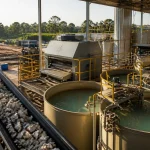
Put another way: the total market capitalization of all global gold miners combined is roughly $1 trillion. That's less than Walmart's current market cap of $1.1 trillion. A single retail chain is valued higher than the entire global industry responsible for producing humanity's oldest store of value.


Why the Market Refuses to Believe
Outdated Models Still Rule
Equity analysts at major investment banks are still running models that assume gold will revert to $3,500 per ounce. Not $5,000. Not even $4,500. They're pricing in a mean reversion that may never come.
As these models get updated: and they will, because eventually reality forces the issue: the net asset value calculations for major producers should see massive overnight increases. Barrick Gold, Newmont, Agnico Eagle: their on-paper value jumps the moment analysts plug in $5,000 gold as the baseline assumption rather than $3,500.
That hasn't happened yet. Which means the current stock prices reflect yesterday's reality, not today's.
Investor Trauma Runs Deep
The gold mining sector has burned investors before. Repeatedly. The 2010-2015 cycle saw companies overpay for acquisitions, blow capital budgets, and dilute shareholders through poorly-timed equity raises. Cost inflation spiraled. Balance sheets deteriorated.
Those memories linger. Even though the current crop of management teams has demonstrated improved capital discipline and stronger balance sheets, the market treats every mining stock as if it's still run by the executives who wrecked value a decade ago.
Investor perception hasn't caught up to operational reality. The skepticism may be outdated, but it's persistent.
Fund Flows Tell the Story
Gold miner ETFs have bled approximately $2 billion in net outflows over the past year. Institutional investors remain substantially underexposed to the sector. Retail investors aren't rushing in either.
Meanwhile, gold itself: held through ETFs, futures, or physical bullion: has seen massive inflows. The commodity is popular. The companies that mine it are not.
All-In Sustaining Costs Are Climbing
Mining stocks didn't rally harder in January partly because AISC trends are moving in the wrong direction. All-in sustaining costs have climbed toward $1,400 to $1,600 per ounce, driven by an 11% year-over-year spike in energy costs and persistent labor inflation.
That's a legitimate concern. Higher costs eat into margins. But at $5,000 gold, even $1,600 AISC still leaves massive profitability on the table. The market, however, tends to overweight cost inflation fears during the early stages of commodity rallies.

The Profitability Paradox
The disconnect becomes absurd when you look at actual earnings.
Barrick Gold is expected to generate EBITDA margins exceeding 70% in 2026 at current gold prices. Seventy percent. That's software company territory, not extractive industry norms.
Free cash flow is exploding across the sector. Companies are generating cash faster than they can deploy it into new projects, shareholder returns, or debt reduction. According to Franklin Templeton, mining equities offer "real operational leverage, with earnings and free cash flow climbing faster than the bullion price itself."
Yet these same companies trade at discounts to historical valuations. The market is pricing in either a collapse in gold prices or a belief that miners will squander the windfall through poor capital allocation. Neither seems particularly likely given current macro conditions and improved corporate governance.
The Great Re-Rating
Institutional analysts are increasingly using that specific term: the Great Re-Rating. It's not hyperbole. It's a recognition that valuation multiples cannot remain suppressed indefinitely when free cash flow generation reaches these levels.
At some point, the math overwhelms the skepticism. The magnitude of cash being generated at $5,000+ gold will force a fundamental reassessment. Buybacks will accelerate. Dividends will increase. Special distributions will get announced. M&A activity will heat up as larger producers use their balance sheet strength to acquire undervalued juniors.
All of those catalysts push stock prices higher, whether the market wants to believe in the sector or not.
The gold price forecast for 2026 increasingly points to sustained elevated prices driven by central bank buying, geopolitical instability, and concerns about fiat currency debasement. If that forecast holds, mining stocks won't be able to trade at 0.75x NAV forever. The valuation gap will close, not because sentiment improves, but because profitability becomes impossible to ignore.
What Happens When Assumptions Shift
The most immediate catalyst for re-rating will be analyst model revisions. When sell-side research teams shift their base case assumptions from $3,500 gold to $4,500 or $5,000, their target prices will jump overnight. That creates buying pressure from institutional investors who benchmark against those targets.
Portfolio managers who have been underweight mining stocks relative to their benchmarks will be forced to add exposure. Not because they suddenly love the sector, but because the performance gap becomes too large to justify to clients.
The AISC trends that worried investors in January may actually stabilize as energy prices moderate and labor markets cool slightly. If costs plateau around $1,500 while gold holds above $5,000, the margin expansion story becomes even more compelling.
Meanwhile, the companies themselves are in the strongest financial position in decades. Debt levels are manageable. Capital discipline has improved. Management teams have learned: often the hard way: that investors reward cash returns over empire-building.
The Timing Question
Nobody knows exactly when the re-rating arrives. Markets can remain irrational longer than most investors can remain patient. But the underlying fundamentals are building pressure.
The current environment shares characteristics with early-stage commodity bull markets: a large gap between spot prices and equity valuations, institutional underexposure, and improving fundamentals that the market refuses to acknowledge.
Those conditions don't last indefinitely. They resolve either through commodity price collapse or equity price appreciation. Given the macro drivers supporting gold price forecast 2026: central bank demand, inflation hedging, geopolitical risk: the former seems less likely than the latter.
The valuation gap exists because markets price in fear faster than opportunity. Mining stocks are still trading as if gold's rally is temporary, costs will spiral, and management teams will waste the windfall. As each quarter passes with $5,000+ gold and 70% EBITDA margins, that thesis becomes harder to defend.
The re-rating won't arrive all at once. It will be gradual, then sudden. First, analyst upgrades. Then, institutional buying. Then, momentum players piling in as the trend becomes undeniable. By the time sentiment fully shifts, the easy money will already be made.
The gap is historic. The profitability is real. The question isn't whether mining stocks catch up to gold. It's how long investors are willing to wait while sitting on companies generating cash flow that even the skeptics can't ignore.