By Salini Krishnan

The global rare earth landscape underwent a structural shift this week as Japan and Lynas Rare Earths formalized a long-term supply agreement that effectively decouples strategic mineral pricing from the volatility of spot markets. At the center of the deal is a $110 per kilogram price floor for Neodymium-Praseodymium (NdPr) oxide, a move that signals a transition from “lowest-cost” procurement to “highest-security” supply chains.
The agreement, brokered between Lynas and Japan Australia Rare Earths (JARE): a joint venture between trading house Sojitz and the state-backed Japan Organization for Metals and Energy Security (JOGMEC): establishes a guaranteed floor price for 5,000 metric tonnes of NdPr annually through 2038. For industry observers and policymakers, the $110 floor represents the first major attempt by an OECD nation to build a policy-driven buffer against China’s historic ability to suppress prices and push international competitors out of the market.
A Departure from Market-Driven Pricing
For decades, the rare earth sector has been defined by extreme price swings, often dictated by production quotas and export policies out of Beijing. This volatility has traditionally discouraged Western investment in midstream processing, as the risk of a sudden price collapse often rendered non-Chinese projects economically unviable.
The Lynas-Japan deal fundamentally alters this calculus. By establishing a $110/kg floor, JARE is providing Lynas with a guaranteed revenue stream that ensures operational stability regardless of how low spot prices might drop. In exchange, Japan secures a locked-in supply for its high-tech manufacturing sector, which is increasingly dependent on high-strength magnets for electric vehicle (EV) motors and wind turbines.
More Read

This mechanism is not a one-way street. The agreement includes an upside-sharing provision: when prices exceed $150/kg, the benefits are shared between the buyer and the seller, subject to annual caps. This prevents Japan from being over-exposed during periods of extreme scarcity while ensuring Lynas captures enough margin to reinvest in its separation facilities in Malaysia and Australia.

Geopolitical Alignment and the $110 Benchmark
The selection of $110/kg as the floor price is not arbitrary. Analysts point out that this figure aligns closely with pricing frameworks discussed during previous U.S. administrations regarding domestic producers like MP Materials. By coalescing around a similar price point, the “Magnificent Three” of the non-Chinese rare earth world: the United States, Japan, and Australia: are effectively creating a coordinated price zone.
More Read

This coordination acts as a defensive perimeter. When China increases production to lower global prices: a tactic used frequently over the last 15 years: the $110 floor ensures that the primary non-Chinese supplier remains profitable and operational. It is a recognition that the “cheapest” supply is rarely the most reliable in a contested geopolitical environment.
This trend toward government-backed price floors is expanding beyond the Indo-Pacific. Similar strategic concerns are driving developments in Europe, where Norway’s Fen Project is becoming Europe’s largest deposit, potentially requiring its own set of floor-price guarantees to compete with integrated Chinese supply chains.
Japan as a Supply System Designer
The deal marks Japan’s evolution from a passive purchaser of minerals to an active “supply system designer.” Rather than simply signing off-take agreements, JOGMEC and Sojitz are now architecting the financial structures that allow mines to exist in the first place.
This strategy extends beyond Australia. Japan has recently engaged in high-level talks with Brazil and Vietnam to develop midstream processing capacity. The goal is to build a “China-plus-one” (or “China-plus-two”) strategy that relies on a network of modular facilities.

A modern rare earth separation facility, highlighting the complex chemical processing required to isolate NdPr from raw ore.
Structural Impact: The Supply-Security Premium
For the broader mining industry, the Lynas-Japan deal introduces the concept of a “supply-security premium.” Downstream manufacturers, particularly in the automotive sector, are beginning to accept that paying a fixed, slightly higher price is preferable to the existential risk of a supply cutoff.
This shift mirrors broader trends in the energy transition. As seen in the strategic pact between Washington and Santiago to secure copper and lithium, the focus has moved from open-market auctions to bilateral, state-supported agreements.
| Feature | Market-Driven Model (Pre-2024) | Policy-Driven Model (Post-Lynas/JARE) |
|---|---|---|
| Pricing Basis | Daily Spot Price (SMM/Asian Metal) | Guaranteed Floor ($110/kg NdPr) |
| Risk Bearer | The Producer (Lynas) | Shared between Producer & State Buyer |
| Contract Length | Short-to-Medium (1-3 years) | Long-Term (Through 2038) |
| Primary Goal | Lowest unit cost | Supply continuity and price stability |
| Market Influence | China-dominated spot market | Coordinated OECD floor pricing |
Technical Challenges and Downstream Integration
While the financial floor provides a safety net, the technical execution remains complex. Lynas is currently optimizing its Kalgoorlie Rare Earths Processing Facility and its Malaysian separation plant to meet the increased 5,000-tonne annual NdPr quota. The total commitment to Japan reaches 7,200 metric tonnes when including additional heavy rare earths (Dysprosium and Terbium), which are essential for high-temperature magnet performance.
The ability to separate these minerals outside of China is the true bottleneck. Even as new mines come online, the midstream “separation” phase remains the most capital-intensive and chemically difficult part of the process. Japan’s financial commitment specifically targets this midstream vulnerability, ensuring that the refined product: not just the raw concentrate: is available for Japanese magnet makers.

Implications for Junior Miners and Investors
The establishment of a $110 floor by a major player like JARE provides a valuation anchor for the entire sector. For junior rare earth miners, this deal serves as a “proof of concept” for their own project financing. Lenders are more likely to fund a project if they see a precedent for state-backed floor prices that protect against Chinese market intervention.
However, the “Lynas Premium” may also create a two-tiered market. Large, established producers with state backing may enjoy stable, high-margin contracts, while smaller explorers without national security “tags” may still be forced to navigate the volatile spot market. Investors are already looking toward companies that can replicate the Lynas model of securing strategic, state-aligned partners.
2026 Outlook: The New Rare Earth Standard
As of late March 2026, the rare earth market is entering a period of “managed stability.” The wild fluctuations of the early 2020s are being replaced by long-term, fixed-price frameworks. While this might limit the speculative “moonshots” often seen in junior mining stocks, it provides the industrial certainty required for the global energy transition.
The Lynas-Japan agreement is likely the first of many. We expect to see similar floor-price mechanisms emerge for other critical minerals, including lithium, cobalt, and high-purity manganese. The era of the “unregulated commodity” is ending for minerals deemed vital to national security.

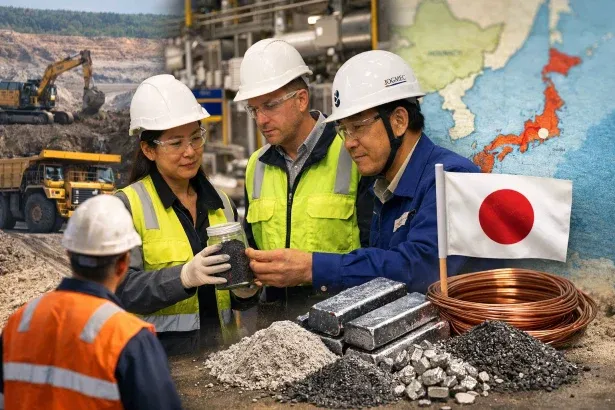
Industry analysts and policymakers in a boardroom setting, discussing the implementation of critical mineral price floors.
The message to the market is clear: the era of chasing the lowest price at the expense of security is over. In the new rare earth economy, the price of independence is $110 a kilo; and for Japan, that is a price well worth paying.
For more deep-dive analysis on the mining industry and commodity markets, visit Skillings Mining Review.