By Penny Laneford

QUEBEC CITY, QUEBEC : In a move that underscores the intensifying race for North American critical mineral independence, SAGA Metals Corp. has officially completed its acquisition of the Garneau titanium property from mining giant Rio Tinto. The transaction, finalized on March 26, 2026, places a high-potential, drill-ready asset into the hands of an agile junior explorer at a time when titanium’s role in aerospace, defense, and the green energy transition has never been more scrutinized.
The acquisition includes a 100% interest in the Garneau Project, a sprawling 6,450-hectare site located in the heart of Quebec’s premier titanium district. For SAGA Metals, the deal represents a “company-maker” opportunity, securing a foothold directly adjacent to some of the most prolific titanium production infrastructure on the planet.
A Strategic Asset in a Tier-1 District
The Garneau property consists of 120 claims covering approximately 64.5 square kilometers near Havre-Sainte-Pierre. Its location is perhaps its most compelling feature; the project sits within the same anorthosite complex as Rio Tinto’s own Lac Tio mine.
For industry observers, the proximity to Lac Tio is a significant indicator of potential. Lac Tio is widely recognized as the largest hard-rock ilmenite deposit in the world. By acquiring a project with a similar geological signature in the Havre-Saint-Pierre district, SAGA Metals is positioning itself within an ecosystem that already supports large-scale commercial extraction and sophisticated logistics.
More Read

 ]
]
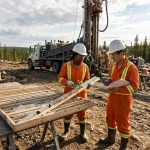
Caption: Mining geologists review exploration data in the Havre-Sainte-Pierre district, where the Garneau project’s proximity to existing majors offers significant logistical advantages.

The Havre-Saint-Pierre region has long been the backbone of North American titanium production. However, as global supply chains shift away from traditional sources, the importance of domestic, stable jurisdictions like Quebec has skyrocketed. This acquisition is a clear signal that junior miners are increasingly taking the lead on primary exploration while majors like Rio Tinto focus on optimizing their massive, existing operations.
Geological Prospects: High-Grade Potential
The technical data supporting the Garneau acquisition suggests a project that has moved well beyond the conceptual stage. Previous exploration work: much of it conducted or initiated by Rio Tinto: has identified a massive ilmenite-rich boulder on the property that returned an assay of 32.4% TiO₂ (titanium dioxide).
More Read

Such high-grade samples are rare and place the Garneau project on par with the known iron-titanium deposits that define the district. Furthermore, geophysical surveys have revealed a 4.5 by 7.5-kilometer magnetic anomaly. This anomaly features a basin-like morphology that bears a striking resemblance to the geophysical signature of the Lac Tio deposit.
Despite these promising indicators, the Garneau project remains largely untested by the drill bit. Rio Tinto’s involvement advanced the property to a “drill-ready” status, essentially de-risking the early-stage targeting for SAGA Metals. The next phase of exploration will be critical in determining whether the geophysical anomaly translates into a bulk-tonnage mineral resource.
The Criticality of Titanium in 2026
The timing of this acquisition aligns with a broader global squeeze on critical minerals. While much of the market’s attention has been focused on the Global Battery Revolution and the looming copper deficit of 2026, titanium remains an indispensable pillar of modern industrial strategy.
Titanium dioxide is the primary feedstock for titanium metal, which is prized for its high strength-to-weight ratio and corrosion resistance. In 2026, the demand drivers are three-fold:
- Aerospace and Defense: With global geopolitical tensions remaining elevated, the demand for titanium in airframes and jet engines has surged.
- Energy Transition: Titanium is increasingly used in geothermal power plants and offshore wind structures due to its durability in harsh environments.
- Advanced Manufacturing: The rise of 3D printing (additive manufacturing) relies heavily on high-purity titanium powders.
The Garneau acquisition ensures that SAGA Metals is leveraged to these high-growth sectors. Unlike speculative “greenfield” projects in remote jurisdictions, Garneau is a “brownfield-adjacent” play in a region that understands how to move ore from the ground to the market.
Infrastructure and ESG Advantages
One of the primary hurdles for any new mining project is the lack of infrastructure. However, the Garneau property benefits from significant regional development. The recently completed Romaine hydroelectric complex provides a source of clean, renewable power: a critical factor for companies aiming to meet modern ESG (Environmental, Social, and Governance) standards.
Additionally, a new Hydro-Québec access road is located just 4.5 kilometers from the property boundary. This proximity drastically reduces the capital expenditure required for early-stage exploration and future development. In an era where OEM parts and optimized costs are essential for junior survival, having a “paved path” to the project site is a massive operational win.
 ]
]
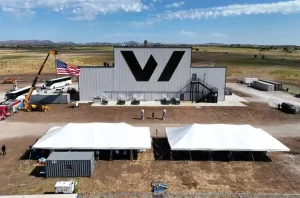
Caption: Modern mineral processing facilities in Quebec are increasingly powered by renewable energy, providing a low-carbon footprint for critical mineral extraction.
Transaction Details and Rio Tinto’s Retained Interest
The terms of the deal reflect a balanced risk-sharing approach between the major and the junior. Under the agreements dated March 26, 2026, SAGA Metals has assumed C$434,298 in exploration expenditures. In a show of support for the transition, Rio Tinto also reimbursed SAGA $60,000 for reasonable costs and expenses incurred during the transaction process.
Crucially, Rio Tinto is not walking away from the project’s potential entirely. The mining giant retains a 2% Net Smelter Returns (NSR) royalty on all mineral extraction and production from the site. This allows Rio Tinto to maintain an upside interest in the project while offloading the day-to-day exploration risks and management to SAGA’s specialized team.
For SAGA Metals, the investment is substantial but manageable, especially given the “drill-ready” nature of the target. The company is essentially buying time: years of prior geophysical work and targeting are now theirs to exploit.
Quebec’s Role in the Global Supply Chain
The SAGA-Rio Tinto deal is part of a larger trend of consolidation and strategic realignment within Quebec. The province has positioned itself as a “one-stop-shop” for critical minerals, offering everything from exploration incentives to world-class geological data.
As we have seen with other projects like the Per Geijer rare earths discovery or the O3 Mining divestments, the movement of assets from majors to juniors often precedes a period of rapid discovery and value creation.
“Quebec is no longer just a gold province,” says one industry analyst. “It is becoming the Western world’s answer to the critical minerals monopoly. Titanium, lithium, and rare earths are the new currency, and Havre-Sainte-Pierre is the bank.”
Looking Ahead: The 2026 Outlook
With the acquisition closed, the market is now waiting for SAGA Metals to announce its inaugural drilling program. The company’s immediate goal will be to test the 4.5 by 7.5-kilometer magnetic anomaly. If the drills return intercepts consistent with the 32.4% TiO₂ surface samples, the Garneau project could quickly move toward a resource estimate.
Investors should monitor the company’s capital-raising activities in the coming months, as a comprehensive drill program in the Quebec backcountry: even with road access: requires significant funding. However, given the pedigree of the project and its former owner, SAGA is likely to find a receptive audience among institutional investors looking for critical mineral exposure.
In the broader context, this deal serves as a reminder that the mining industry’s future is being written in the “transition” minerals. While gold prices may hit record highs, the industrial reality of 2026 is that without titanium, nickel, and copper, the modern economy grinds to a halt.
SAGA Metals has secured more than just a piece of land; it has secured a seat at the table in the North American critical minerals strategy.