By Charles Pitts

BEATTY, NEVADA : AngloGold Ashanti (NYSE: AU) has formalized the economic potential of its flagship Arthur gold project, signaling a transformative shift for the Beatty Mining District and the broader U.S. gold mining sector. According to pre-feasibility study (PFS) results released Monday, the project is slated to become one of the most significant domestic gold producers of the decade, boasting a reserve of 4.9 million ounces and an after-tax net present value (NPV) reaching as high as $3.4 billion under current bullish market conditions.
The confirmation of the Arthur project’s economics comes at a time when major producers are aggressively de-risking Tier-1 jurisdictions. By transitioning to the full feasibility stage, AngloGold Ashanti is positioning the Nevada asset as a cornerstone of its global portfolio, targeting an average annual production profile of 500,000 ounces over an initial nine-year mine life.
Robust Reserves and Geologic Foundation
The Arthur project’s mineral reserve estimate provides a solid technical foundation for the proposed operations. The study outlines 88 million tonnes of ore grading 1.75 grams per tonne (g/t) gold and 2.76 g/t silver. Crucially for processing efficiency, more than 95% of this mineralization occurs as oxide ore.
Oxide deposits are highly coveted in the industry due to their suitability for conventional processing methods, which typically result in higher recovery rates and lower capital intensity compared to complex refractory ores. AngloGold’s geological modeling suggests that the Beatty Mining District, located approximately 120 miles northwest of Las Vegas, offers a rare combination of high-grade oxide mineralization and large-scale open-pit potential.
More Read

The reserve calculation was based on a conservative gold price of $1,950 per ounce, ensuring that the project remains viable even in the event of a significant market correction. However, the current spot prices and forward-looking projections have allowed the company to showcase the project’s massive upside potential.


Financial Metrics: High Margin, Low Cost
The economic heart of the Arthur project lies in its competitive cost profile. AngloGold Ashanti estimates life-of-mine cash costs at approximately $778 per ounce, with all-in sustaining costs (AISC) pegged at $954 per ounce. In an era of persistent inflationary pressure on labor, consumables, and energy, maintaining an AISC below the $1,000 mark is a critical benchmark for institutional investors.
More Read

The PFS evaluates the project’s NPV (at a 5% discount rate) across several price scenarios:
- Base Case ($2,715/oz gold): After-tax NPV of $1.7 billion.
- Bull Case ($3,500/oz gold): After-tax NPV of $3.4 billion.
To bring this production online, the company anticipates an initial capital expenditure of $3.6 billion. While the upfront cost is substantial, the scale of the 500,000-ounce annual production target provides a rapid payback period. This level of investment mirrors other major North American developments, such as the Seabridge Gold KSM project, which are also navigating the transition from exploration to bankable feasibility in high-cost environments.
| Metric | Estimated Value |
|---|---|
| Mineral Reserves | 4.9 Million oz Au |
| Annual Production | ~500,000 oz Au |
| Mine Life | 9 Years |
| AISC | $954 / oz |
| Initial CapEx | $3.6 Billion |
| After-Tax NPV ($3,500 Au) | $3.4 Billion |
Modern Infrastructure and Sustainable Operations
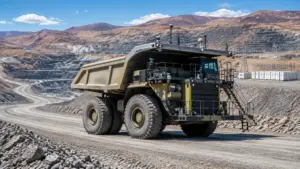
Operational design for the Arthur project reflects the industry’s shift toward electrification and water conservation. AngloGold plans to utilize an open-pit mining method featuring electric shovels and ultra-class haul trucks. This approach is intended to reduce the carbon footprint of the operation while optimizing throughput.
A standout feature of the proposed mine plan is the implementation of dry-stacked tailings. This method is increasingly becoming the standard for projects in arid environments like Nevada, as it significantly reduces water consumption and mitigates the risks associated with traditional tailings dams. The integration of advanced technology is no longer optional for major miners; it is a prerequisite for obtaining social license and regulatory approval in the United States.
Furthermore, the project’s proximity to established infrastructure in the Beatty area: including power, roads, and a skilled labor pool: removes many of the logistical hurdles typically associated with remote mining developments. As mining companies explore new power solutions, some industry leaders are even looking toward small modular reactors (SMRs) to provide stable, low-carbon baseload power for large-scale operations, although Arthur’s current plan remains focused on traditional grid and renewable integration.

Strategic Importance for U.S. Gold Production
The Arthur project is not just a win for AngloGold Ashanti; it is a significant development for U.S. resource sovereignty. Nevada remains the premier jurisdiction for gold mining in North America, but many established mines are reaching maturity. The entry of a major new producer capable of delivering half a million ounces annually is essential for maintaining the state’s status as a global mining powerhouse.
The development comes amidst a broader trend of re-evaluating project valuations in the face of supply chain shifts. Just as the copper market is bracing for a deficit in 2026, gold producers are facing pressure to bring high-quality, long-life assets online to meet investor demand for safe-haven assets.
The Arthur project’s success also highlights the effectiveness of Nevada’s regulatory framework. By providing a clear, albeit rigorous, path to permitting, the state continues to attract the multi-billion-dollar investments necessary for modern mining. This stands in contrast to other regions where jurisdictional risk has stymied development.

Labor and Economic Impact
The scale of the Arthur project will require a significant workforce, both during the multi-year construction phase and throughout the nine-year operational life. For the local economy in Beatty and Nye County, the project represents a multi-generational economic engine. However, the mining industry continues to grapple with a skilled labor shortage that complicates project timelines and budgets.
Finding experienced geologists, engineers, and heavy equipment operators is a persistent challenge. Companies are increasingly forced to look at international talent mobilization and extensive internal training programs to fill the gap. AngloGold’s ability to tap into the existing Nevada mining ecosystem will be a major advantage as it moves toward the construction phase.

Risks and Mitigation
While the PFS results are overwhelmingly positive, the path to production is not without obstacles. AngloGold Ashanti faces the standard suite of risks associated with large-scale mining:
- Capital Inflation: While the $3.6 billion estimate is based on current data, further increases in steel, fuel, or labor costs could compress margins.
- Permitting Timelines: U.S. federal and state permitting processes are thorough and can be subject to litigation or delays.
- Gold Price Volatility: The $3.4 billion NPV is highly sensitive to the gold price. While the $3,500/oz scenario is enticing, the company must ensure the project remains robust if prices retreat toward the $2,000 level.
The company has indicated that its Board of Directors is scheduled to review the PFS in June 2026. A formal decision to advance to a full bankable feasibility study (BFS) and subsequent construction decision will follow that review.
Looking Ahead: The Beatty Mining District 2026-2030
The Arthur project is part of a larger strategic play by AngloGold Ashanti in the Beatty area. The company has methodically consolidated land positions and explored satellite deposits, suggesting that the initial nine-year mine life could be just the beginning.
As the industry watches Arthur move toward full feasibility, the project serves as a barometer for the health of the U.S. mining industry. If AngloGold Ashanti can successfully navigate the transition from a $3.4 billion economic projection to a functioning, 500,000-ounce-per-year operation, it will reaffirm Nevada’s position as the most attractive mining jurisdiction in the world.
For investors and operators, the message is clear: the era of “mega-projects” in safe jurisdictions is back, and Nevada is once again at the center of the surge.