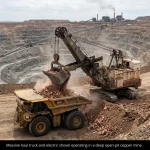
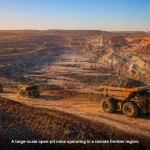
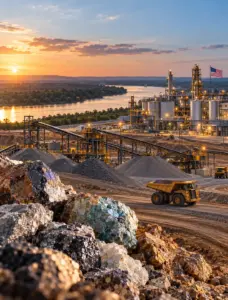
A modern mineral processing facility at sunrise, representing the next phase of Guyana’s industrial gold production.

By Charles Pitts
Guyana’s reputation as the world’s fastest-growing economy has long been anchored by the offshore oil boom in the Stabroek Block. However, as we enter the second quarter of 2026, the narrative is shifting toward a terrestrial “Frontier Alpha.” While petroleum continues to provide the national treasury with unprecedented liquidity, the mining sector: specifically gold: is undergoing a structural transformation. Driven by significant resource upgrades at the historic Omai site and a wave of corporate consolidation led by G Mining Ventures, Guyana is no longer just an exploration play; it is becoming a Tier-1 gold jurisdiction.
For years, the Guiana Shield was viewed as the “poor cousin” to the West African Birimian or the Western Australian Yilgarn. That perception has evaporated. The combination of high-grade discoveries, improved logistical corridors, and a government eager to diversify its revenue streams has created a unique window for investors. By the end of April 2026, the data points to a major re-rating of the region’s gold assets.
The Omai Resource: A 6.5-Million-Ounce Catalyst
The centerpiece of Guyana’s current gold renaissance is the Omai Gold Mines project. Once the largest gold producer in South America during the 1990s, Omai has returned to the spotlight with an aggressive resource expansion program that culminated in a significant update in early 2026.
More Read

As of the latest filing, the Omai project now hosts a total resource of 6.5 million ounces of gold. This represents a 50% increase over the early 2024 estimates, largely driven by the 39,000-meter diamond drilling campaign completed throughout 2025. The resource is split between two primary deposits:

- Wenot Deposit: A high-grade open-pit resource that saw its Indicated category grow by 96% in the last year.
- Gilt Creek Deposit: An underground target located directly beneath the past-producing pits, currently holding 2.5 million ounces at an average grade of 3.26 g/t Au.
The company is currently finalized its Updated Preliminary Economic Assessment (PEA) for the first half of 2026. This study is expected to outline a production profile of 250,000 to 300,000 ounces per year: nearly double the output projected in previous iterations. For operators, the value of Omai lies in its brownfield nature. The presence of existing tailing facilities, established road access, and a historical data set significantly de-risks the capital expenditure required to bring the mine back online.

A diamond core drill rig operating in the Guyanese jungle, part of the 39,000-meter campaign that expanded Omai’s resource base.
More Read

G Mining Ventures and the Consolidation Era
If Omai provides the resource scale, G Mining Ventures (GMIN) is providing the operational blueprint. Following its 2024 acquisition of Reunion Gold, G Mining has spent the last 18 months consolidating the Oko West project into its regional portfolio.
In the 2026 market, G Mining is viewed as the “developer of choice” in the Guiana Shield. Their ability to deliver the Tocantinzinho mine in Brazil on time and on budget has given the market confidence that Oko West will follow a similar trajectory. Oko West is currently on track for first gold production in the second half of 2027, with 2026 serving as the peak year for construction and capital deployment.
The “G Mining Effect” has spurred broader consolidation interest. With G2 Goldfields also advancing its Oko project: projecting 281,000 ounces of annual production: the region is seeing a clustering of high-output mines that share infrastructure and supply chains. This synergy is a key component of the mining investments valuation metrics that analysts are now applying to the region.
Regulatory Stability and the 14-Month Precedent
A common deterrent for frontier mining investment is the “permitting trap”: years of bureaucratic inertia that can kill a project’s internal rate of return (IRR). Guyana has taken deliberate steps to avoid this.
The permitting of Oko West set a new benchmark for the region. The project received its Environmental and Social Impact Assessment (ESIA) approval in roughly 14 months, followed by final mining permits within nine months. This transparency is a direct result of the Guyanese government’s strategy to utilize its oil wealth to build a more efficient civil service.
Unlike other jurisdictions currently grappling with resource nationalism, Guyana’s regulatory framework has remained stable. The government’s focus is on ensuring that international investment brings modern technology and environmental compliance to a sector that was historically dominated by unregulated, small-scale operations.

Mining professionals reviewing a global strategic map; Guyana’s position in the Guiana Shield has become a central focus for international M&A.
Infrastructure: Connecting the Hinterland
Infrastructure has historically been the “bottleneck” for Guyanese mining. Moving heavy equipment into the interior was a costly and seasonal endeavor. However, the 2026 outlook is markedly different due to several key developments:
- Gold Board Expansion: The Guyana Gold Board has established permanent purchasing and assay facilities in Lethem, Marudi, and Mahdia. This decentralization reduces the logistical burden on miners and ensures a more transparent flow of metal.
- Linden-to-Lethem Road: Ongoing improvements to the main arterial road connecting the coast to the interior have significantly lowered “all-in” freight costs for fuel and consumables.
- Grid Modernization: While many sites still rely on diesel power, the government’s Gas-to-Energy project on the coast is expected to eventually lower nationwide electricity costs, making modern open-pit mining technologies like electric haulage more viable in the long term.
2026 Gold Market Outlook: Guyana’s Base/Bull/Bear Case
As we look toward the remainder of 2026, the investment case for Guyana gold can be categorized into three scenarios based on commodity pricing and project milestones.
Base Case
Gold stabilizes between $2,600 and $2,800/oz. Omai delivers a robust PEA confirming 275k oz/year production. G Mining stays on schedule at Oko West. In this scenario, Guyana remains a steady destination for mid-tier growth capital.
Bull Case
Gold pushes past $3,200/oz on geopolitical volatility. A major senior producer (e.g., Newmont or Barrick) enters the Guyanese market through a direct acquisition of Omai or G2 Goldfields. This would trigger a massive re-rating of all junior explorers in the Guiana Shield.
Bear Case
A sustained drop in gold prices below $2,200/oz leads to a slowdown in capital deployment for Oko West. While the projects remain economic, the timeline for “first gold” shifts to 2028 or beyond as financing conditions tighten.

Engineers and site managers reviewing plans at an open-pit operation. Technical expertise is flowing into Guyana at an unprecedented rate.
Conclusion: The New Gold Standard
Guyana is no longer a “one-trick pony” economy. While oil dominates the headlines, the mining sector is providing the diversified backbone that the country needs for long-term stability. The 6.5-million-ounce resource at Omai and the professionalized development approach of G Mining Ventures have set a new standard for what is possible in the region.
For investors, the “Frontier Alpha” in Guyana is found in the transition from exploration to production. As the 2026 PEAs and feasibility studies hit the market, the window for early-stage entry is closing, and the era of the Guyanese “gold major” is beginning.