By Penny Langford
Court Review Puts Rare Earth Deal Under Scrutiny
BRASÍLIA : Brazil’s Supreme Federal Court (STF) will review the legality of the $2.8 billion acquisition of Serra Verde Group by Florida-based USA Rare Earth after a constitutional challenge argued that the transaction threatens national mineral sovereignty.
The lawsuit, filed by the political party Rede Sustentabilidade, seeks an immediate injunction to halt the transfer of assets, including the Pela Ema project in Goiás. The project is the only operational ionic clay rare earth mine outside China. Because of that status, the case carries weight well beyond one corporate transaction.
Attorneys for Rede Sustentabilidade argue that the sale violates Article 176 of the Brazilian Constitution, which treats mineral resources as property distinct from the soil and subject to the national interest.
More Read

The deal was announced in mid-April 2026 and was expected to close in the third quarter of 2026. If completed, it would place one of the world’s more significant deposits of magnetic rare earths — neodymium (Nd), praseodymium (Pr), dysprosium (Dy), and terbium (Tb) — under the control of a U.S.-headquartered entity.

Why the Case Matters for Brazil’s Minerals Policy
The judicial intervention comes at a sensitive moment for the Brazilian administration. Just weeks ago, the government unveiled its National Rare Earth Policy, which created a National Council for Mineral Policy to oversee transactions involving critical minerals. The STF’s decision to hear the case suggests the court may try to define what counts as a strategic resource in the energy transition.
The Pela Ema deposit is not a traditional hard-rock mine. It is an ionic clay deposit, a geological rarity in which rare earth elements are adsorbed onto the surface of clay minerals. These deposits are cheaper to process than hard-rock alternatives. They are also a key source of heavy rare earths used in high-performance magnets for electric vehicles and defense systems.
More Read

“The question before the court is whether a resource of this specific strategic value can be wholly owned by a foreign entity without specific federal legislative approval,” said a legal analyst familiar with the STF filing. “In 2026, the definition of sovereignty has expanded from territory to include the critical supply chains that power the global economy.”

USA Rare Earth’s Strategy and Brazil’s Objections
For USA Rare Earth, the acquisition of Serra Verde is central to its plan to build a fully integrated rare earth platform outside Asia. The company already operates a magnet manufacturing facility and has been seeking a secure long-term source of raw materials.
In its initial announcement, USA Rare Earth highlighted a 15-year supply agreement with a U.S. government-backed entity. That agreement would direct 100% of initial phase production to Western markets. However, that same point has fueled opposition in Brazil because critics say the structure could keep the country in the role of raw material supplier for U.S. strategic needs. They compare it to the export control dynamics seen in China’s gallium and germanium markets.
USA Rare Earth has said it intends to support domestic industrialization in Brazil. “Our goal is to work with the Brazilian government to ensure that the Pela Ema project remains a global leader in sustainable mining while contributing to the local economy in Goiás,” the company said in a brief statement following the STF filing.
Regional and Market Implications
The $2.8 billion valuation reflects the scarcity of non-Chinese heavy rare earth production. China currently controls more than 90% of the world’s heavy rare earth processing. Serra Verde, which began commercial production in early 2024, is projected to reach annual output of 6,500 tonnes of rare earth oxides by late 2027.
The “strategic resource” argument raised by Rede Sustentabilidade echoes recent moves elsewhere in South America. Earlier this year, Peru’s copper sector faced similar scrutiny as governments across the region sought to capture more value from minerals tied to the AI and energy nexus.
Brazil’s Ministry of Mines and Energy has not officially joined the lawsuit. However, it has signaled that it will cooperate with the STF’s inquiry. Finance Minister Dario Durigan previously said the administration prefers “blended finance” models over outright sales to foreign corporations because it wants to keep processing and technological innovation within Brazilian borders.

Why the Ionic Clay Deposit Is Central to the Dispute
The geology at Serra Verde sits at the center of the legal and economic debate. Hard-rock deposits in places such as Australia and the United States require energy-intensive crushing and complex chemical separation. In contrast, ionic clays can be processed through simple leaching with a salt solution.
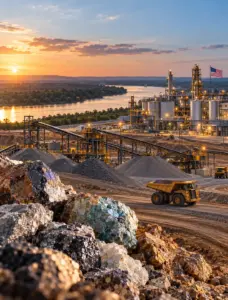
That lower-cost extraction route is one reason Serra Verde is seen as a prize by Western investors. Modern open-pit mining technologies have already been deployed at the site to support dry tailings stacking and renewable energy integration. As a result, the operation is widely seen as one of the more ESG-aligned rare earth sites globally.
However, the STF must weigh those operational benefits against the constitutional mandate. If the court rules that Congress must approve the sale, or that the state must retain a minority stake, it could set a precedent for future mining M&A in Brazil, particularly in lithium and niobium.
Rare Earth Market Snapshot: April 2026
The following table outlines the current market conditions for the primary magnetic rare earths produced at the Serra Verde project.
| Element | Primary Use | Q2 2026 Price (USD/kg) | 12-Month Trend |
|---|---|---|---|
| Neodymium (Nd) | EV Motors, Wind Turbines | $145.20 | +12% |
| Praseodymium (Pr) | High-strength Alloys | $138.50 | +9.5% |
| Dysprosium (Dy) | High-temp Magnets | $485.00 | +18.2% |
| Terbium (Tb) | Electronics, Sensors | $1,920.00 | +22.4% |
Data based on Skillings Mining Intelligence market trackers. Prices represent 99.5% purity concentrate FOB.

What Comes Next
The STF has given the parties 30 days to provide detailed documentation on the economic impact of the sale and the terms of the U.S. supply agreement. For investors, the uncertainty is another sign of rising resource nationalism across South America’s so-called Battery Belt.
The project continues to operate under current management. However, the expected Q3 2026 closing now faces uncertainty. If the court imposes restrictions, USA Rare Earth may have to renegotiate the $2.8 billion price or bring in a Brazilian partner to meet sovereignty requirements.
The outcome will likely help define the limits of foreign investment in Brazil’s mining sector for the rest of the decade. Because the race for terbium and other critical elements is accelerating, the intersection of constitutional law and global trade remains a key risk for mining operators in the region.