By Charles Pitts
The narrative surrounding copper has shifted from a slow-burning energy transition story to an urgent, AI-driven supply crunch. By mid-2026, the global copper market has undergone a significant “price forecast reset,” as analysts reconcile the unprecedented demand of Blackwell-class GPU clusters with a mining sector struggling to bring new tonnage online.
As of May 2026, the metal has already touched record levels near $14,000 per metric ton, fueled by a realization that artificial intelligence is not just a software revolution, but a massive physical infrastructure undertaking. This reset reflects a structural shift: copper is no longer just “the metal of electrification”; it is now the essential heat-sink and power-conduit of the intelligence age.
The Blackwell Effect: Why AI Racks Need More Copper
The primary catalyst for this demand surge is the transition from legacy cloud computing to high-density AI training. Nvidia’s Blackwell-class GPUs (including the B200 and GB200) have redefined power density in the data center. While a conventional server rack might draw 10 to 30 kilowatts (kW), a Blackwell-equipped rack can exceed 120 kW.
More Read

This quadruple-fold increase in power density necessitates a corresponding increase in copper intensity. Inside these “AI Factories,” copper is used extensively in:

- Power Distribution: Thicker busbars and cables are required to handle higher currents with minimal resistive loss.
- Grounding and Bonding: Larger grounding grids are essential for the sophisticated electrical architectures that protect multi-billion dollar GPU clusters.
- Short-Reach Connectivity: Despite the rise of fiber optics, copper twinax Direct Attach Copper (DAC) cables remain the preferred choice for high-speed, short-distance interconnects within the rack due to their low latency and power efficiency.
According to data from S&P Global and internal Skillings Mining Intelligence reports, AI-training data centers now require approximately 47 tons of copper per megawatt (MW) of capacity. This is a 34% increase over the 30–35 tons required for conventional data centers.

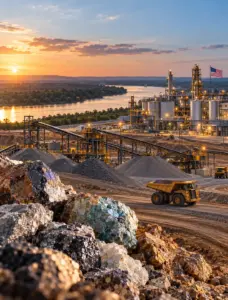
Large-scale open-pit mining operations are under increasing pressure to scale production as AI infrastructure demands surge.
More Read

The Cooling Revolution: Thermal Management as a Demand Driver
Perhaps the most overlooked factor in the 2026 copper forecast is the shift to liquid cooling. As chips run hotter, traditional air cooling is reaching its physical limits. Blackwell-class facilities are increasingly adopting direct-to-chip liquid cooling systems.
Copper’s superior thermal conductivity makes it the material of choice for:
- Cold Plates: These sit directly on the GPUs to wick away heat.
- Heat Exchangers: Large-scale plate-and-frame exchangers and Coolant Distribution Units (CDUs) rely heavily on copper and copper alloys.
- Manifolds: The intricate piping that delivers coolant to thousands of individual blades often utilizes copper for its reliability and corrosion resistance.
Industrial analysts estimate that by the end of 2026, the incremental copper demand from AI data centers will add at least 110,000 tons of annual consumption: a figure that many believe is a conservative floor as hyperscale “gigawatt” campuses become the new industry standard.
2026 Market Snapshot: Copper Fundamentals
The following table illustrates the tightening balance between supply and demand as we move through the 2026 fiscal year.
| Metric | 2024 Baseline | 2026 Forecast (Reset) | % Change |
|---|---|---|---|
| LME Copper Price (Avg) | $9,200 / t | $13,400 / t | +45.6% |
| AI Data Center Demand | ~45,000 t | ~155,000 t | +244.4% |
| Global Refined Balance | -120,000 t (Deficit) | -480,000 t (Deficit) | +300% |
| Blackwell-Class MW Installed | 2,500 MW | 18,000 MW | +620% |
Supply Constraints: The Mining Industry’s Lag
While demand is accelerating, the mining industry faces “long-cycle” realities. Even with record prices, bringing a new greenfield copper project from discovery to production takes an average of 15 to 20 years.
Operational headwinds in key regions have exacerbated the 2026 deficit. Continued regulatory scrutiny in Panama, water scarcity in the Atacama desert, and aging infrastructure at major mines like Escondida have prevented a significant supply response. Furthermore, while critical mineral strategies in China have secured significant midstream processing capacity, the primary extraction remains concentrated and vulnerable to geopolitical shocks.
Investors are now looking toward exploration breakthroughs and brownfield expansions to fill the gap. Mining stocks to watch in 2026 include those with significant exposure to “electrification metals” and projects in tier-one jurisdictions where permitting is streamlined.

Operational efficiency in the control room is critical for maintaining output at mature copper assets facing declining ore grades.
The 2026 Price Forecast Reset: Bull vs. Bear Case
The consensus among institutional analysts has shifted toward a sustained “high-floor” price environment.
- Bull Case ($15,000+ / t): Accelerated rollout of 5 GW “Hyperion” style data centers combined with a major supply disruption (e.g., a strike at a top-three global mine) could trigger a violent price spike.
- Base Case (~$13,500 / t): Steady AI infrastructure growth offset by moderate increases in recycling and scrap utilization. This remains the most likely scenario for the remainder of 2026.
- Bear Case ($11,000 / t): A global macroeconomic slowdown or a significant breakthrough in copper substitution (such as high-conductivity aluminum alloys for data center busbars) could pull prices back from their current peaks.
Strategic Implications for Operators and Investors
For mining operators, the current environment demands a focus on brownfield expansion and technological upgrades. Digitalization of the mine site: using the very AI technologies that are driving demand: is becoming a competitive necessity to manage declining ore grades.
For investors, the 2026 reset underscores the importance of looking beyond the “energy transition” and recognizing the “data transition.” The demand intensity of AI is providing a secondary, more aggressive growth pillar for copper that is less dependent on consumer EV adoption and more tied to the core of the global technology stack.
As we continue to track these developments in the Skillings Mining Review, the message is clear: the physical world is racing to keep up with the digital one, and copper is the primary friction point.
Ready to stay ahead of the markets?
Stay informed on the latest M&A activity, exploration breakthroughs, and market intelligence.
- Explore our Latest Magazine Issue
- Subscribe for Daily News Alerts
- Read more on Critical Minerals Strategy

The projected demand for copper in AI infrastructure suggests a decade of sustained pressure on global supply chains.