By Charles Pitts

PERTH, Australia : Critical Metals Corp. (Nasdaq: CRML) has advanced its position as a primary contender in the Western critical minerals race, finalizing an amended agreement to secure a 92.5% controlling interest in the Tanbreez rare earth project in southern Greenland. The deal positions the company to oversee one of the world’s largest permitted rare earth deposits as North American and European markets seek to detach from Chinese supply chain dominance.
The transaction, an evolution of a binding agreement first announced in June 2024, simplifies the path to majority ownership by removing prior spending requirements. Critical Metals, which already holds a 36.45% stake, will now move to 92.5% by issuing approximately 14.5 million ordinary shares to project founder Gregory Barnes’ company, Rimbal Pty Ltd. The issuance is set at a fixed implied price of $8.00 per share, pending final approval from the Government of Greenland.
Upon completion, European Lithium will retain a 7.5% minority interest in the project.
A Tier-One Resource in the Arctic
The Tanbreez project is not merely significant for its scale, but for its mineralogical composition. Hosted in an outcropping kakortokite body measuring roughly 8 km by 5 km, the deposit holds an estimated 4.7 billion tonnes of mineralized rock. Internal resource assessments suggest the site contains approximately 28.2 million tonnes of total rare earth oxides (TREO).
More Read

More critically, Tanbreez stands out for its high proportion of heavy rare earth elements (HREEs). While many global deposits are dominated by light rare earths like cerium and lanthanum, more than 27% of the TREO at Tanbreez consists of high-value HREEs such as dysprosium, terbium, and yttrium. These elements are indispensable for high-performance permanent magnets used in electric vehicle (EV) drivetrains, wind turbines, and advanced defense technologies.


Strategic Advantage: Logistics and Licensing
Unlike many remote critical mineral projects that face prohibitive infrastructure costs, Tanbreez benefits from a unique geographical advantage. The project is situated near deep-water fjords that remain navigable year-round, providing direct shipping access to the North Atlantic. This eliminates the need for expensive overland rail or road networks, allowing concentrate to be moved directly to European or North American processing hubs.
The project is also significantly advanced in its regulatory lifecycle. The Government of Greenland granted Tanbreez a formal exploitation (mining) license in 2020, which remains valid until 2050. This “permitted” status removes one of the most significant hurdles for Western mining projects, which often face decade-long permitting delays.
“The move to a 92.5% stake represents a definitive step toward bringing Tanbreez into production,” said a company spokesperson. “By securing this level of control, we can streamline the development of a sustainable, reliable HREE supply chain that serves the strategic interests of our Western partners.”
Financial Drivers and the 2026 Outlook
The economics of Tanbreez, as detailed in a Preliminary Economic Assessment (PEA) earlier this year, highlight a project with a pre-tax net present value (NPV) of approximately $3 billion and an internal rate of return (IRR) of 180%. The capital cost to reach initial production is estimated at $290 million.
The U.S. government has already signaled the project’s strategic importance. The U.S. Export-Import Bank (EXIM) previously identified Critical Metals for a potential loan of up to $120 million. This capital would cover nearly half of the projected initial capex, supporting technical work and construction.
Currently, Critical Metals is focused on technical program execution from its local hub in Qaqortoq, Greenland. Construction is underway on a multi-use storage and pilot-plant facility, expected to be operational by May 2026. This facility will handle core management and pilot operations, serving as the technical foundation for full-scale extraction.

Rare Earth Market Snapshot: Tanbreez vs. Global Benchmarks
The following table outlines the comparative scale and HREE concentration of the Tanbreez project based on current management estimates and technical filings.
| Metric | Tanbreez Project Details | Strategic Impact |
|---|---|---|
| Estimated Resource | 4.7 Billion Tonnes | One of the largest globally |
| TREO Content | 28.2 Million Tonnes | Massive scale for long-term supply |
| HREE Proportion | >27% of TREO | Focus on high-value Dy, Tb, and Y |
| Initial Production Target | 85,000 Tonnes (Concentrate) | Scalable to 425,000 Tonnes |
| Estimated Initial Capex | $290 Million | Supported by U.S. EXIM LOI |
| Mining License Term | Valid through 2050 | Long-term operational security |
Geopolitical Realignments
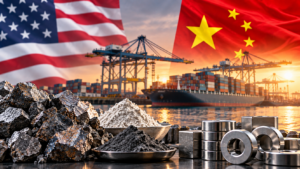
The acquisition comes at a time when the U.S. and its allies are aggressively funding domestic and “friendly” mineral sources. China currently controls approximately 60% of global rare earth mining and nearly 90% of refining capacity. By securing a dominant stake in a Greenland-based asset, Critical Metals provides a hedge against potential export restrictions from Beijing.
The inclusion of associated strategic elements like gallium : for which China recently implemented export controls : further elevates the project’s profile. Drilling at Tanbreez has intercepted grades of up to 90 ppm gallium oxide, adding a secondary revenue stream and another layer of supply chain security for the semiconductor and green energy industries.

Conclusion and Timeline
With the pilot plant scheduled for 2026 and first production potentially following shortly thereafter, Critical Metals is moving at an accelerated pace. The immediate priority remains securing the final governmental rubber stamp for the ownership transfer, a move that will solidify the project’s transition from an exploration asset to a cornerstone of the North Atlantic mining sector.
For investors and operators, the Tanbreez project represents a rare combination of massive tonnage, favorable geology, and high-level political support. As the 2026 critical minerals landscape continues to be shaped by the energy transition and geopolitical rivalry, Greenland’s icy shores may soon host one of the most pivotal industrial operations in the Western hemisphere.