By Charles Pitts

The Andean porphyry belt, stretching from the tip of Chile through the high altitudes of Peru and into the rugged terrain of Colombia, remains the world’s most prolific source of copper. However, as established mines in the south face declining grades and deepening pits, the industry’s focus has shifted toward the northern frontier. In this context, recent drilling results from Copper Giant’s Mocoa project in Colombia have transformed a promising exploration story into a potential Tier-1 development asset.
The announcement of hole MD-064, which intersected a continuous 1,052-meter stretch of mineralization, marks a significant shift for the Mocoa project. This intercept does more than just add volume; it fundamentally alters the geological understanding of the deposit, extending mineralization well below the previously defined conceptual pit shell. As the company moves toward a highly anticipated Preliminary Economic Assessment (PEA) in the second half of 2026, the scale of this “copper column” suggests that Mocoa may be destined for a much larger production profile than earlier models indicated.
The 1,052-Meter Breakout: Deepening the Resource
The results from hole MD-064 are statistically rare in the world of copper exploration. Intersecting over a kilometer of continuous mineralization (0.39% CuEq) is a hallmark of the industry’s largest porphyry systems, such as Grasberg or Oyu Tolgoi. Within this massive intercept, Copper Giant identified a higher-grade core of 486 meters grading 0.57% copper equivalent (0.41% Cu and 0.029% Mo).
This drilling was specifically designed to test the depth extensions of the Mocoa system. By proving that the mineralization continues unabated more than 1,000 meters from the surface, Copper Giant has confirmed that the deposit remains open at depth. For investors and operators, this suggests that the eventual mine plan could involve a significantly deeper open pit or, more likely, a large-scale underground block caving operation similar to those being pioneered at major sites in Chile and Australia.

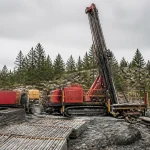
Advanced drilling technology is critical for testing depth extensions in large porphyry systems.

The presence of molybdenum (Mo) as a co-product is also a crucial factor. In the current market, molybdenum serves as a high-value byproduct that can significantly lower the “all-in sustaining costs” (AISC) for copper production. With molybdenum prices showing resilience due to its use in high-strength steel and green energy infrastructure, the 0.029% Mo grade within the Mocoa intercept provides a substantial credit to the primary copper economics.
Confirming the Third Corridor
Beyond the sheer depth of the mineralization, hole MD-064 has confirmed the existence of a third mineralized corridor at Mocoa. Porphyry deposits rarely occur in isolation; they are often part of a larger cluster of “fingers” or “plugs” that originate from a single deep-seated magma chamber.
Prior to this drilling phase, the Mocoa resource was largely defined by two primary zones. The identification of this third corridor suggests that the overall footprint of the system is broader than previously mapped. This lateral and vertical expansion is a key driver for the upcoming PEA, as it allows engineers to consider a multi-pit or integrated underground mining scenario that could process significantly higher tonnages per day.
This expansion comes at a time when the global market is bracing for a prolonged copper deficit. As demand from AI data centers, electric vehicle (EV) infrastructure, and renewable energy grids continues to climb, the industry is desperate for projects capable of delivering 100,000 tonnes of copper per annum or more. Mocoa’s scale, bolstered by these new intercepts, puts it in the conversation for “Tier-1” status: a designation typically reserved for assets with long lives and significant annual output.
PEA 2026: Modeling a Tier-1 Future
Copper Giant has officially commenced the work required for a comprehensive Preliminary Economic Assessment, scheduled for release in H2 2026. This study will be the first time the market sees a formal economic value assigned to the expanded Mocoa resource.
The PEA will integrate several key workstreams:
- Metallurgical Testing: Initiated in early 2026, this phase is testing the recoverability of both copper and molybdenum. Early indications suggest standard flotation methods will be effective, but the PEA will provide the definitive “recovery curves” that determine the project’s revenue potential.
- Infrastructure and Power: Colombia has a robust hydroelectric grid, which could provide Mocoa with a low-carbon power source: a major advantage for ESG-focused investors.
- Mining Methodology: The 1,000-meter intercept necessitates a dual-track study. While an initial open pit would target near-surface mineralization, the PEA is expected to evaluate the potential for a transition to underground mining to capture the deep, high-grade core identified in MD-064.

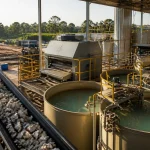
Surface infrastructure planning for Mocoa will need to account for both open-pit and potential underground development phases.
According to recent copper price forecasts for 2026, the economic threshold for new Andean projects has shifted. With prices expected to remain elevated due to supply constraints, even lower-grade porphyries are becoming economically attractive. However, Mocoa’s ability to deliver continuous 0.5% to 0.6% CuEq material over hundreds of vertical meters places it well above the marginal category.
Regional Context: Colombia’s Mining Evolution
The Mocoa project is situated in the Putumayo department of southern Colombia. Historically, Colombia has been known more for its coal and gold production, but the government has recently pivoted toward “minerals for the energy transition.” Copper has been designated a strategic mineral, and the regulatory environment is slowly adapting to support large-scale base metal projects.
However, operating in the Andes is not without challenges. Infrastructure in Putumayo requires significant investment, and community engagement remains a top priority for any operator. Copper Giant has maintained a presence in the region for years, focusing on social licensing and environmental stewardship. The success of Mocoa could serve as a blueprint for other copper projects in Colombia’s portion of the porphyry belt, which remains largely under-explored compared to Chile or Peru.
| Mocoa Project Key Metrics | Data Point | Status/Forecast |
|---|---|---|
| Flagship Drill Hole | MD-064 | 1,052m @ 0.39% CuEq |
| High-Grade Intercept | 486m | 0.57% CuEq (0.41% Cu, 0.029% Mo) |
| Resource Status | Expanding | Open at depth & laterally |
| PEA Completion Date | H2 2026 | In progress |
| Primary Commodities | Copper, Molybdenum | Multi-decade life potential |
| Power Source | Hydroelectric | Colombia national grid |
The Roadmap to H2 2026
Between now and the release of the PEA, Copper Giant is expected to maintain an active news flow. Further drilling is underway to bridge the gap between the known mineralized zones and to further refine the “Third Corridor.” Metallurgical results, expected mid-year, will also be a critical de-risking milestone.
For the broader mining industry, Mocoa represents one of the few remaining large-scale copper opportunities not yet owned by a major diversified miner. As the copper demand forecast for 2026 continues to look bullish, assets with verified scale and depth extensions like Mocoa will likely become prime targets for M&A activity or strategic partnerships.
The 1,000-meter intercept is a rare geological signature. It signifies a system with the “plumbing” to support a massive mineralizing event: the kind of event that creates Tier-1 mines. Whether the 2026 PEA confirms this potential will depend on the engineering trade-offs between depth, grade, and capital intensity, but for now, the Mocoa extension has firmly placed Colombia on the map for the next generation of global copper supply.

Modern data integration and real-time monitoring will be essential as Mocoa progresses from exploration to a formal development study.
Social Media Snippet
LinkedIn / X (Twitter):
? Breaking Copper News: Copper Giant’s Mocoa project has just redefined its potential with a massive 1,052m continuous mineralized intercept. ?
Key Takeaways:
✅ Hole MD-064 confirms a 3rd mineralized corridor.
✅ Mineralization extends well below the conceptual pit shell.
✅ Comprehensive PEA now underway for H2 2026.
As the world faces a looming copper deficit, could this be the next Tier-1 Andean porphyry asset? Read our deep-dive analysis on Skillings Mining Intelligence.
#Copper #MiningNews #AndeanCopper #Mocoa #CopperGiant #EnergyTransition #CriticalMinerals #MiningInvestment