By Charles Pitts

WASHINGTON : White House officials have confirmed a significant expansion of the federal government’s direct equity investment strategy in the critical minerals sector, part of an aggressive push to insulate U.S. high-tech and defense industries from Chinese supply chain dominance.
Jarrod Agen, a senior official with the National Energy Dominance Council (NEDC), announced Friday that the administration has authorized an additional tranche of capital aimed at securing ownership stakes in domestic mining and processing projects. The move builds on a policy shift over the past year that has seen the U.S. government deploy over $1 billion in direct equity and price-support mechanisms to stabilize the domestic production of lithium, rare earths, and other strategic metals.
“The goal is simple: national security through economic resilience,” Agen said in a briefing early Friday morning. “We are no longer just subsidizing projects with grants; we are taking an active seat at the table to ensure that the minerals powering our semiconductors and defense systems remain under the control of the United States and its allies.”
A New Era of Industrial Policy: From Grants to Equity
For decades, U.S. industrial policy relied on tax credits and Department of Energy (DOE) grants to incentivize domestic production. However, the volatility of global mineral markets: often exacerbated by targeted overproduction from Chinese state-backed entities: has historically deterred private investment in U.S.-based projects.
More Read

To counter this, the NEDC has pivoted toward a “commercial-first” approach. By taking direct equity stakes, the government provides immediate “downside protection” for investors while ensuring the public shares in the upside of successful projects. This strategy is specifically designed to support the critical minerals tickers and projects that form the backbone of the energy transition.

The $1 billion invested over the last 12 months represents a fundamental change in how Washington views the mining sector. Officials now treat critical mineral deposits not as mere commodities, but as strategic assets equivalent to petroleum reserves or semiconductor fabrication plants.

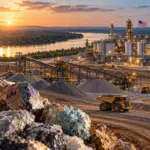
Flagship Investments: MP Materials, Vulcan Elements, and Beyond
The White House equity strategy has focused on four primary “anchors” within the domestic supply chain:
- MP Materials (~15% Equity Stake): As the only operational rare earth mining and processing site in North America, Mountain Pass is the centerpiece of the U.S. rare earth strategy. The government’s stake is paired with a 10-year price floor for neodymium-praseodymium (NdPr) at $110/kg and a commitment to purchase 100% of magnets produced at its upcoming facility. This ensures that essential components for EVs and military guidance systems are sourced domestically.
- Vulcan Elements: A high-tech refining specialist focused on advanced separation technologies. The equity injection here is aimed at scaling proprietary “green” refining methods that bypass the environmentally heavy processes currently dominated by Chinese refineries.
- Trilogy Metals (~10% Equity Stake): Focused on the Ambler Mining District in Alaska, Trilogy represents a massive copper and strategic metal play. By securing a stake here, the U.S. is signaling its long-term commitment to the copper deficit expected to hit global markets by late 2026.
- Lithium Americas (~5% Equity Stake): Centered on the Thacker Pass project, this investment secures a domestic source of lithium carbonate. With global demand for lithium projected to triple by 2030, the government’s involvement is intended to fast-track production and provide a buffer against price spikes.
The NEDC: Centralizing the Command Structure
The coordination of these investments falls under the National Energy Dominance Council, a body tasked with streamlining the permitting and financing of high-impact projects. Unlike previous fragmented efforts across the DOE and Department of Defense (DOD), the NEDC acts as a centralized “war room” for critical minerals.
The council has recently brought in industry veterans to identify a select group of “winners” rather than diluting funds across hundreds of junior exploration firms. This focused approach is intended to build full “mine-to-magnet” or “mine-to-battery” supply chains. Recent news, such as Realloys securing $100M from the US Army, illustrates how the military is increasingly acting as the primary offtake partner for these equity-backed projects.

Market Snapshot: 2026 Critical Minerals Equity Stakes
The following table outlines the current federal equity landscape as of July 2026:
| Company | Government Stake (%) | Primary Mineral Focus | Key Strategic Goal |
|---|---|---|---|
| MP Materials | 15% | Rare Earths (NdPr) | Domestic Magnet Production |
| Trilogy Metals | 10% | Copper / Strategic Metals | Alaskan Mineral Security |
| Lithium Americas | 5% | Lithium Carbonate | EV Battery Independence |
| Vulcan Elements | Undisclosed | Advanced Refining | Separation Tech Innovation |
| USA Rare Earth | 10% (Proposed) | Rare Earths / Magnets | Stockpile Expansion |
Decoupling from China: The Geopolitical Mandate
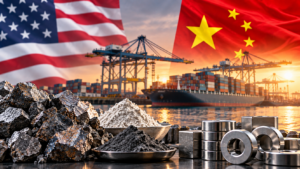
The urgency of this $1 billion strategy is driven by China’s continued grip on the refining stage of the mineral lifecycle. While many countries can mine raw ore, China processes over 60% of the world’s critical minerals and over 90% of its rare earth magnets.
Recent export restrictions from Beijing on gallium, germanium, and certain rare earth technologies have served as a wake-up call for U.S. policymakers. In response, the White House is not only investing in extraction but also in the mid-stream processing required to turn ore into “usable products.” This includes projects like Teck’s Trail expansion for germanium, which the U.S. views as a vital allied asset.
“We are building a firewall,” said a spokesperson for the National Energy Dominance Council. “Every ton of refined lithium or neodymium produced in Nevada or Alaska is one less ton that can be used as a geopolitical lever against us.”

Risks and 2026 Outlook
While the equity strategy provides much-needed capital, it is not without risks. Critics argue that the government “picking winners” could distort market competition and lead to inefficiencies. Furthermore, the 10-year price floors, while providing stability, could result in the government paying above-market prices if global supply increases unexpectedly.
However, for most industry analysts, the “security premium” is worth the cost. As the U.S. moves into the second half of 2026, the market expects more announcements regarding the “Project Vault” strategic reserve and additional equity plays in the nickel and cobalt sectors.
The transition from a passive observer to an active equity partner signals that the U.S. government is finally treating the critical minerals race with the same level of intensity as the Cold War-era space race. For operators and investors, the message is clear: the White House is now the biggest venture capitalist in the mining world.