By Salini Krishnan

The domestic rare earth supply chain reached a pivotal milestone this week as REalloys (Nasdaq: ALOY) secured approximately $100 million in equity financing and a conditional partnership with the U.S. Army to establish a heavy rare earth processing plant on military soil. This deal represents more than just a capital infusion; it marks the formal integration of critical mineral processing into the U.S. national security infrastructure.
By selecting the Tooele Army Depot in Utah as the site for its new separation facility, REalloys is pioneering a model where the U.S. military provides the land and security, while private capital: led by industry heavyweights like Blackstone and Citadel: funds the technological hardware. For an industry historically vulnerable to global supply chain shocks and geopolitical leverage from China, the REalloys deal offers a blueprint for how domestic processing can bypass the traditional bottlenecks of permitting and logistics.
The $100M Capital Infusion: Institutional Backing for Critical Minerals
The $100 million equity raise is a significant signal to the markets. Priced at approximately $14.25 per share, the financing provides the necessary liquidity for REalloys to transition from a development-stage company to an active industrial operator.
The involvement of Blackstone and Citadel suggests that institutional investors now view "mine-to-magnet" vertical integration as a bankable asset class rather than a speculative mining venture. These funds are earmarked for working capital and the build-out of domestic rare earth processing and magnet manufacturing capacity. This capital bridge is essential as the company works to scale its North American metallization facility, which is slated to become the largest of its kind on the continent.
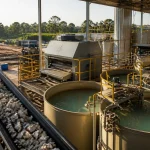


The Tooele Army Depot: Processing Behind the Perimeter
The most innovative aspect of the REalloys strategy is the Enhanced Use Lease (EUL) agreement at the Tooele Army Depot. Under this arrangement, REalloys will design, finance, build, and operate a rare earth separation facility on Army land.
The strategic advantages of this "on-base" model are multifold:
- Security: Rare earth processing facilities are high-value targets. Placing them within a military installation provides an inherent level of physical security and operational continuity.
- Permitting Speed: Utilizing military land can often streamline certain federal hurdles, as these sites are already designated for industrial and defense-related use.
- National Defense Stockpile Integration: The facility is positioned to feed directly into the Defense Logistics Agency (DLA) requirements. REalloys previously secured a DLA contract to produce samarium and gadolinium metal, and the Tooele site expands this scope to heavy rare earths like terbium (Tb) and dysprosium (Dy).
This shift mirrors other strategic moves in the sector, such as the Antimony strategy being utilized by the DLA to re-rate critical mineral stocks as defense assets.
Closing the "Magnet Gap"
The primary output of the Tooele facility will be heavy rare earth oxides. These are the critical precursors for high-temperature permanent magnets used in precision-guided munitions, F-35 actuators, and nuclear submarine propulsion systems.
Currently, the United States relies almost entirely on Chinese processing capacity for the separation of heavy rare earths. Even when ore is mined domestically or in allied nations, it frequently returns to China for the final, most complex stages of chemical separation. The REalloys deal aims to break this cycle by keeping the value chain entirely within North America.
Table: Key Rare Earth Elements and Defense Applications (2026 Forecast)
| Element | Defense Application | Current Primary Source | REalloys Strategy |
|---|---|---|---|
| Dysprosium (Dy) | Jet engines, high-temp magnets | China | Separation at Tooele |
| Terbium (Tb) | Sonar systems, naval sensors | China | Separation at Tooele |
| Gadolinium (Gd) | Radar, specialized alloys | China/U.S. | Modular DLA Plant |
| Samarium (Sm) | Missile guidance systems | China | Modular DLA Plant |

The Junior Miner Blueprint: Navigating the Defense-Mining Nexus
For junior mining companies, the REalloys $100M deal serves as a roadmap. The "defense-mining nexus" is no longer a niche sector; it is a primary driver of project financing and valuation.
To replicate this success, junior players are increasingly focusing on:
- Upstream Offtake Security: REalloys has secured a 15% offtake agreement from Critical Metals’ Tanbreez project in Greenland. This provides a guaranteed feedstock for the Tooele separation plant.
- Governmental Strategic Partnerships: Projects that can demonstrate a direct "National Security" benefit are finding it easier to access Department of Defense (DoD) programs like the Defense Production Act (DPA) Title III or the Army’s Strategic Capital Initiatives.
- Modular Scalability: REalloys’ development of modular plants: specifically for samarium and gadolinium: allows for lower initial capex and faster deployment compared to massive, centralized refineries.
This strategy is already being seen in other critical mineral sectors, such as Generation Mining's Marathon project, which emphasizes strategic domestic supply for North American industrial resilience.
Operational Control and Technology Integration
The complexity of rare earth separation requires advanced data monitoring and real-time operational oversight. As processing moves to military sites, the integration of secure control systems becomes paramount. The Tooele facility is expected to employ state-of-the-art telemetry and automation to ensure high-purity separation of Dy and Tb.

This level of technological sophistication is becoming the standard for 2026 operations. Companies that can integrate modern fleet management and autonomous technology into their processing workflows are significantly more likely to meet the stringent purity standards required for defense-grade materials.
Geopolitical Implications: The 2026 Outlook
As we look toward the remainder of 2026, the REalloys deal is likely to trigger a "land grab" for similar partnerships between mining companies and the U.S. military. The Army has already indicated interest in developing processing hubs for lithium, graphite, and boron on other underutilized installations.
The message to global markets is clear: the U.S. is no longer content to merely export raw materials. It is building the industrial capacity to process and refine those materials within its most secure borders. This decapping of the mid-stream processing bottleneck is the final piece of the puzzle for true mineral independence.
For investors, the REalloys deal highlights a fundamental shift. The valuation of mining companies is increasingly tied to their position within the defense supply chain. Those that can secure the "Army-Grade" seal of approval: along with the capital that follows it: will be the market leaders of the next decade.

Shareable Social Media Snippet (LinkedIn/X):
The U.S. Army just redefined the domestic rare earth supply chain. REalloys ($ALOY) has secured a $100M deal and a military partnership to build a heavy rare earth processing plant at the Tooele Army Depot. This is the blueprint for the "Mine-to-Magnet" defense nexus. ?️⚒️ #RareEarths #MiningNews #NationalSecurity #REalloys #CriticalMinerals #DefenseIndustry