By Charles Pitts

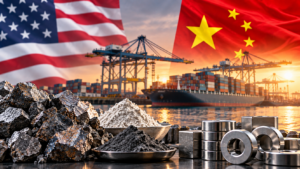
Artificial intelligence has officially transitioned from a software phenomenon to a physical commodity driver. According to a new report from Sprott Asset Management, first detailed by The Northern Miner, AI has joined national defense and the global energy transition as the third structural pillar of rare earth element (REE) demand. This shift arrives as Western governments accelerate efforts to rebuild the rare earths supply chain 2026 landscape, pouring billions into domestic processing to counter China’s long-standing market dominance.
The demand surge is being fueled by an unprecedented capital expenditure cycle. The world’s five largest hyperscale data center operators are projected to spend approximately US$400 billion in 2025 alone. This massive build-out of infrastructure is creating a direct link between the ai energy nexus mining stocks and the raw materials required to power, cool, and network the next generation of compute.
The AI-Energy-Mining Nexus: A New Demand Profile
While electric vehicles (EVs) and wind turbines have traditionally dominated the “green” demand narrative for rare earths, the AI revolution is introducing a more complex consumption profile. Rare earths: specifically neodymium and praseodymium (NdPr): are essential for high-performance permanent magnets used in the electric motors and pumps that drive advanced liquid-cooling systems for data centers.
As AI chips consume more power and generate more heat, traditional air cooling is becoming insufficient. High-density AI server racks increasingly require liquid cooling solutions, which depend on the reliability and efficiency of REE-based magnets. Furthermore, optical metals like germanium and indium, often mined alongside or managed within the same critical minerals complex, are seeing increased demand for the high-speed fiber optics and networking hardware necessary to link thousands of GPUs in parallel.
More Read

Key Data: Global Rare Earth Market Concentration (2026 Estimates)
| Segment | China Market Share | Rest of World |
|---|---|---|
| Rare Earth Mining | ~65% | 35% |
| Oxide Refining & Processing | ~90% | 10% |
| Permanent Magnet Production | ~94% | 6% |
| AI Hardware Integration | ~15% | 85% |
Source: Industry analysis based on Sprott and S&P Global data.


Policy Response and the Race for Supply Chain Security
The concentration of magnet production in China: estimated at 94% globally: has become a central concern for Western policymakers. The U.S. government has taken an increasingly active role in de-risking the domestic supply chain. Recent actions include the Department of Defense taking an ownership stake in MP Materials (NYSE: MP), the primary producer of NdPr in the United States.
Washington has also moved to implement long-term price guarantees for critical minerals to protect domestic producers from the price volatility often associated with the rare earth market. This “scarcity premium” is increasingly reflected in the valuations of ai energy nexus mining stocks that possess clear paths to production or possess integrated processing capabilities.
In Brazil, projects like the Caldeira project are being watched closely as potential Tier-1 assets that could provide high-grade ionic clay deposits, which are typically easier and cheaper to process than hard-rock alternatives.
Supply Chain 2026: Navigating Structural Deficits
Industry analysts suggest that despite the influx of capital, the supply of magnetic rare earths may triple by 2035, yet still face a structural deficit of 30% to 40%. The bottleneck remains midstream processing. While mining capacity is expanding in North America and Australia, the ability to refine those ores into high-purity oxides and subsequently into magnets remains limited outside of Asia.

To combat these bottlenecks, some companies are exploring unconventional sources. For instance, Ramaco Resources is developing the Brook mine in Wyoming to extract rare earths from coal and carbon-associated materials. Meanwhile, the mine of the future concept is being applied to REE extraction, utilizing AI-driven geological modeling to identify higher-grade zones and AI-enabled process controls to stabilize refinery recoveries.
Implications for Investors and Operators
For decision-makers in the mining and financial sectors, the emergence of AI as a demand driver changes the valuation calculus. Rare earths are no longer just an “EV play.” They are now a “compute play.”
- Commodity Mix Matters: Investors are shifting focus toward projects with high NdPr, dysprosium, and terbium content, as these are the primary elements used in permanent magnets.
- Geopolitical De-risking: Assets located in supportive jurisdictions with clear government backing or offtake agreements with Western OEMs are commanding a premium.
- Technological Integration: Companies that utilize mine electrification and AI in their own operations are better positioned to manage the high OPEX typically associated with rare earth processing.

Conclusion: A Multi-Decade Demand Uptrend
The Sprott report underscores a fundamental shift in the global materials market. As AI continues its rapid expansion, the pressure on the rare earths supply chain 2026 will only intensify. The convergence of military requirements, the energy transition, and the AI infrastructure boom has created a “perfect storm” for demand that is likely to sustain prices and drive investment into new projects for the next decade.
While risks such as technological substitution (the development of REE-free magnets) and permitting delays remain, the physical reality of the AI revolution is clear: you cannot have the world’s most advanced intelligence without the world’s most critical minerals.