By Charles Pitts

PERTH/POÇOS DE CALDAS : Meteoric Resources has released its long-awaited Definitive Feasibility Study (DFS) for the Caldeira Rare Earth Project in Minas Gerais, Brazil, establishing a post-tax net present value (NPV) of US$847 million under spot pricing parameters. The technical report marks a pivotal milestone in the development of Western-aligned rare earth supply options as industrial users and policymakers grapple with mounting supply chain vulnerabilities.
The comprehensive engineering study outlines a Tier-1 asset anchored by a 151-million-tonne ore reserve, positioning Caldeira as one of the largest and most commercially viable ionic clay rare earth deposits outside China. With global demand for magnet metals projected to accelerate through the remainder of the decade, the DFS provides critical clarity on capital requirements, metallurgical performance, and commercial timelines for investors and off-takers tracking the critical minerals supply chain 2026 landscape.
Financial Architecture and Valuation Metrics
The DFS models two distinct pricing scenarios to account for near-term market volatility and long-term structural deficits in rare earth elements (REE). Under baseline spot pricing assumptions, the project yields a post-tax NPV of US$847 million and an internal rate of return (IRR) of 24%, with a capital payback period of approximately four years.
Under independent consensus forecast pricing, the valuation expands significantly. The post-tax NPV surges to US$2.721 billion, accompanied by a 47% IRR, reflecting anticipated structural shortages in neodymium, praseodymium, dysprosium, and terbium.
More Read

| Metric | Spot Pricing Case | Forecast Pricing Case |
|---|---|---|
| Post-Tax NPV (8% discount) | US$847 million | US$2.721 billion |
| Post-Tax IRR | 24% | 47% |
| Initial Capital Expenditure | US$498 million | US$498 million |
| Life-of-Mine Revenue | US$9.4 billion | US$17.4 billion |
| Average Operating Cost (LOM) | US$11.68 / kg TREO | US$11.68 / kg TREO |
| Payback Period | 4.1 years | 2.1 years |
Initial capital expenditure is pegged at US$498 million, which includes a comprehensive 10% contingency buffer. The figures incorporate the design and construction of a 6 million tonnes per year (Mt/y) processing facility and associated infrastructure in the Poços de Caldas alkaline complex.


Ore Reserve Scale and Geological Advantages
Unlike hard-rock pegmatite deposits that require energy-intensive crushing, grinding, and high-temperature roasting, Caldeira is hosted in weathered ionic absorption clays. This geological setting allows for shallow, open-pit extraction and low-cost heap or tank leaching using standard ammonium sulfate or alternative lixiviants at ambient temperatures.
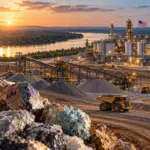
The DFS underpins an initial Ore Reserve of 151 million tonnes grading 3,524 ppm Total Rare Earth Oxides (TREO), which includes 857 ppm Magnet Rare Earth Oxides (MREO). Magnet rare earths account for approximately 24% of the total TREO basket, delivering high economic value per tonne of ore processed.
“The scale and metallurgical simplicity of the Caldeira deposit distinguish it within the global development pipeline,” noted technical reviewers familiar with the study. “Ionic clay deposits offer distinct operating cost advantages over traditional hard-rock monazite or bastnäsite projects, provided regional environmental permitting and reagent management protocols are strictly observed.”
The initial reserve supports a mine life exceeding 20 years, though the broader Mineral Resource Estimate (MRE) stands at a staggering 1.6 billion tonnes at 2,317 ppm TREO, pointing to substantial expansion potential as operations mature.
Processing Engineering and Construction Strategy
Meteoric Resources partnered with leading engineering consultancy Ausenco to deliver the DFS metallurgy and process plant design. The flowsheet leverages a benign ammonium sulfate desorption process, which selectively strips rare earth ions from the clay matrix without destroying the underlying mineral structure.
The 6 Mt/y processing plant will produce a mixed rare earth carbonate (MREC) product suitable for export to international refining hubs in North America, Europe, Asia, and domestic processing channels. Pilot-plant testing conducted throughout 2024 and 2025 confirmed consistent recoveries across all primary weathering zones, de-risking the metallurgical assumptions embedded in the economic model.

Operating cash costs are projected at an average of US$11.68 per kilogram of TREO over the life of the mine, placing Caldeira in the lower half of the global cost curve for rare earth producers. This cost competitiveness is driven by shallow overburden, a soft ore body requiring minimal comminution, and straightforward hydrometallurgical processing.
Geopolitical Context and Market Implications
The release of the Caldeira DFS arrives amid heightened volatility across global raw materials markets. Following stringent export controls implemented by major Asian producers on heavy rare earths such as dysprosium and terbium: which triggered sharp price spikes across industrial sectors: Western governments have accelerated efforts to diversify upstream sourcing.
As analyzed in recent coverage by Skillings Mining Intelligence, automotive manufacturers, defense contractors, and renewable energy developers face acute exposure to midstream bottlenecks. Projects capable of delivering multi-thousand-tonne annual outputs of separated magnet rare earths outside of established monopoly corridors are receiving intense scrutiny from institutional financiers and strategic off-takers.
With environmental licensing well advanced in Minas Gerais, Meteoric Resources aims to advance project financing discussions and secure binding offtake agreements ahead of a final investment decision (FID).

Operational Roadmap and Next Steps
With the DFS finalized, Meteoric’s immediate operational roadmap focuses on:
- Permitting Finalization: Securing construction and operating licenses from state environmental agencies in Minas Gerais.
- Financing and Partnerships: Advancing discussions with export credit agencies, commercial banks, and industrial end-users for project debt and equity syndication.
- Front-End Engineering Design (FEED): Transitioning from DFS engineering into detailed design phases ahead of targeted ground-breaking.
As mining news editors and market analysts evaluate the long-term supply-demand balance for electrification metals, Caldeira’s combination of scale, low capital intensity, and favorable metallurgy establishes a new benchmark for ionic clay development globally.