Here’s the thing nobody wants to admit: The Pentagon doesn’t give out $27 million grants because they like your business model. They do it because they’re scared. They’re scared that the very materials required to tip a missile, fire a bullet, or power a military-grade circuit board are almost entirely controlled by people who aren’t our friends.

On March 4, 2026, the Department of War (Defense) finally put its money where its mouth is. United States Antimony Corporation (USAM) was awarded a $27 million grant under the Defense Production Act (DPA) Title III program. This isn’t just another government handout; it’s a desperate, strategic move to revive a domestic supply chain that we’ve let wither on the vine for forty years.
If you aren’t familiar with antimony, you should be. It’s the “war mineral.” It’s essential for munitions, military electronics, flame retardants, and even the next generation of batteries. And yet, for decades, we’ve been content to let China, Russia, and Tajikistan dictate the terms of its availability.
That era just hit a wall.
The $27 Million Jolt: Montana and Alaska
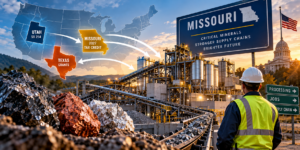
This funding isn’t going into a black hole. It has two very specific targets: refining in Montana and extraction in Alaska.
More Read

For US Antimony, this is about vertical integration. In the mining world, if you don’t control the source and the processing, you don’t control your destiny. The Pentagon’s award is designed to fix both ends of that equation.

1. The Montana Modernization
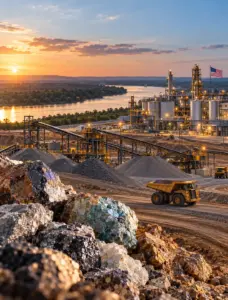
US Antimony operates the only antimony smelter of scale in the United States. Think about that for a second. One smelter. That is a massive single point of failure for the entire U.S. defense industry. The grant funds the modernization and expansion of this Thompson Falls facility. We aren’t just talking about a fresh coat of paint; we’re talking about a 500 percent expansion of capacity that was already kickstarted by a previous $245 million supply contract with the Defense Logistics Agency.
2. The Alaska Extraction Push
Refining is useless if you don’t have the ore. The Pentagon is putting money into USAM’s Alaska operations, which include roughly 120 claims. This is about securing the “dirt” so we stop relying on foreign concentrates to feed the Montana furnace.
More Read


Why Antimony Matters (And Why We’re Behind)
We’ve spent the last few years obsessed with the battery metals rebound, focusing on lithium and cobalt for EVs. But while we were looking at Teslas, we forgot about the hardware that keeps the country safe.
Antimony is a hardener for lead-acid batteries and a critical component in infrared sensors and signal flares. More importantly, it’s a primary ingredient in the primers for ammunition. Without it, the military stops moving.
China currently holds a stranglehold on global production. In late 2024 and throughout 2025, we saw them tighten export controls on both antimony and tungsten. It was a clear signal: “We have it, you need it, and we might not give it to you.”
The strategic calculus here isn’t subtle: If the U.S. doesn’t build its own capacity, we are effectively outsourcing our national security to Beijing.
The Financials: A Company Transformed
Let’s look at the numbers, because they don’t lie. US Antimony’s revenue in 2024 was a modest $9.3 million. In 2025, that jumped to $26.2 million. That’s not a rounding error; that’s a transformation.
The $27 million DPA award is the fuel for the next stage of that growth. When you combine this grant with the massive $245 million five-year supply contract for antimony ingots, you see a company that has moved from a “penny stock” curiosity to a cornerstone of the domestic defense industrial base.
But here is where it gets really uncomfortable: $27 million is a drop in the bucket. While we’re celebrating this award, China is spending billions to lock up mineral rights across Africa and Central Asia. We’re playing catch-up, and the clock is already ticking.
The Skillings Perspective: A Legacy of Neglect
At Skillings, we’ve been tracking the ebb and flow of American mining for over a century. We’ve seen the booms and the busts. The grim reality is that we’ve spent the last forty years prioritizing “cheap” over “secure.”
We outsourced our smelting. We shuttered our mines because of environmental red tape: ironically pushing production to countries with zero environmental standards. Now, in 2026, the chickens are coming home to roost.

This award to US Antimony is part of a broader, belated realization. We’ve seen $43.4 million go to Nova Minerals for their Estelle project in Alaska and nearly $82 million in total go to Perpetua Resources for the Stibnite project in Idaho. The government is finally building redundancy. They realize that one project isn’t enough. We need an ecosystem.
ESG and the Regulatory Hurdle
Even with $27 million in the bank, US Antimony faces the same “permitting purgatory” that plagues every other American miner. You can have all the Pentagon backing in the world, but if you can’t navigate the local and federal regulatory maze, that ore stays in the ground.
This is where mining ESG reporting in 2026 becomes a competitive advantage. Companies like USAM aren’t just mining; they’re proving they can do it cleaner and faster than the state-owned enterprises in Russia or Tajikistan. If they can’t win the ESG argument, they won’t get the permits to use the Pentagon’s money. It’s a needle that’s almost impossible to thread, but they have no choice.
Is It Enough?
The $27 million award is a victory, sure. But let’s be real: It’s the beginning of a very long, very expensive road. Modernizing a smelter isn’t like upgrading your iPhone. It involves massive infrastructure, specialized labor (which is in short supply), and a constant battle against global commodity price volatility.
If the price of antimony crashes because China decides to flood the market, will the Pentagon continue to subsidize domestic production? History says they might get cold feet. But the current geopolitical climate: the tension in the South China Sea, the ongoing issues in Eastern Europe: suggests that “security” has finally replaced “cost” as the primary driver of procurement.
What Investors and Operators Should Watch
If you’re watching this space, don’t just look at the $27 million headline. Look at the execution milestones in Thompson Falls.
- Throughput Increases: Can they actually hit that 500 percent expansion target?
- Alaska Yields: How quickly can those 120 claims move from “exploration” to “extraction”?
- Secondary Sources: Watch for USAM’s work in recycling and recovery, which is the other half of the DPA mandate.
The U.S. is finally treating mining like the strategic industry it is. Whether it’s lithium in Quebec or antimony in Montana, the goal is the same: break the dependency.
Final Thoughts
US Antimony is no longer just a mining company; it’s a defense contractor. That shift in status changes everything from their valuation to their regulatory scrutiny.
The $27 million award is a signal to the market that the U.S. government will not let the domestic antimony supply chain die. For an industry that has felt abandoned by Washington for decades, that’s the most important takeaway of all.
But don’t mistake this for a finished story. This is the first chapter of a very long, very messy attempt to reclaim our mineral independence. We’ve spent forty years digging this hole; it’s going to take more than $27 million to climb out of it.
Welcome to the new reality of “Defense First” mining. It’s about time.

Stay updated on the latest shifts in critical mineral policy and market movements at Skillings.net.