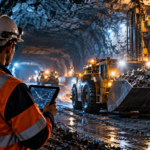
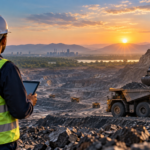
Remote operators monitor mine maps, equipment status and production data.

By Penny Langford
The global autonomous haulage fleet has moved beyond the pilot stage, passing the 2,000-truck threshold and approaching 4,000 units by mid-2025, according to industry estimates. By 2026, EACON says its platform alone has been deployed on more than 3,500 mining trucks, while Komatsu has commissioned 1,000 ultra-class autonomous haul trucks.
The figures are not directly comparable. Some count trucks commissioned, others count active deployments or vehicles equipped with autonomous-ready systems. But the direction is clear: autonomous mining technology is becoming a production strategy rather than an isolated technology demonstration.
The productivity debate is changing with it. Operators are no longer asking only whether a truck can drive without a cab operator. They are assessing whether connected fleets can improve cycle-time consistency, reduce idle periods, extend component life and coordinate power, maintenance and dispatch across an entire mine.
The 2,000-truck threshold is a systems milestone
Autonomous haulage systems reached approximately 2,080 units globally in 2024, according to industry research cited in market analyses. That number rose to about 3,832 trucks by July 2025, although methodologies vary.

The important point is not the exact global total. It is that autonomous haulage is now operating at a scale large enough to generate meaningful operational data across different commodities, climates and mine designs.
Komatsu reported that its FrontRunner system had commissioned its 1,000th ultra-class autonomous haul truck in 2026. The company says the trucks have collectively moved more than 11.5 billion metric tons of material. Caterpillar, meanwhile, reported approximately 690 autonomous trucks using its Command for hauling system at the end of 2024 and has described a long-term objective of exceeding 2,000 units.
EACON’s reported deployment of more than 3,500 trucks adds another dimension. Its platform is designed for factory-fit and retrofit applications across diesel, hybrid and battery-electric equipment, allowing operators to introduce autonomy without replacing every truck at once.

Large haul trucks are becoming connected nodes in mine-wide production systems.
Productivity gains come from consistency
Autonomous haulage does not create value simply by removing the driver from the cab. The larger opportunity comes from operating the fleet with greater consistency.
Autonomous trucks can maintain defined speeds, follow optimized routes and reduce variability caused by shift changes, fatigue, traffic interruptions and inconsistent braking. When integrated with fleet-management software, they can also be dispatched according to production requirements, road conditions, maintenance status and, increasingly, battery state of charge.
Komatsu has reported productivity gains above 20% compared with conventional operation in suitable applications. Other industry assessments place typical improvement in the range of 15% to 25%, with higher results possible when mine layouts, roads and dispatch systems are designed for autonomy.
The operational gains can also extend to maintenance. More consistent acceleration, braking and loading can reduce harsh operating events. Komatsu has reported longer tire and brake life and lower maintenance costs in autonomous fleets, although results vary by haul profile, road quality and equipment configuration.
Autonomous haulage indicators
| Indicator | Reported figure | What it suggests |
|---|---|---|
| Global autonomous haul trucks, mid-2024 | About 2,080 | Autonomy had moved beyond early pilot fleets |
| Global fleet, mid-2025 | About 3,832 | Deployment was accelerating across multiple regions |
| Komatsu FrontRunner milestone | 1,000 ultra-class trucks | OEM-scale commercial adoption |
| EACON deployment | More than 3,500 trucks | Retrofit and multi-OEM strategies are expanding |
| Typical productivity improvement | 15%–25% | The principal value is consistent fleet output |
| Komatsu reported material moved | More than 11.5 billion metric tons | Large operating datasets are now available |
Figures are company-reported or industry estimates and use different counting methods.
Connectivity is the real productivity lever
A truck operating autonomously on a fixed route is only one part of the system. The larger productivity gains come when trucks, loading equipment, crushers, maintenance teams and control centers share reliable operational data.
That requires a technology stack including:
- High-precision positioning and digital mine maps.
- Radar, cameras, LiDAR and other perception systems.
- Private LTE, Wi-Fi or 5G communications.
- Fleet-management and dispatch software.
- Remote supervision and intervention tools.
- Equipment-health monitoring.
- Integrated charging and energy-management systems.
The network must work in dust, rain, low light and changing pit geometry. A communications outage can stop production even when the mechanical equipment is functioning properly. For that reason, availability, failover performance and recovery procedures are as important as autonomous driving accuracy.
The same principle applies to battery-electric trucks. A connected fleet can coordinate charging windows, route assignments and battery state of charge. Without that coordination, charging queues can simply replace driver-change delays as a new production bottleneck.
Mixed fleets will define the next phase
Most mines will not move from conventional haulage to a fully autonomous fleet in one step. Operators are more likely to create defined autonomous operating zones while manually operated trucks, graders, water carts, light vehicles and maintenance equipment continue to share parts of the mine.
That makes mixed-fleet coordination a central commercial issue.
EACON’s ORCASTRA platform is designed to support diesel, hybrid and battery-electric trucks and to coordinate autonomous and manually operated equipment. Caterpillar and Komatsu have also demonstrated the importance of fleet-management systems that can operate across different equipment configurations.
The practical test is whether the mine can maintain production when a manual vehicle enters an autonomous zone, a road is temporarily closed or a sensor requires maintenance. If every exception requires a long manual intervention, the theoretical productivity gain can quickly narrow.
Safety systems must also be integrated rather than treated as separate products. Vehicle intervention technologies can control speed, inhibit propulsion or apply braking when a vehicle enters a defined hazard. These systems are particularly relevant in mixed fleets, where autonomous and manually operated equipment share roads and loading areas.

Mine design, road quality and fleet coordination determine whether autonomy delivers sustained output.
Implications for copper, lithium and critical minerals
Autonomous haulage is particularly relevant to mines producing copper, gold, iron ore, lithium and nickel because these operations often depend on repetitive truck cycles and large material movements.
For copper producers, greater truck availability can support consistent mill feed and reduce interruptions between the pit and processing plant. In lithium operations, where haul profiles and processing schedules can change quickly, connected dispatch may help match material movement with plant requirements. Gold and silver mines may see value in reducing worker exposure to high-risk haul roads, particularly at remote sites or during night operations.
The investment case is less straightforward for smaller or short-life mines. Autonomous equipment may require new road standards, control rooms, wireless infrastructure, training programs, maintenance capability and cybersecurity controls. Those costs must be measured against expected production gains over the remaining life of the operation.
Greenfield projects have an advantage because they can design pit geometry, power distribution, communications and maintenance facilities around autonomous equipment from the outset. Brownfield mines may have to retrofit systems around existing roads, mixed truck fleets and established work practices.
Base, bull and bear framework
| Scenario | Operating assumptions | Likely outcome |
|---|---|---|
| Base case | Autonomous haulage expands through staged deployment, with remote supervision and mixed fleets remaining common | Double-digit productivity improvements at suitable sites, but infrastructure and workforce transition slow adoption |
| Bull case | Autonomous trucks, electric power, digital twins and mine-wide dispatch systems become interoperable | Higher fleet utilization, fewer idle hours, improved component life and broader deployment across copper, gold and critical-minerals operations |
| Bear case | Connectivity failures, weak project economics, cybersecurity concerns or charging constraints limit reliability | Autonomy remains concentrated in repetitive routes and large mines able to spread infrastructure costs across sizable fleets |
The base case is the most likely near-term path. Mines will continue to automate the most repetitive and hazardous tasks first, then expand the operating zone as reliability and workforce capability improve.
What operators should measure
Fleet size is a useful adoption indicator, but it does not prove that a project is economically successful. Decision-makers should track:
- Autonomous availability and productive hours.
- Tonnes moved per operating hour.
- Cycle-time variation.
- Intervention and emergency-stop frequency.
- Communications coverage and latency.
- Charging queue time and energy use per tonne.
- Tire, brake and component life.
- Maintenance time for autonomous systems.
- Manual vehicle incursions into autonomous zones.
- Training completion and workforce-transition outcomes.
The strongest projects will be measured by cost per tonne and safe production, not by the number of trucks connected to a control system.
The 2,000-truck milestone matters because it shows autonomous mining technology has reached industrial scale. It does not mean every mine will achieve the same productivity result. The outcome will depend on road design, fleet size, power availability, communications reliability, maintenance capability and the quality of integration between people and machines.
The next competitive advantage will belong to operators that treat autonomy as a mine-wide operating model. The truck is only the visible asset. The productivity reset comes from connecting the truck to the dispatch system, the energy network, the maintenance plan and the people supervising production.
Related reading: Autonomous mining technology and electric haulage, Autonomous drilling and the crewless surface mine, and Skillings mining technology coverage.
Distribution snippets
LinkedIn:
More than 2,000 autonomous haul trucks are now operating globally, with EACON reporting deployments on more than 3,500 trucks and Komatsu reaching 1,000 ultra-class units. The next productivity gains will come from connecting haulage with dispatch, charging, maintenance and mine-wide safety systems. Read the analysis: Autonomous mining technology 2026: 2,000 connected haul trucks reset productivity.
X:
Autonomous haulage has moved beyond pilot fleets. With global deployments passing 2,000 trucks, operators are measuring more than driverless movement: cycle-time consistency, charging, maintenance, connectivity and safe mixed-fleet operations. #Mining #Automation #Copper #CriticalMinerals