By Charles Pitts

TRAIL, BRITISH COLUMBIA : In a move that signals a hardening of North American supply chain strategy, Teck Resources Limited and the Canada Growth Fund (CGF) have signed a landmark Strategic Investment Agreement to transform the Trail Operations into a global powerhouse for critical minerals. The C$850 million expansion, announced early Wednesday, is designed to double the production of germanium and antimony while introducing Canada’s first domestic primary gallium production capacity.
The transaction marks the inaugural deal under the federal government’s newly minted Canada Critical Minerals Accelerator (CCMA). Under the terms of the agreement, the CGF will provide up to C$400 million in equity-like capital, de-risking a total investment that could reach C$850 million as Teck moves to fortify one of the world’s largest fully integrated smelting and refining complexes.
The First Accelerator: A New Model for Critical Minerals
The deal is more than a simple capital injection; it represents a fundamental shift in how the Canadian government supports the mining and processing sectors. Managed by Export Development Canada on behalf of Natural Resources Canada, the CCMA is designed to provide “certainty in uncertainty.” By taking an equity-like position, the CGF allows Teck to move forward with high-stakes infrastructure improvements that might otherwise be stalled by the volatility of commodity markets.
As part of the Strategic Investment Agreement, the Government of Canada has secured an offtake framework for a significant portion of the future production of germanium, antimony, and gallium. This move directly addresses national security concerns, ensuring that high-purity metals essential for defense and advanced technology remain accessible to domestic and allied manufacturers.
More Read

The investment is a cornerstone of the broader 2026 industry outlook, which has seen a flurry of activity as Western nations race to decouple their high-tech supply chains from Chinese dominance.


Operational control centers are becoming increasingly central to the precision refining required for critical minerals.
Breaking the Bottleneck: Germanium and Antimony
The expansion at Trail is specifically targeted at two metals that have become geopolitical flashpoints: germanium and antimony.
More Read

Germanium: The Strategic Bottleneck
Germanium is a critical component in fiber-optic communications, infrared night-vision systems, and high-performance semiconductors. Currently, China controls approximately 83% of the global germanium supply. Following export restrictions imposed by Beijing in 2023 and subsequent bans in late 2024, the global market has faced a structural deficit.
Teck’s expansion aims to double Trail’s current capacity, providing a vital non-Chinese alternative for defense contractors and telecommunications giants. With germanium prices seeing a 47% surge in the first quarter of 2026, the timing of the Trail expansion is critical for maintaining the pace of global fiber-optic rollouts.
Antimony: The Defense Essential
Antimony is often described as the “workhorse” of the defense industry, used in everything from ammunition and infrared sensors to flame retardants for military vehicles. While global supply in 2026 has stabilized somewhat after the 2025 peak, the metal remains highly sensitive to geopolitical shifts. China still controls over 56% of global supply, with significant portions of the remainder located in Russia and Tajikistan.
The Trail expansion will significantly increase North American self-sufficiency. By roughly doubling its antimony output, Teck is positioning itself as the primary secure supplier for the renewable energy transition, where antimony is increasingly used in solar PV cells and large-scale liquid metal batteries.
Gallium: A New Frontier for Trail
Perhaps the most notable technical aspect of the C$850 million play is the introduction of gallium production. Gallium is essential for next-generation radar systems (AESA radar), high-speed semiconductors, and LEDs. Until now, North American production has been virtually non-existent, leaving the continent entirely dependent on imports.
By integrating gallium recovery into the existing polymetallic flow at Trail, Teck is turning a metallurgical byproduct into a high-value strategic asset. This “Strategic Metals Initiative” leverages the facility’s existing infrastructure: which already produces 19 distinct products: to maximize the value of every ton of concentrate processed.

Strategic stockpiles of refined germanium and antimony are crucial for national security and high-tech manufacturing.
Geopolitical Context: Navigating the Export Ban Maze
The investment arrives during a period of extreme tension in the critical minerals trade. In late 2025, China’s Ministry of Commerce temporarily suspended export bans on antimony, germanium, and gallium for the United States, but only through November 2026. This “policy window” has created a sense of urgency for Western operators to bring their own capacity online before the restrictions potentially tighten again.
“The Trail expansion is a direct response to the weaponization of supply chains,” says one industry analyst. “Canada is essentially buying its way to a seat at the table. By funding the CAPEX for these processing upgrades, the Canada Growth Fund is ensuring that Teck doesn’t just mine the material, but refines it to the high-purity standards required by the most sensitive industries.”
Market Snapshot: Critical Minerals (July 2026)
| Commodity | Spot Price (Est.) | YTD Change | 2026 Outlook |
|---|---|---|---|
| Germanium (99.99%) | $2,850/kg | +18% | Structurally Tight; High Risk |
| Antimony (Regulus) | $22,400/t | -12% | Stabilizing; Geopolitically Volatile |
| Gallium (99.99%) | $740/kg | +5% | Rising Demand; Strategic Scarcity |
| Copper (LME) | $4.85/lb | +2.5% | Balanced; Energy Transition Support |
Note: Prices are indicative of mid-year 2026 market trends based on industry reports.
Regional Impact and the “Look West” Strategy
For the community of Trail, the C$850 million investment secures the long-term future of a facility that employs over 1,400 people. British Columbia has designated the project as a “Priority Resource Project,” part of its broader Look West strategy to capitalize on the province’s metallurgical expertise and proximity to Asian markets.
The Trail Operations have been a fixture of the B.C. interior since the early 20th century, but the transition from a traditional lead-zinc smelter to a high-tech “critical minerals hub” represents its most significant evolution to date. The integration of advanced hydrometallurgical processes and AI-driven control systems will likely make Trail one of the most efficient refineries in the world.

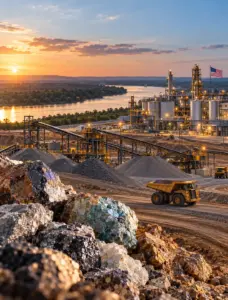
Advanced hydrometallurgical processing units at the heart of the Trail expansion project.
The Road Ahead: Timeline and Execution
While the Strategic Investment Agreement is signed, the project now enters a phase of definitive documentation and final regulatory approvals. Construction on the expansion components is expected to begin in early 2027, with the first new production volumes slated for 2028.
For investors, the deal provides a clear signal of Teck’s commitment to its post-coal identity. Since divesting its steelmaking coal business, Teck has focused relentlessly on “metals for the future.” The Trail expansion serves as a bridge between the company’s traditional mining operations and the high-value specialty chemical markets that will define the next decade of industrial growth.