Greenland’s rugged Arctic terrain is becoming more important to European plans for critical minerals and clean energy.

**NUUK, Greenland : ** The European Union has announced a €200 million partnership package with Greenland focused on connectivity, sustainable energy and critical raw materials, placing the Arctic territory closer to the center of Europe’s effort to diversify mineral supply chains.
The package, announced Sept. 7 under the EU’s Global Gateway initiative, has been widely reported as worth about $200 million. At current exchange rates, €200 million is closer to $230 million, although the dollar value will vary. The European Commission’s official description uses the euro figure and does not present the program as a mining-only investment.
The agreement is intended to support projects and programs during 2026 and 2027. It was announced alongside a new joint declaration involving European Commission President Ursula von der Leyen, Greenland Prime Minister Jens-Frederik Nielsen and Danish Prime Minister Mette Frederiksen.
The package combines three priorities:
- Connectivity and digital infrastructure
- Sustainable energy, including hydropower
- Critical raw materials and related value chains
For mining companies, investors and policymakers, the significance lies less in the headline amount than in the EU’s attempt to connect early-stage mineral development with energy, infrastructure and local economic capacity.

What the EU-Greenland package confirms
| Issue | Confirmed position |
|---|---|
| Total package | €200 million under the Global Gateway initiative |
| Period | 2026–2027 |
| Main priorities | Connectivity, sustainable energy and critical raw materials |
| Mining projects mentioned publicly | Amitsoq graphite and Malmbjerg molybdenum |
| Rare earths | Part of Greenland’s broader critical-minerals potential, but no specific rare-earth project allocation was disclosed |
| Funding status | A strategic package; project-specific amounts and final financing structures remain unclear |
The European Commission factsheet describes the initiative as a new €200 million Global Gateway Partnership Package. It says the package will expand existing cooperation in education and fisheries into connectivity, sustainable energy and critical raw materials.
That wording is important. It confirms a policy and investment framework, but it does not establish that €200 million has been committed directly to a particular mine, processing plant or mining company.
More Read
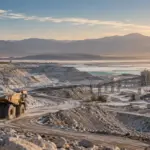
Mining projects are part of a wider energy strategy
Von der Leyen’s public remarks in Nuuk highlighted work associated with the Amitsoq graphite project and the Malmbjerg molybdenum project. The European Commission has not publicly assigned a fixed euro amount to either project in the documents reviewed for this report.
Amitsoq is viewed as a potential source of graphite, a material used in battery anodes and therefore important to electric-vehicle and energy-storage supply chains. The EU’s public language refers to financing preparations for the project, which could include technical studies, permitting support, infrastructure planning or other early-stage work. It should not be read as a final investment decision or a commitment to fund mine construction.
Malmbjerg is a molybdenum project in central-east Greenland. Molybdenum is used in steel alloys, industrial equipment and other applications where strength and corrosion resistance are important. The project has also been presented as having the potential to create significant economic value for Greenland, although development remains subject to permitting, financing, infrastructure and operating conditions.
The package’s energy component is equally important. Greenland’s geography makes transport and power expensive, particularly for remote mining developments. The EU has said the partnership will support new hydropower capacity and broader clean-energy development.
That could help reduce reliance on imported fuels and improve the economics of energy-intensive projects. It could also support future industrial activity, including mineral processing or clean industries such as renewable hydrogen, if the required infrastructure can be built at competitive cost.

Hydropower and reliable transmission will be central to any effort to develop Greenland’s remote mineral resources.
Why rare earths remain central to the discussion
The new package does not announce a dedicated rare-earth mine or specify a rare-earth financing tranche. Rare earths are nevertheless central to the strategic context surrounding Greenland.
The territory has attracted international attention because of its potential deposits of rare earth elements and other minerals considered important to the energy transition, defense, electronics and advanced manufacturing. The EU’s broader objective is to reduce exposure to concentrated supply chains and build more resilient access to materials used in permanent magnets, wind turbines, electric motors and high-performance equipment.
The EU and Greenland established a strategic partnership on sustainable raw-materials value chains in 2023. The memorandum of understanding covers the value chain from prospecting and exploration through extraction, processing and refining.
It also identifies infrastructure, skills development, research and innovation as part of the cooperation framework. The document specifically recognizes that Greenland’s mining projects may need to establish their own electricity, water and communications infrastructure, while operating in Arctic and sub-Arctic conditions.
That framework helps explain why the 2026 package includes energy and connectivity alongside minerals. Greenland’s resource potential cannot be separated easily from the cost of building roads, ports, power systems, telecommunications and logistics networks in a sparsely populated territory with difficult weather and terrain.
For the EU, supporting those enabling systems could be a way to reduce the early-stage risk of future mineral projects. For Greenland, the objective is to convert resource potential into local economic activity without compromising environmental standards or political control over mineral development.
A partnership, not yet a mine-finance commitment
The distinction between policy support and project finance will matter to investors and operators.
The joint declaration and Commission factsheet establish a strategic direction. They do not, by themselves, provide the detailed terms of loans, grants, guarantees or equity investments. Nor do they guarantee that any particular project will receive final approval.
The 2023 raw-materials memorandum is similarly broad. It states that the partnership does not create legal or financial obligations and does not represent a financing commitment by either side.
That means the next material indicators will be project-specific:
- Whether feasibility and environmental studies are completed
- Whether Greenland grants the required permits
- How power, water and transport infrastructure will be financed
- Whether developers secure offtake agreements with European buyers
- Whether processing takes place in Greenland, Europe or another jurisdiction
- How local communities participate in decisions and share in economic benefits
These questions are especially relevant for rare-earth projects, which often require complex separation and refining capacity beyond the mine site. Extracting ore is only one part of building a secure supply chain. Europe would need processing, chemical conversion, manufacturing and recycling capacity to reduce dependence on external suppliers meaningfully.

Early-stage exploration and technical work will determine how much of Greenland’s mineral potential can become commercial supply.
Environmental and local governance risks
Greenland’s mineral resources are controlled under its self-government arrangements, while Denmark retains responsibility for some areas of foreign and security policy. Mining projects must navigate Greenlandic regulation, environmental review and community consultation.
The EU’s 2023 memorandum calls for high environmental, social and governance standards and says mining development should take place in close dialogue with Greenlandic society. Those commitments will be tested as projects move from exploration to construction.
Arctic mining presents particular challenges, including fragile ecosystems, limited infrastructure, extreme weather and high remediation costs. A project that depends on imported fuel, long shipping routes or new transmission lines may face a higher carbon and capital footprint than its initial resource assessment suggests.
For operators, the commercial test will be whether clean energy and shared infrastructure can offset those costs. For investors, the key issue is whether policy support can translate into bankable projects without weakening permitting standards or community confidence.

Processing and analytical capacity will be essential if Greenland is to capture more value from future mineral production.
Strategic implications for Europe
The EU-Greenland package signals a more integrated approach to critical-minerals policy. Rather than treating mining as an isolated supply problem, Brussels is linking mineral development with energy security, digital access, skills and regional economic resilience.
That approach could benefit projects involving graphite, molybdenum and rare earths, but it will take time to produce physical supply. Exploration success, permitting and construction timelines in Greenland are measured in years, not months.
The package also places Greenland within a wider geopolitical contest over Arctic access and critical-minerals supply. Europe’s stated objective is partnership with Greenland, not control over its resources. Whether that model gains credibility will depend on transparent funding, clear local benefits and evidence that environmental commitments are enforced.
For now, the €200 million announcement is best understood as an opening framework. It strengthens the political relationship, identifies critical minerals as a priority and may help advance early-stage projects. It does not yet guarantee a new source of rare earths or battery materials for European manufacturers.
The next phase will be measured by implementation: which projects receive funding, how much capital is mobilized, and whether Greenland’s mineral potential can be developed into reliable, responsible supply.