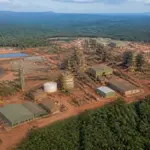
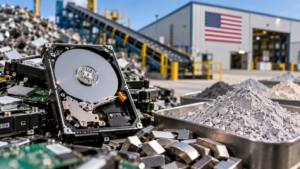
Rare earth permanent magnets move through an automated manufacturing and inspection line.

The Pentagon’s annual requirement for specialized rare earth magnets could rise to about 10,000 metric tons by 2030, roughly triple current consumption and enough to absorb close to half of today’s non-Chinese production, according to industry reporting cited by Northern Miner, The Associated Press and market analysts.
The projection highlights the scale of Washington’s effort to build a defense supply chain that does not depend on Chinese mining, processing or magnet manufacturing. Non-Chinese producers currently make an estimated 20,000 to 25,000 metric tons of rare earth magnets annually, against global output of roughly 250,000 tons.
That leaves the United States facing a narrow window. A statutory deadline beginning in 2027 will restrict the use of China-linked rare earth materials and magnets in qualifying defense systems, while most large-scale domestic projects are not expected to reach commercial production until 2028 or later.
Pentagon demand is rising faster than non-Chinese capacity
The Pentagon currently requires an estimated 3,000 to 4,000 metric tons of specialized rare earth magnets each year. By 2030, that requirement is expected to reach approximately 10,000 metric tons.
More Read

The figure is small compared with total global magnet consumption, which is driven primarily by electric vehicles, wind turbines, industrial motors, consumer electronics and automation. However, defense procurement is subject to stricter requirements on traceability, performance and country of origin.

That distinction is important. The Pentagon cannot simply compete for supply in the broader global market. Magnets used in aircraft, missiles, radar systems, submarines, drones and other defense platforms must comply with specific sourcing rules and qualification standards.
At current production levels, the Pentagon’s projected demand would represent between 40% and 50% of total rare earth magnet output outside China.
More Read

| Market indicator | Current estimate | 2030 outlook |
|---|---|---|
| Pentagon rare earth magnet demand | 3,000–4,000 tonnes per year | About 10,000 tonnes |
| Non-Chinese magnet production | 20,000–25,000 tonnes per year | Higher if new projects start on schedule |
| Global rare earth magnet production | About 250,000 tonnes per year | Expected to expand with commercial demand |
| Pentagon share of current non-Chinese output | About 12%–20% | Close to 40%–50% on a static-supply basis |
Estimates compiled from industry reporting and market analysis cited by IndexBox and Sprott Asset Management.
The “static-supply” qualification is critical. The Pentagon is not expected to consume half of all non-Chinese magnets permanently if new facilities are built on schedule. Rather, the comparison shows how quickly defense procurement could tighten the market before new capacity is commissioned and qualified.
The 2027 deadline is driving procurement decisions
The U.S. defense sector is working toward a 2027 deadline restricting the use of rare earth materials that are mined, refined, separated or melted in China for qualifying weapons systems.
The rule reflects a broader shift in U.S. policy. For years, Washington’s concern centered on whether rare earth elements were available at a competitive price. The focus has now moved toward whether the full supply chain can be controlled, audited and operated without Chinese involvement.
Rare earth magnets are particularly difficult to replace because of their combination of strength, size and energy efficiency. Neodymium-praseodymium magnets are used in high-performance electric motors and actuators, while dysprosium and terbium can improve magnet performance at elevated temperatures.
A disruption in this supply chain became visible in 2022, when deliveries of F-35 aircraft were temporarily suspended after a Chinese-origin alloy was identified in a magnet used in the aircraft’s engine. Although the material was not considered a safety risk, the incident exposed how deeply Chinese-origin inputs remained embedded in advanced defense manufacturing.
China’s position extends well beyond mining. The International Energy Agency has estimated that China controls about 90% of rare earth refining capacity used for magnets and more than 90% of finished permanent magnet production. That means a new mine outside China does not automatically create a secure alternative supply.

Industrial separation and materials-processing equipment at a rare earth facility.
Washington is using price floors, loans and offtake guarantees
The Pentagon’s response has combined direct financing with long-term purchase commitments designed to make projects bankable.
MP Materials provides the clearest example. In July 2025, the company announced a public-private partnership with the U.S. Department of Defense covering mining, separation, refining and magnet manufacturing.
Under the agreement, the Pentagon committed to a 10-year price floor of $110 per kilogram for MP Materials’ neodymium-praseodymium products. The department also agreed to ensure that all magnets produced at the company’s planned 10X facility would be purchased by defense and commercial customers for 10 years after construction.
The 10X facility is expected to begin commissioning in 2028. Once completed, MP Materials said its total U.S. rare earth magnet manufacturing capacity could reach about 10,000 metric tons annually.
The package also includes a $400 million preferred-equity investment by the Defense Department, a $150 million loan tied to heavy rare earth separation at Mountain Pass, and a commitment letter for up to $1 billion in construction financing.
The structure is intended to address a central problem in rare earths: market prices may not reflect the value of supply security. New projects can struggle to compete with Chinese producers that benefit from scale, integrated processing and established customer networks.
Government-backed price floors and offtake contracts can reduce that commercial risk. They can also shift the market from conventional spot-price competition toward strategic procurement, where reliability and origin are valued alongside cost.
New projects may cover defense demand, but timing remains uncertain
Several other projects are being developed to expand non-Chinese magnet capacity.
USA Rare Earth has received federal support for a supply chain that includes rare earth materials, metals and finished neodymium-iron-boron magnets. Its planned South Carolina facility is designed to produce about 6,400 metric tons of magnets annually. An expansion in Oklahoma could bring the company’s planned U.S. capacity to roughly 10,000 tons per year.
Vulcan Elements and ReElement Technologies have also outlined plans for a U.S. magnet facility with annual capacity of approximately 10,000 metric tons. ReElement is expected to supply non-Chinese critical minerals under a five-year agreement.
In South Korea, Evolution Metals and Technologies has announced plans to expand rare earth magnet production capacity to 10,000 metric tons per year, including 6,000 tons of high-performance sintered magnets. The timing is intended to align with the U.S. defense sourcing deadline.
The combined nameplate capacity from these projects could eventually exceed the Pentagon’s projected requirement. But nameplate capacity is not the same as qualified commercial production.
Facilities must still secure permits, complete construction, install specialized equipment, qualify materials for defense applications, recruit skilled workers and establish reliable feedstock. Any delay could push production beyond the point at which the 2027 sourcing rules begin to affect procurement.
Commercial buyers may remain exposed
Even if defense needs are met with non-Chinese material by 2028 to 2030, broader commercial markets are likely to remain import-dependent.
The United States uses rare earth magnets directly in motors, generators, industrial equipment, electronics and defense systems. It also imports magnets embedded in finished products. Market analysts estimate that total U.S. demand, including embedded magnets, could exceed 50,000 metric tons annually by 2030.
That would leave a potential gap between domestic production and total consumption, even if planned facilities reach their targets.
Commercial manufacturers may therefore continue sourcing from Japan, South Korea, Europe and other Asian markets. Those supply chains may be less exposed to direct Chinese ownership or processing than before, but they can still depend on Chinese-origin feedstock, metals or alloys.
The result could be a two-tier market. Defense customers may receive priority access to audited, non-Chinese material supported by government contracts, while commercial users continue to rely on a wider and more complex import network.

Critical-minerals processing infrastructure and logistics facilities viewed from above.
The bottleneck is moving downstream
For miners and exploration companies, the policy shift strengthens the case for integrated projects that extend beyond the orebody.
The most valuable assets may not be deposits alone, but supply chains that connect mining to separation, refining, metal-making, alloy production and finished magnets. Projects that can document origin at each stage may attract government support or long-term offtake commitments.
The same shift creates challenges for operators. Rare earth projects often contain multiple elements with different technical and commercial characteristics. Separating light rare earths such as neodymium and praseodymium is different from producing heavy rare earths such as dysprosium and terbium, which are important for high-temperature applications.
Processing complexity, environmental approvals and limited technical expertise can all extend development timelines.
The Pentagon’s projected demand therefore represents more than a new source of consumption. It is becoming an anchor for a new industrial system in which governments help finance capacity, guarantee demand and establish supply-chain standards.

Precision testing of rare earth permanent magnets for high-performance applications.
What to watch through 2030
For mining companies, investors and manufacturers, four indicators will determine whether the projected supply gap narrows:
- Commissioning schedules: Whether planned U.S. and allied magnet plants begin production before or after the 2027 defense deadline.
- Feedstock security: Whether new facilities receive separated oxides, metals and alloys from verified non-Chinese sources.
- Defense qualification: How quickly new magnets pass testing for aircraft, missile, naval and other defense applications.
- Commercial allocation: Whether government-backed contracts leave enough capacity for electric vehicles, wind turbines, robotics and industrial motors.
Washington may be able to meet defense requirements without Chinese-origin material by the end of the decade if announced projects are completed and qualified. That outcome, however, will not make the wider rare earth magnet market independent of China.
The immediate issue is capacity. The longer-term challenge is building a competitive, fully integrated supply chain that can survive without permanent government support.
For the mining sector, rare earths are becoming a test of whether strategic minerals policy can move successfully from mine development to industrial production.
Sources
- IndexBox: Pentagon rare earth magnet demand to soak up half of non-Chinese supply by 2030
- MP Materials: Public-private partnership with the Department of Defense
- U.S. Department of Energy: Neodymium magnets supply chain report
- International Energy Agency: Rare earth elements
- Skillings: Critical minerals demand, energy transition and supply gaps
- Skillings rare earths coverage