By Charles Pitts
The transition from traditional heap leaching to complex milling represents a pivotal shift for the Hycroft Mine in Nevada. As the project advances into 2026, the technical debate between Pressure Oxidation (POX) and Roasting has moved from desktop studies to final engineering decisions. For one of the world’s largest undeveloped silver resources, the choice of processing technology is not merely a matter of recovery percentages but a fundamental economic decision involving energy inputs, byproduct revenue, and long-term capital intensity.
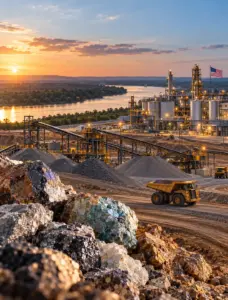
Hycroft Mining Holding Corporation (HYMC) is currently navigating the complexities of sulfide ore processing. While the mine previously operated as a low-grade heap leach facility, the underlying sulfide and transition ores contain the vast majority of its 562.6 million ounces of silver and 16.4 million ounces of gold. To unlock this value, the “oxidative” step: breaking down the sulfide minerals to expose the precious metals: is required before cyanidation can take place.
The Hycroft Resource: A Silver-Dominant Giant
Located in the historic Sulphur District of Nevada, the Hycroft Mine stands out in a state primarily known for gold. Its silver endowment is significant, positioning it among the top five largest silver deposits globally. However, the geology presents a challenge: the silver is often encapsulated within pyrite and marcasite minerals.
More Read

In the oxidized upper layers, simple heap leaching was sufficient. But as the pit deepens, the ore turns “refractory,” meaning the gold and silver are chemically locked in the sulfide lattice. Standard leaching yields negligible recovery for these ores. To achieve commercial viability, the mill must employ either high-pressure oxygen (POX) or high-temperature roasting.

Pressure Oxidation (POX): The Conventional High-Recovery Route
Pressure Oxidation is a hydrometallurgical process where ore is ground into a fine slurry and then fed into a massive horizontal vessel called an autoclave. Inside, the slurry is subjected to high temperatures (typically 190°C to 230°C) and high pressures under an oxygen-rich atmosphere.
The POX Advantage at Hycroft
Recent metallurgical test work completed in late 2025 has confirmed that POX is highly effective for Hycroft’s mineralization. The company reported recoveries of approximately 83% for gold and 78% for silver using a milling-plus-POX flowsheet.
More Read


“The POX results provide a high degree of confidence in the technical feasibility of the project,” notes recent technical documentation from the site. “The consistency of the recovery across various sulfide grades suggests a robust process.”
However, POX is energy and reagent-intensive. It requires a constant supply of liquid oxygen and high-pressure steam. Furthermore, the sulfuric acid generated during the oxidation must be neutralized, typically using large quantities of lime or limestone, which adds to the operating expense (OPEX) and creates a large volume of neutralized tailings.
Roasting: Turning Waste into Revenue
As an alternative to the hydrometallurgical route, Hycroft has been aggressively studying Roasting. In this process, the sulfide concentrate is heated in a furnace (fluidized bed roaster) to temperatures exceeding 500°C. This thermally decomposes the sulfides, leaving behind a porous calcine from which silver and gold can be easily leached.

The primary driver behind the roasting trade-off study is the potential for byproduct revenue. Unlike POX, which produces a dilute acid that must be neutralized, roasting generates a high-concentration sulfur dioxide (SO2) gas. This gas can be captured and converted into commercial-grade sulfuric acid.
In the current 2026 market, sulfuric acid is a critical reagent for the lithium and copper industries, particularly for heap leaching operations in the southwestern United States. By producing its own acid, Hycroft could potentially:
- Eliminate Neutralization Costs: Avoid the expense of purchasing and transporting lime.
- Generate Ancillary Revenue: Sell excess sulfuric acid to nearby copper and lithium projects.
- Optimize Energy Use: Roasting is an exothermic process; once started, the combustion of sulfides provides much of the required heat.
Data Comparison: POX vs. Roasting Performance
The following table outlines the key metrics being evaluated in the 2026 feasibility trade-off study, based on preliminary metallurgical and engineering data:
| Metric | Pressure Oxidation (POX) | Roasting (Thermal) |
|---|---|---|
| Gold Recovery | 82% – 84% | 80% – 83% |
| Silver Recovery | 77% – 79% | 75% – 80% |
| Byproduct Capture | Minimal (Neutralized) | High (Sulfuric Acid) |
| Reagent Dependency | High (Lime/Limestone) | Low |
| Energy Profile | High Electricity (Oxygen Plant) | High Thermal (Initial Start-up) |
| Environmental Footprint | Large Tailings Volume | Gas Emission Control Required |
Note: Data represents estimated ranges based on Hycroft’s 2025/2026 technical reports and desktop trade-off analysis.
Operational and Risk Considerations
Choosing between these technologies involves more than just a recovery spreadsheet. Operational complexity and “the tech stack” for remote mining operations play a significant role. According to analysis on mining tech stacks for remote operations, the maintenance requirements for autoclaves: which operate under extreme pressure and acidity: are often higher than those for roasters.
Water and ESG Impact
In Nevada, water management is a primary regulatory concern. POX requires significant water for the slurry and cooling systems. Roasting, while requiring water for gas scrubbing, has a different footprint. The “acid plant” associated with roasting also introduces a chemical manufacturing element to the mine site, requiring specialized labor and safety protocols.
Capital Expenditure (CAPEX)
Historically, POX has a reputation for high initial capital costs due to the specialized alloys (like titanium-lined autoclaves) needed to withstand the corrosive environment. Roasters are also expensive, but the modularity of modern roasting plants may offer some advantages in staged expansions. Preliminary 2026 estimates suggest that the CAPEX for both routes at Hycroft is comparable within a 15% margin, making the OPEX and byproduct credits the true deciding factors.
2026 Outlook and Market Impact
As of May 2026, the mining industry is closely watching Hycroft’s final technology selection. If the company chooses Roasting and successfully integrates sulfuric acid production, it could set a new benchmark for “circular” mining in Nevada, turning a sulfide liability into a regional reagent asset.

For investors and analysts focusing on the Skillings Mining Review, the decision impacts the project’s Net Present Value (NPV) significantly. A successful silver recovery strategy at Hycroft would contribute significantly to the domestic US silver supply at a time when silver demand for photovoltaics and electronics remains at record highs.
Conclusion
The “battle” between POX and Roasting at Hycroft underscores a broader trend in the mining sector: the necessity of advanced metallurgy to unlock the next generation of critical and precious metal deposits. While POX offers a proven, high-recovery pathway that has been successfully deployed by majors like Barrick in Nevada, the economic allure of roasting: specifically its potential to produce sulfuric acid: makes it a compelling alternative in a reagent-starved market.
Hycroft’s final feasibility study, expected to be the cornerstone of their 2026-2027 development plan, will ultimately decide which technology wins the day. For now, the focus remains on optimizing the flowsheet to ensure that every ounce of the 500-million-plus silver resource is accounted for.