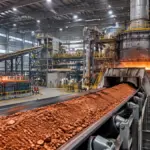
Australian hard-rock lithium mining and processing infrastructure.

By Penny Langford
The lithium market is moving toward a more fragile balance as mine closures, slower project ramps and export restrictions remove supply that producers once expected to deliver. A cumulative 500,000 tonnes of hard-rock concentrate is now a useful milestone for measuring that disruption, although the figure should not be interpreted as one confirmed shutdown or as 500,000 tonnes of lithium carbonate equivalent (LCE).
The more precise reading is that approximately 500,000 tonnes of spodumene concentrate may be removed, delayed or placed at risk against earlier operating and project plans across the 2025–2026 period. That distinction matters. Depending on grade and recovery, the material represents a much smaller quantity of LCE, but it is still significant for a seaborne market that depends heavily on Australian and African hard-rock supply.
The central question for operators and investors is whether those curtailments will be enough to move lithium from a narrowing surplus into a sustained deficit. Forecasts remain divided, with published 2026 lithium carbonate estimates ranging from the low-to-mid teens to more than $23,000 per tonne.
More Read
The 500,000-tonne milestone needs careful definition
Public data do not identify a single, independently verified 500,000-tonne cut confined to hard-rock mines. Instead, the figure is best understood as an aggregate supply-risk scenario that combines:

- production cuts at higher-cost Australian mines;
- delayed or slower project ramp-ups;
- Chinese mine and permitting disruptions;
- Zimbabwe’s restrictions on raw-mineral and concentrate exports; and
- previously announced capacity that may not return quickly when prices recover.
Consultancy CRU estimated that announced mine cuts and postponed projects reduced expected global lithium mine output by about 228,000 tonnes in 2025 compared with earlier plans. That figure covers the broader lithium supply chain and should not be added directly to a 500,000-tonne hard-rock estimate.
The Australian closure cycle provides much of the hard-rock component. Bald Hill was placed into care and maintenance after operating costs remained too high, while Pilbara Minerals suspended the Ngungaju processing plant. Mt Cattlin also halted operations in 2025. At Kathleen Valley, the issue has been a slower ramp-up rather than a permanent closure.

Other producers have moved in the opposite direction. Mineral Resources increased guidance for Wodgina and Mt Marion, illustrating why the market cannot be assessed simply by counting mine closures. Lower-cost operations are positioned to gain market share as higher-cost tonnes leave.

Crushing and concentration circuits determine how quickly hard-rock supply can respond to price signals.
2026 lithium forecasts split over the market balance
The biggest disagreement among forecasters is not whether demand will grow. It is how quickly new supply, restarts and expansions will arrive.
S&P Global expects lithium chemical consumption to rise 13.5% in 2026 to about 1.48 million tonnes LCE. Supply is forecast to increase 9.9% to approximately 1.58 million tonnes LCE, leaving a surplus of around 109,000 tonnes. That would still be a surplus, but narrower than the estimated 141,000-tonne surplus in 2025.
Fastmarkets has a tighter view. Its published outlook points to a small deficit of roughly 1,500 tonnes LCE in 2026 and a lithium carbonate price forecast of about $23,800 per tonne. The firm has argued that the market may require several years of higher prices to attract enough investment into new mines and processing capacity.
BMI, the Fitch Solutions research firm, remains more cautious on the longer-term balance. Its analysis expects lithium production to grow strongly in 2026, supported by Australia and China, while demand growth slows from the exceptionally high levels recorded in 2025. BMI forecasts lithium demand growth of about 4.8% in 2026 and has said the market could remain in surplus if projects restart quickly.
The result is a wide range of outcomes:
| Indicator | Conservative view | Base view | Tight-market view |
|---|---|---|---|
| 2026 lithium carbonate price | $13,000–$17,000/t | $17,000–$21,000/t | $23,000–$30,000/t |
| Market balance | Surplus above 100,000 t LCE | Near balance | Small deficit |
| Hard-rock response | Rapid restarts | Selective restarts | Prolonged curtailments |
| Main demand driver | EV growth | EVs plus storage | Accelerating energy storage |
| Key risk | New supply arrives early | Delayed project ramp-ups | Export and permitting disruptions |
These are scenario ranges rather than a single consensus forecast. Price reporting agencies use different specifications, delivery points and averaging periods, so direct comparisons require caution.
Hard-rock supply is becoming more responsive : and more concentrated
The economics of hard-rock lithium are changing. When prices were high, producers advanced expansions and accepted higher operating costs to secure market share. The subsequent downturn exposed the vulnerability of mines that depend on high-grade ore, low logistics costs and reliable conversion capacity.
Bald Hill is one of the clearest examples. Its planned 2025 spodumene shipments were reduced to about 60,000 dry metric tonnes from an earlier range of 120,000 to 145,000 tonnes. The mine remained suspended into 2026, although a possible restart has been considered.
At Greenbushes, output moderation has been less severe and linked partly to grades, inventories and logistics. Wodgina and Mt Marion, meanwhile, have continued to support supply growth. This divergence creates a two-tier market: low-cost producers can increase output when prices recover, while marginal mines may require a much higher price before returning.
That response function will determine whether the 500,000-tonne milestone becomes a temporary shock or a structural supply gap. If producers restart quickly, the market could remain near the conservative range. If idled capacity stays offline and new projects face delays, prices could move toward the upper end of the forecast band.
China and Zimbabwe add policy risk
Hard-rock supply is also exposed to permitting and trade policy.
The suspension of CATL’s Jianxiawo mine in China led Benchmark Mineral Intelligence to reduce its 2026 production estimate for the operation from 62,500 tonnes LCE to 32,000 tonnes. That is a reduction of about 30,500 tonnes LCE from the earlier forecast. Other Jiangxi mines could face scrutiny, although the volumes at risk are not confirmed cuts.
Zimbabwe has introduced a separate policy shock. The government suspended exports of raw minerals and lithium concentrates in February and later outlined a quota framework linked to domestic processing. Zimbabwe had become an important supplier of spodumene to Chinese converters, meaning even a temporary halt can affect inventories and spot prices.
BMI said supply restrictions and stronger demand from low-carbon industries had supported lithium’s rebound, while warning that rapid restarts of idled capacity could cap prices. That tension is likely to define the market through 2026: policy-driven disruptions can lift prices quickly, but the response from producers may also be faster than in previous cycles.

Spodumene grade and recovery rates remain central to the conversion economics of hard-rock lithium.
Energy storage is the swing factor
Electric vehicles remain the largest source of lithium demand, but stationary energy storage is becoming more important in the price outlook. Grid-scale battery deployment is expanding as utilities address renewable intermittency, transmission constraints and rising electricity demand from data centers.
BMI expects global battery energy storage capacity to increase from approximately 325 gigawatts to about 1,270 gigawatts by 2035. The United States and China are expected to remain the dominant markets in the near term.
Storage demand also affects the chemical mix. Lithium iron phosphate batteries, which use lithium carbonate rather than lithium hydroxide, have gained share in electric vehicles and stationary storage. That trend supports carbonate demand but may limit the premium previously associated with high-nickel chemistries and lithium hydroxide.
For operators, the implication is that lithium demand is becoming less dependent on passenger EV sales alone. For investors and policymakers, the risk is that storage growth may be strong but uneven, particularly if elevated lithium prices increase battery costs or delay project approvals.

Energy storage is emerging as a second major source of lithium demand alongside electric vehicles.
Base, bull and bear cases for 2026
Base case: a narrow market
In the base case, Australian production continues to recover selectively, but Bald Hill and other higher-cost operations remain offline. Chinese supply restarts gradually, while energy storage offsets slower EV growth. Lithium carbonate trades mainly in the $17,000–$21,000-per-tonne range.
Bull case: curtailments persist
The bull case assumes the cumulative hard-rock supply gap approaches the 500,000-tonne milestone relative to earlier plans, Zimbabwe’s restrictions remain disruptive and Chinese restarts are delayed. A small LCE deficit develops, pushing carbonate toward $23,000–$30,000 per tonne and improving the economics of marginal mines.
Bear case: supply returns faster than demand
In the bear case, idled Australian capacity restarts, Chinese projects regain regulatory clearance and new brine and hard-rock projects ramp on schedule. EV sales slow while storage growth fails to compensate. Prices remain in the mid-teens or fall toward the low end of current forecasts.
What to monitor next
The most important indicators are not headline prices alone. Market participants should track:
- Restart decisions at Bald Hill, Mt Cattlin and other idled operations.
- Actual concentrate shipments from Zimbabwe after the quota framework takes effect.
- Jianxiawo and Jiangxi permitting developments in China.
- Kathleen Valley’s ramp-up rate against its revised production plan.
- Battery storage deployments in China, the United States and Europe.
- Conversion margins for lithium carbonate and hydroxide in China.
The lithium price forecast for 2026 therefore depends less on whether supply has been cut than on whether those tonnes can return. The 500,000-tonne milestone is best treated as a measure of cumulative hard-rock supply at risk against previous plans. If much of that material remains offline while storage demand accelerates, the market could move into deficit. If lower-cost producers respond quickly, the adjustment may produce a recovery without a sustained price spike.
LinkedIn snippet
Lithium’s 2026 outlook is being shaped by a cumulative hard-rock supply gap that could approach 500,000 tonnes of concentrate against earlier plans. The figure is not one confirmed shutdown, but it captures mine closures, delayed ramps and export restrictions across Australia, China and Zimbabwe. Our analysis compares the base, bull and bear cases for lithium carbonate prices.
X snippet
Lithium’s 2026 price outlook hinges on whether hard-rock supply returns. Mine closures, delayed ramps and export restrictions could remove or place up to 500,000 tonnes of concentrate at risk against earlier plans. The market balance could range from a 100,000-t surplus to a small deficit.
Sources and further reading
- BMI revises lithium price forecast upwards amid tightening supply
- Reuters: lithium mines that have cut output because of low prices
- S&P Global: lithium carbonate surplus to narrow as energy storage drives growth
- Benchmark Mineral Intelligence: CATL suspends operations at Jianxiawo mine
- Skillings: lithium mine permit review and CATL project update
- Skillings Mining Intelligence