VANCOUVER, BC : Lundin Mining has authorized a $215 million capital allocation to increase its stake in the Vicuña District, signaling a definitive move to consolidate its dominance over what is becoming the world’s most significant emerging copper-gold province. The move, announced early Thursday, March 26, 2026, accelerates the company’s transition from a mid-tier producer to a top-tier copper heavyweight.

The strategic calculus here isn’t subtle: copper demand is diverging from supply at an alarming rate. By securing a larger piece of the Vicuña pie, Lundin is positioning itself to control a multi-generational asset that the industry now views as the primary answer to the looming “green metal” deficit.
The $215 Million Bet on Geologic Certainty
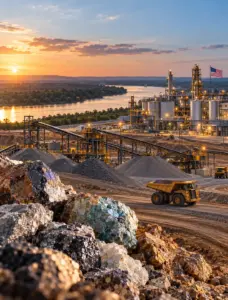
This $215 million investment is not a speculative exploration play. It is a calculated consolidation of ownership and infrastructure rights within the Vicuña District, a massive mineralized cluster spanning the border of San Juan Province, Argentina, and the Atacama Region of Chile. This district includes the flagship Josemaria project, the Filo del Sol deposit, and the Caserones mine.
For Lundin Mining, this stake increase represents an inflection point. The company is no longer just looking for ore; it is building a district-scale ecosystem. By increasing its financial and operational exposure, Lundin is effectively front-running the competition in a region where geology has already proven its worth.
The district is characterized by massive porphyry systems that offer something rare in modern mining: scale and longevity. We aren’t talking about a ten-year mine life. We are talking about a 70-year operational horizon. That’s not a typo. It’s a multi-generational commitment that shifts the company’s valuation from a series of individual assets to a permanent industrial hub.
More Read



Targeting 500,000 Tonnes: The Production Mandate
Lundin’s objective is clear: reach an annual production rate of 500,000 tonnes of copper. To put that in perspective, reaching this threshold would place Lundin in the same league as the industry’s most established “majors.”
But you can’t disrupt geology. The Vicuña District provides the grade and the volume necessary to sustain these numbers, but the engineering required to extract it is staggering. The district-wide integration plan focuses on creating synergies between Josemaria and the Filo del Sol joint venture with BHP. This isn’t just about sharing a border; it’s about sharing power lines, water pipelines, and processing facilities to drive down the all-in sustaining costs (AISC).
More Read

The 500,000-tonne target is a response to a global market that is increasingly desperate for “clean” copper: metal sourced from jurisdictions that adhere to modern ESG standards. While other regions face rising geopolitical risks and security policy shifts, the Vicuña District has benefited from a unique cross-border treaty between Chile and Argentina that facilitates mining activity in the high Andes.
293,000 Tonnes Per Day: Processing at Scale
The technical heart of this expansion lies in the processing capacity. Lundin has outlined a growth path that sees processing throughput reaching up to 293,000 tonnes per day (tpd). This level of throughput is reserved for only a handful of the world’s largest operations, such as Escondida or Grasberg.
Scaling to 293,000 tpd requires more than just bigger crushers. It requires a complete rethink of high-altitude logistics. The plan involves:
- Modular Expansion: Building out processing units that can be scaled as the Filo del Sol and Josemaria pits expand.
- Automation Integration: Utilizing autonomous haulage and drilling to maintain consistency in a challenging environment.
- Energy Efficiency: Leveraging the regional power grid, which is increasingly supplied by renewable sources in both Chile and Argentina.

The sheer volume of material moving through these mills will make Lundin one of the most significant industrial consumers in the region. The logic is simple: in a world of declining ore grades, the only way to win is through massive, efficient volume.
The 70-Year Horizon: Why Duration Matters
Investors often focus on the next quarter or the next fiscal year. Lundin is focusing on the next seven decades. The 70-year operational lifespan identified in the Vicuña District study changes the cost of capital. When an asset is expected to produce for nearly a century, the initial multi-billion dollar CAPEX becomes much easier to swallow.
This longevity provides a hedge against commodity price volatility. Over a 70-year cycle, copper will see multiple bull and bear markets. An operation of this scale, however, is built to survive the lows and print cash during the highs. It becomes a foundational asset: a “bank” of copper that can be drawn upon regardless of the short-term economic weather.
Furthermore, the long-term nature of the project allows for deeper community and government partnerships. In San Juan, Argentina, the project is viewed as a cornerstone of provincial economic development. In Chile, it reinforces the nation’s status as the world’s primary copper provider, especially as strategic pacts with the United States secure supply chains for the energy transition.
Geopolitical Synergy and Regional Stability
Operating on the border of Chile and Argentina is not without its complexities, but the Vicuña District is governed by a specific Mining Integration and Complementation Treaty. This legal framework allows for the seamless movement of people, equipment, and minerals across the border.
Lundin’s $215 million stake increase is a vote of confidence in this treaty. While Argentina has seen its share of economic shifts, the San Juan province remains a pro-mining bastion. On the Chilean side, the stability of the mining code: despite recent debates over royalties: remains a global benchmark.

The strategic importance of this district cannot be overstated. As Western nations scramble to secure critical minerals, the Vicuña District represents a secure, predictable source of supply. It is one of the few places on earth where you can find a Tier-1 copper deposit that isn’t already owned by a legacy major or a state-owned enterprise.
The BHP Factor: A High-Octane Partnership
It is impossible to discuss Lundin’s move in the Vicuña District without mentioning BHP. The two companies are already partners in a 50/50 joint venture for the Filo del Sol project. Lundin’s decision to independently increase its stake in the broader district suggests a desire to maintain a dominant seat at the table as the district-wide integration progresses.
BHP brings massive balance sheet strength and technical expertise in large-scale open-pit mining. Lundin brings the “first-mover” agility and the deep regional relationships established by the Lundin family over decades. This partnership is a formidable force that effectively blocks out other competitors from entering the district’s core.
The $215 million stake increase ensures that when the final investment decisions (FIDs) are made for the integrated district plan, Lundin is negotiating from a position of maximum strength.
Risks and Technical Hurdles
Despite the bullish outlook, the Vicuña District presents brutal challenges. The altitude alone: often exceeding 4,000 meters: requires specialized equipment and rigorous health and safety protocols for the workforce. Oxygen enrichment systems and strict acclimatization schedules are standard operating procedures.

Water management is another critical factor. The high Andes are an arid environment. Lundin has committed to utilizing desalinated water or recycled industrial water to minimize the impact on local aquifers. The cost of pumping water from the coast up to the mine site is a significant OPEX consideration, but it is a necessary cost for securing a “social license” to operate.
Finally, there is the CAPEX. Building a mining complex capable of 293,000 tpd is an $18 billion endeavor across all stages. Lundin will need to maintain a disciplined balance sheet and likely seek further debt financing or strategic partnerships to bring the full vision to life.
The Bottom Line for 2026
Lundin Mining’s $215 million stake increase is the opening salvo in a new era of copper production. By doubling down on the Vicuña District, the company is betting that scale, longevity, and geologic quality will triumph over short-term market fluctuations.
With a target of 500,000 tonnes of annual copper production and a 70-year mine life, Lundin is no longer playing the same game as its mid-tier peers. It is building a copper empire in the clouds. The industry is watching, and the message is clear: the Vicuña District is the future, and Lundin owns the keys.