By Salini Krishnan
A new wave of streaming and royalty transactions is giving the mining sector a fresh valuation benchmark, with large-cap precious metals financiers continuing to command premium multiples even as many junior developers and operators trade closer to asset value. For operators, investors, and dealmakers, the widening gap is becoming more than a market curiosity. It is increasingly shaping how capital is raised, how projects are financed, and where M&A pressure is building.
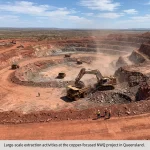
The clearest benchmark is the $4.3 billion silver streaming agreement between Wheaton Precious Metals and BHP tied to Antamina in Peru, one of the world’s largest copper mines. The scale of the transaction stands out not only for its headline value, but for what it says about market confidence in long-life, low-risk, high-quality production exposure. In practical terms, the deal reinforces the pricing power available to established royalty and streaming groups with strong balance sheets, diversified portfolios, and access to institutional capital.
That premium is showing up across the sector. Large-cap royalty names have been trading around roughly 2.5x price-to-net-asset-value, while many junior miners and developers remain closer to about 1.0x P/NAV. The consequence is a structural arbitrage opportunity: better-rated acquirers can use stronger equity currency and lower-cost capital to buy or finance ounces and pounds in the ground at a discount to where public markets value their own businesses.
More Read

Antamina Deal Sets the Sector Benchmark
The Wheaton-BHP Antamina transaction has become the reference point for current discussions around mine finance and portfolio valuation. Antamina is a large-scale, long-life operation with established infrastructure, and that lowers several of the key risks that often weigh on project finance in mining. For streaming companies, assets of that quality offer visible production, lower execution uncertainty, and commodity exposure without direct operating control.

For the broader market, the significance is twofold. First, the transaction shows that top-tier streams can still attract multi-billion-dollar commitments even in a higher-cost capital environment. Second, it underlines the strategic value of mines that combine long reserve life, scale, and reliable jurisdictional footing. Those characteristics are now commanding a sharper premium relative to earlier-stage or single-asset juniors.

More Read

OR Royalties Expands With $28 Million Stream Acquisition
At the smaller end of the market, OR Royalties’ $28 million stream acquisition on Canadian Copper’s Murray Brook and Caribou assets offers a useful contrast. The transaction is modest relative to Antamina, but strategically important because it highlights how royalty capital continues to move into development-stage and restart-linked assets where operators need flexible funding.
For Canadian Copper, stream financing can help bridge capital requirements without immediate large-scale equity dilution. For OR Royalties, the appeal is access to future production optionality on assets with known histories and identifiable development pathways. In a market where many juniors remain capital-constrained, this kind of transaction is likely to remain a recurring feature, particularly for brownfield projects and assets with existing infrastructure.
Taken together, the Antamina and Canadian Copper-linked deals show the sector operating on two tracks at once: mega-cap transactions that reset benchmarks at the top end, and smaller stream acquisitions that quietly accumulate optionality further down the development curve.
Why the P/NAV Gap Is Driving M&A
The valuation gap between royalty companies and junior miners is now one of the most important forces behind deal activity. When large-cap royalty and streaming players trade near 2.5x P/NAV and junior miners hover around 1.0x, the math increasingly supports acquisitions, structured financings, and hybrid transactions.
In simple terms, a higher-multiple buyer can acquire exposure to future metal output more cheaply than developing the same exposure organically. That does not eliminate permitting, technical, or execution risks, but it can improve deal economics enough to justify faster transaction activity. The same dynamic is affecting larger producers as well, especially those seeking pipeline replenishment without taking on full greenfield risk.
This helps explain why M&A interest is staying elevated across developers, restart stories, and advanced-stage assets. Projects that have completed substantial drilling, metallurgical work, or permitting steps may look especially attractive because they offer a shorter route to value realization. The market is effectively rewarding de-risked optionality and punishing capital intensity and long timelines.
Market Snapshot: Commodity and Valuation Signals
| Metric | Latest Level | Why It Matters |
|---|---|---|
| Gold | ~$4,839/oz | Supports stronger margins, stream valuations, and financing appetite for precious-metals exposure |
| Copper | ~$5.12/lb | Reinforces strategic demand for long-life copper assets and by-product revenue streams |
| Uranium | ~$112/lb | Keeps attention on fuel-cycle security, mine restarts, and financing optionality across the nuclear supply chain |
| Large-cap royalty P/NAV | ~2.5x | Indicates premium market pricing for diversified, lower-risk exposure |
| Junior miner P/NAV | ~1.0x | Suggests public-market discounting is creating acquisition and financing opportunities |
Data Source: Company disclosures, market pricing, and Skillings Mining Intelligence analysis.
What Operators and Investors Are Watching
For operators, the current setup favors financing strategies that preserve balance-sheet flexibility. Streaming and royalty capital remains attractive where management teams want to avoid raising large amounts of discounted equity or adding more conventional debt. That is especially relevant for assets in construction, restart, or late-stage development.
For investors, the key issue is whether the valuation gap narrows through junior reratings or through more transactions. If majors, royalty companies, and mid-tier consolidators continue to pursue discounted assets, M&A could do part of the repricing work that public markets have so far resisted. The underlying signal from current deal flow is that strategic buyers are often more constructive on asset value than listed equity markets appear to be.

Bottom Line
The Wheaton-BHP Antamina deal has reset the upper end of the streaming market, while OR Royalties’ acquisition on Murray Brook and Caribou shows that smaller, targeted transactions remain active where financing gaps persist. Between those two endpoints sits the sector’s central investment theme: a persistent valuation disconnect between premium-rated royalty platforms and discounted junior miners.
As long as large-cap royalty companies trade at materially higher multiples than many developers and junior operators, the incentive for acquisitions, streams, and structured financing is likely to remain strong. In that sense, the valuation gap is not just a market signal. It is becoming a mechanism for sector consolidation.