Here's what nobody's talking about: Minnesota just became ground zero for the electric mining revolution, and most operators are still pretending diesel is forever.

Mesabi Metallics dropped the hammer last week with a fleet order of fully electric Pit Viper 351 E drilling rigs from Epiroc. Not hybrid. Not "transitioning." Fully electric. For a $2.4 billion taconite operation in Nashwauk that's already rewriting the rulebook for Great Lakes iron ore.
This isn't some pilot project or ESG theater. This is the first new iron ore mine in Minnesota in 50 years betting its entire drill fleet on battery power.

The Electric Gambit Nobody Saw Coming
The Pit Viper 351 E isn't just a diesel rig with a battery stuck on. It's purpose-built for zero-emission drilling with single-row autonomous capabilities baked in from day one. Mesabi plans to flip that autonomous switch once the mine hits full production: targeting safety improvements and efficiency gains that diesel operators can't touch.
More Read

Joe Broking, Mesabi's CEO, said the quiet part out loud: "Automation technology has the potential to significantly improve on-site safety while also increasing efficiency and reducing our environmental footprint."

Translation: They're building this facility to lead, not follow. And they're doing it in a state where iron ore extraction has been diesel-dependent since the Mesabi Range opened in the 1890s.
The equipment deal runs through Road Machinery & Supplies Co., a Minnesota-based distributor that's been Mesabi's heavy equipment partner since the beginning. This electric fleet follows a $110 million equipment investment the two companies inked back in July 2025. Mesabi isn't experimenting. They're all-in.
More Read

What Operators Need to Understand
The first Pit Viper 351 E arrives on-site this summer: June 2026. Additional rigs roll in during Q1 2027, right as the facility completes commissioning and ramps toward commercial production.
That timeline matters. Most mining operations treat electrification like a decade-out problem. Mesabi is operationalizing it before first ore ships.

Matthew Inge, VP and Business Line Manager for Drilling Solutions at Epiroc, framed it like this: "These drills deliver exceptional performance while significantly reducing emissions and enabling safer, more sustainable and responsible mining operations."
Here's what that actually means on the ground:
Zero diesel particulate emissions. No exhaust venting issues. No diesel storage and handling overhead. Cleaner air for drill operators, maintenance crews, and everyone working downwind.
Lower noise profiles. Electric motors run quieter than diesel engines. That's not just a comfort issue: it's a safety communication issue. Crews can hear warnings, equipment failures, and each other.
Instant torque delivery. Electric drivetrains provide consistent power across the entire RPM range. Diesel rigs lose efficiency at low speeds. Electric doesn't.
Predictable energy costs. Diesel pricing swings with crude benchmarks, refinery margins, and geopolitical chaos. Grid electricity: especially in Minnesota with its renewables mix: offers more stable, contractable rates.
Simplified maintenance. Fewer moving parts. No oil changes, fuel filters, or particulate traps. Downtime drops. Parts inventory shrinks.
But here's the kicker: Mesabi's entire drill fleet is now Epiroc equipment. That's not vendor diversification. That's strategic lock-in with a supplier betting hard on electric and autonomous futures.
Why Minnesota, Why Now
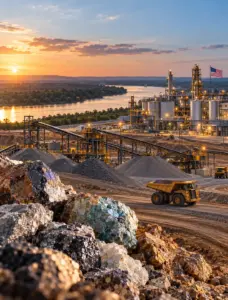
Mesabi Metallics is building North America's first new integrated taconite facility in half a century. The project sits on the western Mesabi Range: the same geological formation that fed America's steel mills through two world wars and built the industrial Midwest.

But this isn't your grandfather's iron mine. Modern taconite operations crush, concentrate, and pelletize low-grade magnetite ore into high-grade iron pellets. It's energy-intensive, equipment-heavy, and increasingly scrutinized for environmental impact.
Minnesota has some of the strictest air quality and mining permitting standards in North America. Mesabi didn't choose electric drilling to be virtuous. They chose it because it's the clearest path through regulatory approval and community acceptance.
The state's grid runs roughly 30% renewable energy, with strong wind generation across the Iron Range and northern Minnesota. That means Mesabi's electric fleet isn't just shifting emissions from the pit to a coal plant two states over. They're plugging into a grid that's already cleaner than diesel combustion by a significant margin.
And here's the part most operators miss: Minnesota is hungry for this project to succeed. The Iron Range has been bleeding mining jobs for decades. Mesabi represents 1,000 construction jobs and 400 permanent positions in a region desperate for good-paying industrial work.
State and local governments want this to work. That means infrastructure support, workforce development programs, and regulatory cooperation that most greenfield mines never see.
The Autonomous Layer
Mesabi isn't activating autonomous drilling on day one, but the equipment is ready when they are. Single-row autonomous capability means these rigs can execute pre-programmed drill patterns without an operator in the cab.
That's not full autonomy: someone still supervises from a remote station: but it's a massive safety upgrade. Drill operators aren't exposed to rock falls, equipment failures, or proximity incidents. They're monitoring from a climate-controlled room with better sightlines and zero blast exposure.

The efficiency gains stack up fast:
Consistent hole spacing and depth. Automated drilling eliminates human variability in blast pattern execution. More consistent blasts mean better fragmentation, easier loading, and less downstream crushing.
24/7 operation potential. Human operators need breaks, shift changes, and time off. Autonomous rigs don't. Mesabi can run drilling around the clock without fatigue risk or overtime costs.
Real-time data integration. Autonomous systems feed drilling data directly into mine planning software. Engineers see rock hardness variations, equipment performance, and energy consumption in real time. That means faster decision cycles and better resource allocation.
But the real advantage is recruitment. Young operators don't want to spend 12-hour shifts in a drill cab breathing dust and diesel fumes. They want to run technology. Mesabi's automation-ready fleet makes the Iron Range a destination for the next generation of mining talent.
What This Means for the Industry
Mesabi Metallics is a proof-of-concept on a massive scale. If this works: and the project is on track for Q1 2026 completion: every major mining company will be forced to justify why they're still ordering diesel equipment.
The business case is already shifting. Epiroc, Caterpillar, Komatsu, and Sandvik are all racing to electrify their drill, haul, and load fleets. Battery technology is improving. Charging infrastructure is standardizing. Total cost of ownership calculations are starting to favor electric over diesel, especially in jurisdictions with carbon pricing or strict emissions limits.

But the real pressure comes from investors and offtake partners. Steel mills and downstream manufacturers are setting scope 3 emissions targets. That means they're asking suppliers: including taconite producers: to prove they're reducing carbon intensity across the value chain.
Mesabi can point to a fully electric drill fleet and a grid-powered operation. That's a competitive advantage in a market where ESG credentials increasingly determine contract awards and financing terms.
Other operators are watching. If Mesabi hits production targets, maintains uptime, and proves the economics work, electric drilling stops being a "nice-to-have" and becomes table stakes for new mine development.
The Operational Reality
None of this is easy. Electric mining equipment is newer, more expensive upfront, and requires different maintenance expertise than diesel fleets. Charging infrastructure has to be built out. Grid connections have to be upgraded. Workforce training programs need complete overhauls.
But Mesabi isn't doing this to win awards. They're doing it because the old playbook doesn't work anymore. Regulatory timelines are longer. Community opposition is fiercer. Financing costs are higher for carbon-intensive projects.
Going electric solves multiple problems at once. It's a permitting advantage, a recruitment tool, an operational efficiency play, and a market differentiator. That's rare in an industry where most decisions involve trade-offs and compromises.
The first Pit Viper 351 E hits Nashwauk this summer. By Q1 2027, Mesabi will have a fully electric drill fleet operating in commercial production at one of the largest taconite facilities in North America.
If it works, Minnesota won't just be leading the green shift. It'll be forcing everyone else to catch up or explain why they're still burning diesel in 2027.