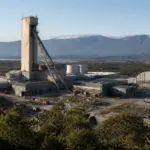
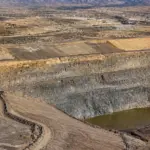
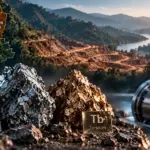
Exploration drilling in the remote Sarfartoq region of southwest Greenland.

By Charles Pitts
Greenland Mines has completed its acquisition of the Sarfartoq neodymium-praseodymium rare earths project in southwest Greenland, adding an advanced magnet-materials asset to its portfolio as governments and manufacturers seek to diversify supply chains beyond China.
The transaction, valued at US$35 million, closed after the Government of Greenland approved the indirect transfer of the mineral exploration licence covering the Sarfartoq Carbonatite Complex. The deal includes US$20 million in cash and US$15 million in Greenland Mines shares, according to disclosures from Greenland Mines and Neo Performance Materials.
Neo, which previously owned the project through subsidiaries, will remain connected to Sarfartoq as a shareholder and offtake partner. Its rights cover up to 60% of future ore or mineral concentrate production, subject to the terms of the transaction and a definitive offtake agreement.
More Read
The closing was confirmed by Neo Performance Materials in a Sept. 2 announcement. Greenland Mines had previously said it expected to complete the acquisition by the start of September.

Acquisition transfers Sarfartoq licence to Greenland Mines
The transaction involved the transfer of Neo North Star Resources and related holding entities to Greenland Mines. The acquired group holds Mineral Exploration Licence MEL 2020-32, which covers the Sarfartoq Carbonatite Complex.
Greenland’s Ministry of Business and Mineral Resources approved the indirect transfer under Section 69(1) of the Greenland Mineral Activities Act. That approval was a key condition for closing the deal.
More Read
| Transaction detail | Reported terms |
|---|---|
| Acquirer | Greenland Mines Ltd. |
| Acquired asset | Sarfartoq Nd-Pr Rare Earths Project |
| Location | Southwest Greenland |
| Consideration | US$35 million |
| Cash component | US$20 million |
| Share component | US$15 million |
| Offtake rights | Up to 60% of future ore or concentrate |
| Regulatory milestone | Approval under Section 69(1) |
| Next development stage | Pre-feasibility study work |
The approval allows Greenland Mines to take control of the exploration programme, but it does not authorize mine construction or commercial production. The project remains subject to further technical, environmental, social and permitting work.
Sarfartoq is located approximately 60 kilometres from Kangerlussuaq and about 20 kilometres from tidewater, according to project information cited by the company. Greenland Mines has also pointed to nearby power potential and existing exploration infrastructure as factors that could support future development.
Nd-Pr focus targets permanent magnet supply
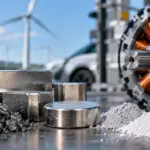
The project’s strategic value is tied to its concentration of neodymium and praseodymium, commonly referred to as NdPr. These elements are the principal magnetic components in high-strength NdFeB permanent magnets.
Those magnets are used in:
- Electric vehicle traction motors
- Wind turbine generators
- Industrial robotics
- High-efficiency electric motors
- Aerospace and defense systems
- Guidance, actuation and other specialized equipment
Sarfartoq’s ST1 deposit is a carbonatite-hosted rare earths system. Greenland Mines and previous project owners have reported that NdPr accounts for approximately 25% to 40% of total rare earth oxides across parts of the deposit.
That product mix is significant because many rare earth projects contain a broad basket of elements but have limited exposure to the magnet materials most sought by manufacturers. A high NdPr proportion can improve the relevance of a deposit to downstream magnet supply, although economic outcomes still depend on recovery rates, concentrate quality, processing costs and long-term offtake terms.

Drill-core evaluation will support resource modelling and future metallurgical work.
Project carries a substantial exploration database
Greenland Mines is acquiring a project with a large body of historical technical work. Previous exploration included more than 23,000 metres of drilling, while broader company disclosures have referenced a database of more than 35,000 metres.
The most advanced target is the ST1 zone. The nearby ST40 area has also been identified as a priority for further drilling and geological investigation because of indications of elevated NdPr concentrations.
An independent Initial Assessment cited in project disclosures outlines a combined indicated and inferred resource of approximately:
- 6.9 million tonnes grading 1.60% total rare earth oxides in the indicated category
- 5.3 million tonnes grading 0.96% total rare earth oxides in the inferred category
The assessment considered a hybrid open-pit and underground mining concept. It also referenced approximately 40,700 tonnes of contained NdPr oxide across the combined resource categories.
Those figures are not mineral reserves. Indicated and inferred resources have not demonstrated that they can be economically mined, and the estimates remain subject to additional drilling, engineering, metallurgical testing and permitting.
Greenland Mines has said the next phase of work will include targeted infill drilling, pilot-scale metallurgical testing, mine engineering and environmental and social baseline studies. Drone-based magnetic surveys are also planned to improve geological understanding across the broader licence area.
Neo retains a role in downstream processing
The transaction gives Neo Performance Materials a continuing commercial interest in Sarfartoq. Neo operates across rare earth chemicals, oxides, metals, alloys, magnetic powders and permanent magnets, with manufacturing and processing facilities in several countries.
Its Silmet facility in Estonia is a rare earth separation and processing operation. The proposed offtake structure could eventually connect Sarfartoq concentrate with European downstream processing, although the project must first establish a viable mine and processing route.
Neo President and Chief Executive Officer Rahim Suleman said the company remained invested in Sarfartoq’s success as both a shareholder and offtake partner, while focusing its capital on midstream and downstream growth.
For Greenland Mines, the relationship offers a potential route into a wider rare earth supply chain. For Neo, it preserves exposure to future feedstock without retaining sole responsibility for advancing the mine project.
That structure reflects a broader change in the rare earths sector. Governments and industrial companies are increasingly looking for integrated supply chains that connect mining, concentration, separation and magnet manufacturing. New deposits alone do not resolve supply risk if they lack processing capacity or reliable customers.
Skillings has examined this issue in its coverage of the critical minerals supply chain and the gap between rare earth oxides and finished magnets.
Greenland project gains geopolitical relevance
The Sarfartoq acquisition comes as export controls, industrial policy and defense planning have pushed rare earths higher on the strategic agenda.
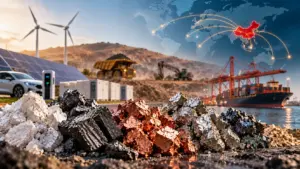
China remains dominant across major parts of the rare earth value chain, particularly separation, refining and permanent magnet manufacturing. That concentration has encouraged the United States, Europe and allied governments to seek alternative sources of magnet materials.
Greenland’s location gives Sarfartoq relevance within that diversification effort. The project sits in the North Atlantic, between North American and European markets, and is located within the Kingdom of Denmark. Its potential supply routes and proximity to European processing facilities could make the asset strategically interesting if technical and permitting work supports development.
That geopolitical positioning does not remove the practical challenges of building a mine in the Arctic. Seasonal weather, logistics, energy supply, workforce requirements, environmental baseline work and community engagement will all influence the development timetable and capital requirements.

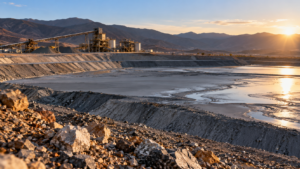
Remote terrain and logistics will remain central to Sarfartoq’s development planning.
Next test is conversion from exploration to development
With the acquisition complete, Greenland Mines’ immediate task is to convert Sarfartoq’s existing technical database into an updated development plan.
That process is expected to include:
- Infill drilling to improve confidence in the resource model.
- Metallurgical testing to assess concentrate quality and rare earth recoveries.
- Mine engineering for the proposed open-pit and underground scenario.
- Environmental and social studies to support future permitting.
- Infrastructure assessment covering access, power, water and shipping.
- Pre-feasibility work to test capital costs, operating assumptions and project economics.
Earlier test work cited by the company indicated that ST1 could produce a flotation concentrate grading approximately 8.25% total rare earth oxides, with a design recovery of about 63.6%. Those results will need to be confirmed and expanded through additional pilot-scale work.
Greenland Mines has also cited an Initial Assessment with a high-case pre-tax net present value of approximately US$2.05 billion and a pre-tax internal rate of return of 118.6%. The figures are based on mineral resources rather than reserves and should not be treated as a definitive project valuation.

Downstream separation capacity will be critical to any future Sarfartoq supply chain.
The completion of the US$35 million transaction gives Greenland Mines control of a strategically positioned NdPr project and provides Neo with continuing exposure to potential future production. The more important milestones will now be technical: resource validation, metallurgical performance, infrastructure design and the ability to secure the approvals required for development.
Sarfartoq is therefore closer to becoming a potential Western rare earths supplier, but it remains an exploration and development project rather than an operating mine. Its significance will ultimately depend on whether its geological potential can be converted into a permitted, financeable and internationally integrated source of magnet materials.