By Charles Pitts

China’s rare-earth export controls are allowing some licensed shipments to continue, but the latest trade flows show how dependent global manufacturers remain on processing capacity concentrated inside the country.
China exported 29 tonnes of yttrium oxide to the United States in the latest month covered by a Reuters report, the second-highest monthly volume since Beijing introduced its latest controls. The shipment demonstrates that the measures are not an outright ban on all rare-earth exports. They are, instead, a licensing system that gives Chinese authorities greater control over the timing, destination and end use of strategically important materials.
That distinction matters for automakers, defense contractors, electronics manufacturers and mining companies developing projects outside China. The principal vulnerability is not simply access to ore. It is the limited availability of commercial separation, refining, metallization, alloying and magnet-production capacity outside China.
China still dominates the midstream
The International Energy Agency says China accounted for 91% of global refined rare-earth output in 2024 and 94% of global sintered permanent-magnet production. China’s share of mined magnet rare earths was lower, at approximately 60%.
More Read

The figures show why new mines alone cannot quickly diversify the supply chain. Rare-earth concentrate must be separated into individual oxides, converted into metals and alloys, and then incorporated into permanent magnets or other advanced materials. Each step requires specialized facilities, technical expertise, qualified customers and environmental permits.

The IEA’s rare-earth elements analysis generally reports production shares rather than a single global measure of installed processing capacity. Industry commentary often describes the 91% refined-output figure as China’s share of processing capacity, but the distinction is important: output reflects what plants are producing, while capacity measures what they could produce under suitable operating conditions.
| Supply-chain stage | China’s reported position | Why it matters |
|---|---|---|
| Mined magnet rare earths | About 60% of global output in 2024 | Mining is geographically more diversified than processing |
| Refined rare-earth output | 91% in 2024, according to the IEA | Separation and refining remain the main midstream bottleneck |
| Sintered permanent magnets | 94% of global production | Manufacturers remain exposed even when non-Chinese ore is available |
| Heavy rare-earth processing | Near-total concentration, according to CSIS | Dysprosium and terbium are difficult to replace in high-performance magnets |
The Center for Strategic and International Studies has described heavy rare-earth processing as an especially acute weakness. It cited China’s control of approximately 99% of global heavy rare-earth processing as of 2023, while noting that light rare earths are processed by a broader group of countries.
More Read
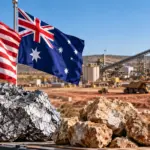

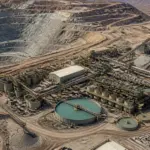
Rare-earth oxide processing depends on specialized separation, filtration and material-handling systems.
The controls are layered, not uniform
China’s current regime rests on several measures introduced at different points.
On April 4, 2025, China’s Ministry of Commerce and General Administration of Customs issued Announcement No. 18. The announcement placed export controls on selected medium and heavy rare-earth materials linked to:
- Samarium
- Gadolinium
- Terbium
- Dysprosium
- Lutetium
- Scandium
- Yttrium
The controlled products include metals, oxides, compounds, alloys, targets and certain permanent-magnet materials. Exporters must apply for licenses and identify controlled goods during customs declarations.
Those April measures remain in force. That means a company may still face licensing requirements even when broader restrictions introduced later are suspended.
China announced a second, wider package in October 2025. According to an European Parliament briefing and legal analyses of the measures, the package expanded controls to additional rare-earth elements, processing technologies, equipment and foreign-made products containing Chinese-origin rare earths.
The package also included an extraterritorial provision often described as a “0.1% rule.” In broad terms, foreign-made products containing at least 0.1% by value of specified Chinese-origin rare-earth materials, or made using certain Chinese rare-earth technologies, could require Chinese authorization.
Beijing later suspended implementation of the broader October measures until Nov. 10, 2026, following a U.S.-China trade agreement. The suspension does not cancel the underlying rules. Nor does it remove the April licensing system.
November 10 should therefore be treated as the end of a suspension period, not as an automatic new embargo. China could extend, revise or replace the suspension before that date. If it does not, the wider controls could return under the existing legal framework.
Licensed shipments still carry strategic information
The continued movement of yttrium oxide to the United States illustrates how the licensing system works in practice.
A shipment can proceed when Chinese authorities approve the transaction, but the process introduces uncertainty for buyers that previously relied on regular supply arrangements. Lead times, documentation requirements, end-user checks and the risk of delayed approval all become part of procurement planning.
The effect is particularly significant for companies that have no qualified alternative source of separated oxides or magnet-grade materials. A manufacturer may be able to source concentrate from Australia, Brazil or the United States, but that material still requires chemical separation and downstream conversion before it can enter a motor, turbine, radar system or electronics component.
This is why export controls on processing technology and equipment may be as important as controls on the materials themselves. China’s 2023 restrictions on exports of certain rare-earth processing and separation technologies already limited access to technical know-how. The October 2025 package went further by identifying equipment used in separation, metal production and magnet manufacturing.
For companies building new facilities, the practical question is not only whether feedstock is available. It is whether the project can secure equipment, engineers, operating procedures, water, energy, waste-management systems and customer qualification without relying on restricted Chinese inputs.
The United States is expanding capacity, but the gap remains
The United States has increased investment in rare-earth separation and magnet production, but much of the new capacity remains under construction, in commissioning or at the expansion stage.
MP Materials is developing an integrated mine-to-magnet platform around its Mountain Pass operation in California and magnet facilities in Texas. Lynas Rare Earths is advancing separation capacity in the United States, while Energy Fuels has expanded its rare-earth strategy through the acquisition of Australian Strategic Materials.
As Skillings reported, the Energy Fuels transaction adds ASM’s Korean Metals Plant, which produces rare-earth metals and NdFeB alloy. The plant has approximately 1,300 tonnes per year of installed NdFeB alloy capacity and is being expanded toward 3,600 tonnes per year.
That capacity is strategically relevant because alloy production sits between separated oxides and finished magnets. It does not, however, remove the need to build additional separation, metal, alloy and magnet capacity across the wider market.
The U.S. Department of Defense has set a goal of developing a domestic mine-to-magnet supply chain. CSIS said the department had awarded more than $439 million since 2020 to projects involving rare-earth separation, processing and magnet production.
Even if announced projects are completed, the non-Chinese supply chain will need time to qualify products with automakers, defense contractors and industrial manufacturers. A plant that is mechanically complete may still require months or years of process optimization and customer approvals before reaching full commercial output.

Rare-earth metallization and alloying are essential steps between oxide production and finished magnets.
Europe faces a similar midstream problem
Europe has pursued domestic mining, recycling and processing projects under its critical-minerals strategy, but remains heavily dependent on imported refined materials and magnets.
The European Parliament has estimated that China accounts for roughly 75% of global rare-earth mining and about 85% of processing, with its position even stronger for some heavy rare earths. Other estimates vary because they measure different stages of the chain, but they point to the same conclusion: Europe’s exposure is greatest after the mine gate.
This leaves European manufacturers vulnerable to both direct export restrictions and competition for licensed material. If the broader Chinese measures return in November, companies using Chinese-origin inputs or Chinese processing technology could face additional compliance requirements even when final manufacturing occurs elsewhere.
Recycling can reduce some primary supply pressure, but it cannot immediately replace large-scale separation capacity. Industrial recycling systems must collect suitable material, recover individual elements at commercial yields and produce specifications acceptable to magnet and component manufacturers.
What operators and policymakers are watching
The next phase of the rare-earth supply chain will be measured less by the number of announced mines than by progress at the midstream and downstream stages.
Key indicators include:
- The status of China’s suspension after Nov. 10, 2026. Any extension, modification or reactivation could change procurement and compliance planning.
- Non-Chinese separation output. Projects must move from pilot production to consistent commercial volumes.
- Heavy rare-earth capability. Dysprosium and terbium remain particularly important for high-temperature magnet applications.
- Metal and alloy production. Oxide supply is not sufficient without metallization and alloying capacity.
- Customer qualification. New material must meet technical, traceability and performance requirements before manufacturers can switch suppliers.
- Processing technology access. Restrictions on equipment, technical assistance and intellectual property may slow project construction even where financing is available.
The latest yttrium shipment to the United States shows that China’s controls can permit trade while still increasing uncertainty. For the global mining industry, the more durable issue is structural: China continues to control the processing and magnet stages that convert rare-earth geology into industrial products.
Until that midstream gap narrows, export licensing decisions in Beijing will remain a central variable for the critical-minerals, energy-transition and advanced-manufacturing sectors.
Sources: International Energy Agency; China Ministry of Commerce Announcement No. 18; Reuters; CSIS; European Parliament.