By Charles Pitts
The global rare earths supply chain in 2026 has reached a definitive crossroads. After decades of undisputed Chinese dominance, the narrative has shifted from theoretical “de-risking” to the operational reality of Western vertical integration. While China continues to control the lion’s share of global production, the emergence of a viable, Western-led alternative is no longer a distant prospect: it is currently being commissioned across North America and Australia.
For operators, investors, and policymakers, the central question is no longer whether the West can mine rare earths, but whether it can process them and manufacture the high-performance magnets essential for the energy transition and national defense. As we enter the second half of the decade, the rare earths supply chain 2026 landscape is defined by a fierce race for midstream autonomy.
The Chinese Fortress: Why Volume Still Dictates Reality
Despite the surge in Western projects, China’s grip on the sector remains formidable. As of mid-2026, China still accounts for approximately 65-70% of global mining output and a staggering 85-90% of complex separation and refining capacity. More importantly, Beijing retains over 90% of the world’s production of neodymium-iron-boron (NdFeB) magnets.
More Read

China’s strategy has evolved from simple export quotas to sophisticated critical minerals strategies that prioritize domestic value-added manufacturing. By consolidating its state-owned enterprises into behemoths like the China Rare Earth Group, Beijing has effectively managed global price volatility to its advantage, occasionally flooding markets to suppress the economics of nascent Western competitors.

However, the “monopoly” is showing hairline fractures. Export controls on processing technology and gallium/germanium implemented in previous years have accelerated Western resolve to decouple. The result is a bifurcated market: a high-volume, low-cost Chinese chain and a strategic, policy-insulated Western chain.
MP Materials: The American Vertical Integration
MP Materials (NYSE: MP) has emerged as the primary challenger to the traditional supply model. Operating the Mountain Pass mine in California: one of the world’s premier light rare earth deposits: the company has successfully transitioned from a concentrate exporter to a fully integrated producer.
More Read

In 2026, MP Materials is proving that vertical integration is the only viable path for Western firms to survive Chinese price swings. The company’s “Phase 2” separation facility is now producing separated neodymium-praseodymium (NdPr) oxide at scale, eliminating the need to ship concentrate to China for refining.
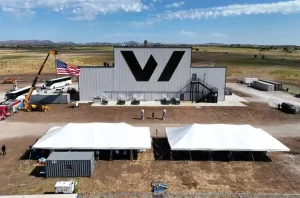
Perhaps most significant is the “Phase 3” capstone: the Fort Worth, Texas, magnetics facility. This plant represents the first large-scale, domestic “mine-to-magnet” supply chain in the United States. With an initial target of 1,000 tonnes of NdFeB magnets per year, MP is providing a strategic backstop for the U.S. Department of Defense (DoD) and major automotive OEMs.
Key 2026 Data Points for MP Materials:
- Production: Targeting ~6,000 tonnes of NdPr oxide annually.
- Integration: Successful commissioning of the Fort Worth magnet plant.
- Policy Support: Utilization of a $110/kg price floor for NdPr through DoD-backed contracts, providing a critical buffer against market manipulation.

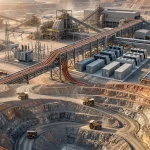
The Mountain Pass mine in California serves as the foundational asset for the U.S. rare earth independence strategy.
Lynas Rare Earths: The Global Midstream Workhorse
While MP Materials focuses on the American market, Australia-based Lynas Rare Earths (ASX: LYC) remains the largest non-Chinese producer of separated rare earth oxides globally. For investors looking at critical minerals stocks to buy 2026, Lynas offers a different profile: a diversified, midstream-heavy operation with a global footprint.
Lynas has successfully navigated the regulatory complexities of its Malaysian refinery while aggressively expanding its domestic Australian footprint. The Kalgoorlie Rare Earths Processing Facility is now fully operational, handling the “cracking and leaching” of ore from the world-class Mt Weld deposit.
Furthermore, Lynas’s collaboration with the U.S. DoD has resulted in a heavy rare earths (HRE) separation plant in Texas. This facility is crucial because it addresses the “HRE Gap”: the West’s historical reliance on China for dysprosium and terbium, which are essential for high-temperature magnet performance.
Breaking the Processing Bottleneck: New Western Facilities
The real battle of 2026 isn’t happening in the pits; it’s happening in the labs and separation halls. Historically, the “processing bottleneck” was the primary barrier to entry due to the chemical complexity and environmental challenges of separating 17 nearly identical elements.
Several new facilities have changed the math in 2026:
- Saskatchewan Research Council (SRC) Rare Earth Processing Facility: Canada’s first commercial-scale plant has begun providing third-party separation services, helping junior miners avoid the massive capex of building their own refineries.
- Iluka Resources (Eneabba): The Australian mineral sands giant has moved into full-scale rare earth refining, leveraging its existing stockpiles to create a major new source of NdPr.
- Solvay (La Rochelle): In Europe, Solvay has expanded its French facility to produce separated oxides, supporting the EU’s drive for material sovereignty.

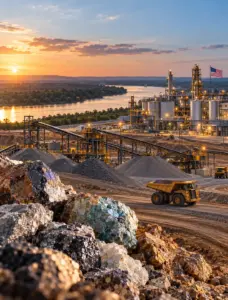
Advanced chemical separation is the technical hurdle that Western facilities are now overcoming at commercial scale.
M&A and Policy: The 2026 Deal Landscape
The year has seen a significant uptick in mining M&A deals 2026, driven by the need for scale and technical expertise. We have seen major diversified miners: traditionally wary of the niche rare earths space: beginning to take equity stakes in advanced-stage projects.
Government intervention has become the “new normal.” The U.S. Department of Energy and Department of Defense are no longer just providing grants; they are taking equity positions and establishing price-support mechanisms. This mirrors the lithium refining strategy in Australia, where the state is actively de-risking the midstream to ensure downstream industrial health.
| Asset/Company | Region | 2026 Status | Key Strategic Value |
|---|---|---|---|
| Mountain Pass | USA | Fully Integrated | Mine-to-Magnet capability |
| Mt Weld / Kalgoorlie | Australia | Separation Hub | High-volume NdPr production |
| Eneabba | Australia | Refined Oxide | New refinery for third-party ore |
| Nolans Project | Australia | Construction/Final Prep | Vertical integration in the NT |
The 2026 Outlook: A Bifurcated Supply Chain
Can the West break the Chinese monopoly? The answer is nuanced. In terms of sheer volume, China will likely remain the global leader for the foreseeable future. However, if the goal is “strategic autonomy,” the West has already achieved a significant victory.
By the end of 2026, the global market has split into two distinct tiers:
- The Commodity Tier: Dominated by China, providing high-volume material for general electronics and lower-end EVs.
- The Strategic Tier: Anchored by MP Materials, Lynas, and new Western refiners, providing “clean,” policy-compliant material for Western defense, aerospace, and premium automotive sectors.
Investors should note that while 2026 lithium forecasts suggest oversupply, the rare earths market remains tightly balanced due to the high barrier to entry for separation technology. The monopoly isn’t broken in the sense of China being irrelevant; it is broken in the sense that it is no longer the only option.

The final stage of the supply chain: manufacturing high-performance magnets for EV motors and wind turbines.
Conclusion
The rare earths supply chain in 2026 is no longer a tale of potential; it is a tale of production. The commissioning of midstream facilities in Texas, Australia, and Canada has fundamentally altered the geopolitical chessboard. While China’s scale provides it with enduring pricing power, the establishment of an independent Western “mine-to-magnet” ecosystem ensures that the global energy transition is no longer beholden to a single source of supply.