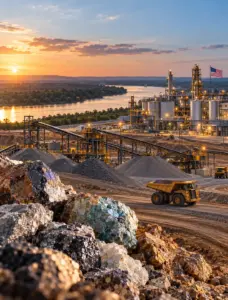
The United States likes to talk about energy independence while holding a begging bowl for the very minerals required to achieve it. It’s a glaring contradiction. We want the electric vehicles, the high-tech defense systems, and the modernized grid, but the domestic supply chain has been stuck in a decade-long regulatory purgatory.

Until yesterday.
On March 16, 2026, the deadlock finally broke. The U.S. Forest Service and Resolution Copper: the heavyweight joint venture between Rio Tinto and BHP: officially completed a historic land exchange. This isn’t just another administrative checkbox. It is the single most significant development for the U.S. copper industry in a generation.
By clearing this final hurdle, the project is positioned to eventually supply up to 25% of total U.S. copper demand. That is not a rounding error. That is a strategic pivot.
The Swap: 5,400 Acres for the Future of Tech
The mechanics of the deal are straightforward, even if the politics were anything but. Under the terms of the exchange: a process initiated over ten years ago and authorized by a 2014 defense rider: Resolution Copper has transferred approximately 5,400 acres of environmentally sensitive and culturally significant land into federal protection.
More Read

In return, the company takes ownership of roughly 2,400 acres near the Magma Mine in Arizona. This includes the controversial Oak Flat area.

The strategic calculus here isn’t subtle: the U.S. government is trading peripheral conservation land for the keys to one of the largest undeveloped copper deposits on the planet. For an administration obsessed with the “Green Revolution,” this was the only logical endgame. You cannot build a decarbonized economy on good intentions. You build it on red metal.

More Read
Why the 25% Number Changes Everything
Let’s look at the brutal numbers.
The U.S. currently relies heavily on imports for its copper needs, competing on the global market with a rampant Chinese industrial complex. Resolution Copper has the potential to produce enough copper to meet a quarter of the entire nation’s demand for several decades.
Electrification. Digitization. Automation. These three pillars of the 2026 economy all run on copper.
An average electric vehicle requires nearly four times as much copper as a traditional internal combustion engine. The massive data centers powering the “shiny AI revolution” are essentially giant boxes of copper and silicon. Without Resolution, the U.S. was looking at a permanent, structural deficit.
Now, the floor has shifted. This project provides a domestic buffer against the volatility of international markets. It’s the difference between being a price-taker and a price-maker. As we’ve noted in our analysis of Skillings Mining Intelligence – The Critical Minerals Corridor, the frontier of U.S. mineral security is moving back home.
$500 Million: Rio Tinto and BHP Stop Waiting
Mining companies don’t like uncertainty. They loathe it. For years, Rio Tinto and BHP have been “slow-walking” infrastructure because the legal ground was shifting beneath them.
That ended with the March 13 federal appeals court decision that paved the way for this week’s transfer. Rio Tinto has already announced an immediate $500 million investment over the next 24 months.
This capital isn’t for “exploration” in the traditional sense; they know what’s down there. This is for enabling works, infrastructure, and the massive underground cooling systems required for a mine that will reach depths of 7,000 feet. The project will utilize block-cave mining: a high-tech, large-scale method that allows for the extraction of deep ore bodies that would be inaccessible via traditional open-pit methods.
It’s expensive. It’s technically demanding. And it’s exactly the kind of project that Rio Tinto’s $8.6 billion lithium acquisition suggested they were hungry for: Tier-1 assets in stable jurisdictions.

The Friction: Cultural Costs and Tribal Opposition
We have to talk about the discomfort.
Despite the court rulings, the San Carlos Apache Tribe and several conservation groups remain in staunch opposition. To the Tribe, Oak Flat is not a “mineral deposit.” It is a sacred site. The block-cave mining method, while efficient, will eventually cause the surface to subside, creating a crater that will fundamentally alter the landscape.
The litigation has been exhaustive. The courts have spoken, but the social license to operate remains a complex needle to thread. This project serves as the ultimate case study in the “Green Dilemma”: the minerals required to save the planet often sit directly beneath the lands most valued by the people living on it.
The industry likes to use words like “consultation” and “engagement.” The reality is more grit than grace. It’s a push-pull dynamic that won’t end just because the land title changed hands.
Geopolitical Realities: Escaping the Stranglehold
If you think this is just about Arizona, you aren’t paying attention.
The global supply chain for critical minerals is currently a chokehold. We’ve seen what happens when export controls are weaponized, as with gallium and germanium over the last 12 months. Copper is the next logical target.
By securing a domestic source that accounts for 25% of demand, the U.S. is de-risking its entire tech sector. This is as much a defense story as it is a mining story. It aligns with the broader trend of consolidating control over critical assets to ensure that the American military-industrial complex isn’t dependent on a rival’s permission to operate.

The 2026 Outlook: What Happens Next?
The land transfer is done, but the clock is just starting.
The next two years will see a flurry of activity in Superior, Arizona. We’re talking about 100 immediate new jobs and a total of several thousand during peak construction. The economic ripple effect for the region is estimated at $1 billion annually.
For investors and operators, the takeaway is clear: the era of “permitting paralysis” for Tier-1 U.S. projects might finally be thawing. It took a decade of legal warfare, but the precedent is now set.
The Strategic Bottom Line:
- Capacity: 25% of U.S. copper demand.
- Timeline: $500M spend over 2026-2027.
- Method: Advanced block-caving.
- Risk: Ongoing tribal appeals and environmental monitoring.
You can’t disrupt geology. You can’t code your way out of a mineral shortage. At some point, you have to dig. Resolution Copper is the clearest sign yet that the U.S. is finally ready to do the heavy lifting required for its own future.
The strategic floor for copper just got a lot more solid.