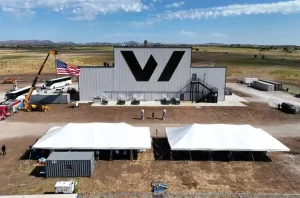
The United States hasn’t seen a new greenfield copper production site come online since 2008. Think about that for a second. For nearly two decades: through the rise of the smartphone, the EV revolution, and the birth of generative AI: the domestic copper industry has been essentially running on treadmill mode, trying to keep old assets from falling apart.

That drought officially ended on March 2, 2026.
Taseko Mines just harvested its first copper cathodes at the Florence Copper facility in Arizona. This isn’t just a “business as usual” update; it is a tactical pivot for the American supply chain. By utilizing Metso’s specialized solvent extraction and electrowinning (SX-EW) technology and a unique In-Situ Copper Recovery (ISCR) process, Taseko has managed to do what most mining majors have failed to do for 18 years: build something new on American soil.
The 18-Year Wait is Over
The mining industry is full of projects that look great on a PowerPoint slide but die in the permitting phase or the financing stage. For Florence Copper to reach the cathode-harvesting stage is a minor miracle of persistence. This marks the first new greenfield copper production in the U.S. since the Great Financial Crisis.
Per facility. That’s not a typo.
More Read

While the world was busy arguing over energy transitions, the actual hardware required to power those transitions: copper: was becoming increasingly scarce. We’ve seen a structural deficit looming for years, and Florence is one of the few projects actually delivering metal to the market when it’s needed most.

The facility isn’t just a mine; it’s a technological statement. Instead of traditional open-pit digging, which involves massive trucks and even more massive carbon footprints, Florence uses ISCR. It’s cleaner, it’s quieter, and it’s significantly harder to pull off from an engineering standpoint.

More Read

Metso Tech: The Engine Under the Hood
You can’t talk about the success at Florence Copper without talking about the hardware. Taseko integrated Metso’s SX-EW technology to handle the heavy lifting of turning pregnant leach solution (PLS) into 99.9% pure copper cathode.
The SX-EW process is the heart of the operation. Metso’s technology allows for high-efficiency recovery even at the commercial scales Taseko is targeting. We are looking at a nameplate capacity of 85 million pounds of LME Grade A copper cathode annually.
Here is the strategic calculus:
- Capacity: 85M lbs/year.
- Life-of-Mine: At least 22 years.
- Domestic Impact: A roughly 5% increase in total U.S. refined copper production.
That 5% might not sound like much to a layman, but in an industry where supply is measured in razor-thin margins, it’s a massive injection. And every single pound of that copper is staying in the U.S. It’s headed straight for the automotive, aerospace, and AI data center sectors that are currently starving for domestic supply.
The ISCR Advantage: Why it Matters for Permitting
Let’s be honest: building a traditional mine in the U.S. in 2026 is an exercise in pain. The regulatory hurdles are legendary. Taseko bypassed many of the typical “anti-mining” sentiments by opting for In-Situ Copper Recovery.

ISCR works by injecting a low-pH solution into the ore body, dissolving the copper in place, and pumping it back to the surface. No blasting. No massive waste rock piles. No tailings dams that keep environmentalists awake at night. This “invisible” mining is likely the only way we see future greenfield projects in the lower 48 states.
It’s low-cost, low-impact, and high-efficiency. For Taseko, the operating costs are expected to be in the bottom quartile of the global cost curve. In a world where water scarcity is strangling Andean mines, a closed-loop system in Arizona is a strategic masterstroke.
The Geopolitical Context: 2026 and Beyond
We are living through a period of intense resource nationalism. China has been tightening its grip on critical minerals for years, and the U.S. is finally waking up to the reality that you can’t have a “Green Revolution” without the “Red Metal.”
Florence Copper makes Taseko the third-largest copper cathode producer in the United States. That’s a significant move up the leaderboard. It places Taseko in a position of strength as the Department of Defense and the Department of Energy look for “trusted” sources of material. We’ve seen the U.S. government inject millions into projects like U.S. Antimony to break foreign grips; while Florence hasn’t relied on the same level of direct subsidies, its success is a win for the same strategic goals.

Production Timeline and Risks
While the first cathode is a victory, the ramp-up to 85 million pounds is where the real work begins. Start-up of the electrowinning plant began in late February, and we are now seeing the first fruits. However, investors and operators should keep a close eye on the following:
- Scale-up Flux: Moving from a production test facility to full commercial scale is where technical gremlins usually hide.
- Copper Price Volatility: While the 2026 forecast remains bullish, any sudden macroeconomic downturn could squeeze margins during the capital-intensive ramp-up phase.
- Labor Scarcity: As we’ve noted in other sectors, finding skilled mining engineers and technicians in a tight labor market remains a persistent headache.
A Stark Assessment of the Copper Gap
The reality is grim: Florence Copper is a win, but it’s not a cure. Global demand is expected to double by 2035. Even with projects like Florence coming online, the industry is still fighting a losing battle against depletion in older mines.
Taseko’s achievement shows that it is possible to permit and build in the U.S., provided you have the right technology and enough patience to wait 18 years. But the fact that it took nearly two decades to get a single greenfield project to the finish line should be a wake-up call to policymakers.
Florence Copper is the outlier, not the norm. That’s a problem.

The first harvest of copper cathode in Arizona is a signal that the U.S. is finally back in the game. With Metso’s SX-EW technology providing the technical backbone and Taseko’s ISCR method providing the environmental path forward, Florence Copper stands as the blueprint for domestic resource independence.
But here’s the kicker: we need ten more of these. And we need them yesterday.