By Penny Laneford

The global energy landscape in March 2026 is no longer defined by the speculative promises of the early 2020s, but by the pouring of concrete and the signing of multi-decade procurement contracts. What market analysts are now calling “Uranium’s Third Wave” has officially broken, driven by the commercial maturation of Small Modular Reactors (SMRs) and a radical shift in how power utilities secure their fuel.
As of early 2026, the traditional spot market for uranium: once the primary barometer of industry health: has taken a backseat to a more structured, vertically integrated model. This shift was catalyzed by the landmark agreement between Microsoft and Constellation Energy to restart Three Mile Island Unit 1, but it has since evolved into a standard operating procedure for the “Big Tech” data center boom and heavy industrial mining operations.
For the mining industry, the implications are profound. We are witnessing the end of the “mine-and-sell” era and the beginning of the “direct-to-utility” partnership model.
The Microsoft-Constellation Paradigm: A New Blueprint
The 2024 deal between Microsoft and Constellation Energy served as the starting gun for 2026’s market reality. By securing the entire output of a nuclear plant for 20 years to power its AI infrastructure, Microsoft didn’t just buy electricity; it essentially de-risked the entire fuel supply chain for the utility.
More Read

In 2026, this “Direct-to-Utility” model has expanded to the SMR space. Tech giants like Google, Amazon, and Meta are now entering three-way partnerships with SMR developers and uranium miners. These “tripartite fuel-and-power agreements” ensure that the miner has a guaranteed floor price for their U3O8, the SMR operator has a secured supply of HALEU (High-Assay Low-Enriched Uranium), and the tech company receives carbon-free, 24/7 baseload power.

This vertical integration is a direct response to the supply volatility of 2024 and 2025. By bypassing the traditional market intermediaries, these stakeholders are insulating themselves from the geopolitical shocks that previously rocked the uranium sector.

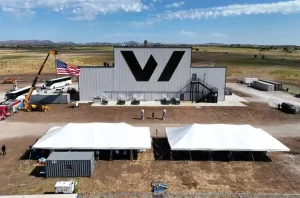
Figure 1: Realistic aerial view of an SMR facility under construction in 2026, showing the modular containment structures and integrated cooling systems.
More Read

SMR Deployment Status 2026: From Blueprint to Bedrock
As we move through the first quarter of 2026, SMR deployment has moved into the critical construction phase in several key jurisdictions.
- Wyoming, USA: TerraPower’s Natrium reactor project has broken ground on its non-nuclear components, serving as a beacon for domestic fuel demand.
- Ontario, Canada: OPG’s Darlington site is seeing the first fleet-scale deployment of GE Hitachi’s BWRX-300, a move that has tightened the Canadian uranium supply-demand balance.
- Industrial Mining Sites: Remote mining operations are increasingly looking at SMRs to replace diesel generation. As noted in our previous analysis of the nuclear renaissance and mining’s next power play, the ability to deploy modular power at the source of mineral extraction is a game-changer for ESG metrics and operational costs.
The demand is not just for standard enriched uranium. The 2026 SMR fleet heavily relies on HALEU, which contains between 5% and 20% Uranium-235. This specialized requirement has created a “market within a market,” where premiums for HALEU-ready feedstock are significantly outperforming standard U3O8 prices.
The Death of the Spot Market?
The most striking trend in 2026 is the atrophy of the uranium spot market. Large-scale utilities and SMR operators are no longer willing to gamble on the secondary market. According to recent trade data, long-term contracting volume has reached levels not seen since the mid-2000s.
Miners are now prioritizing “off-take or bust” strategies. For junior miners, the path to financing now requires a direct link to a utility or an SMR developer. This has led to a wave of consolidation. Major producers are acquiring junior projects not just for their pounds in the ground, but to secure the long-term contracts already attached to them.

The HALEU Hurdle and Supply Chain Security
Despite the optimism, the “Third Wave” faces a bottleneck: enrichment. Until recently, the global supply of HALEU was uncomfortably dependent on Russian sources. In 2026, the push for Western enrichment sovereignty has reached a fever pitch.
The U.S. Department of Energy and private entities like Centrus and Urenco have accelerated domestic enrichment capabilities. However, the ramp-up time for these facilities remains a primary risk factor for the 2027–2030 SMR rollout window. This has made “provenance” a primary value driver. Uranium mined in “Tier 1” jurisdictions: specifically Canada, Australia, and the U.S.: now carries a “security premium” over material sourced from more volatile regions.
This focus on secure supply chains is also reflected in the broader mining sector, where ESG and social licensing are now inextricably linked to national security funding.
Geopolitics and the “Uranium Curtain”
The 2026 market is bifurcated. On one side is the Western-aligned SMR ecosystem, characterized by transparent, long-term direct deals and a focus on HALEU development. On the other is the Russo-Chinese nuclear export model, which continues to dominate the “Belt and Road” jurisdictions.
This “Uranium Curtain” has forced miners to choose sides. Canadian and Australian majors have almost entirely decoupled from Eastern enrichment hubs, focusing instead on the burgeoning demand from the U.S. and EU SMR programs. This decoupling is a key driver behind the price floors we are seeing today; the cost of “secure” uranium is fundamentally higher than the cost of “global” uranium.

2026 Outlook: Drivers, Risks, and the Investor Case
As we look toward the remainder of 2026, the uranium market is characterized by three distinct scenarios:
The Bull Case: The “SMR Acceleration”
In this scenario, the first wave of SMRs in North America and Europe meets all construction milestones. Public sentiment continues to shift in favor of nuclear as the only viable path to Net Zero. Direct-to-utility deals become the default, driving uranium prices toward new historic highs as utilities scramble to cover a 20-year fuel horizon.
The Base Case: “Steady Integration”
SMR deployment proceeds with minor delays. Enrichment capacity in the West grows steadily but remains tight. Uranium prices remain elevated and stable, supported by long-term contracts, while the spot market remains thin and illiquid.
The Bear Case: “The Enrichment Bottleneck”
If Western enrichment facilities fail to hit their 2026 production targets, SMR developers may be forced to delay reactor startups. This could lead to a temporary overhang in feedstock supply, putting downward pressure on prices for junior miners who lack direct utility off-take agreements.
| Metric | 2024 Actual | 2026 Forecast (Base) | 2026 Forecast (Bull) |
|---|---|---|---|
| SMR Units Under Construction (Global) | 5 | 18 | 24 |
| HALEU Domestic Production (US – Tons) | Trace | 20 | 45 |
| % Uranium Traded via Long-term Contract | 75% | 88% | 92% |
| Average Term of New Off-take (Years) | 8 | 15 | 20 |
Strategic Implications for Operators
For mine operators, 2026 is the year to secure partnerships. The era of playing the market is over. Success now depends on technical ability and the strength of one’s rolodex at the utility level.
As the industry continues to evolve, staying informed through deep-dive analysis is critical. For those tracking the broader context of the mining industry’s evolution, resources like the Skillings Mining Review January 2025 and March 2025 editions provide the historical data necessary to understand this current surge.
The Third Wave is no longer a forecast: it is the operational reality of 2026. Those who recognized the shift from “commodity mining” to “energy infrastructure partnership” are the ones currently leading the market.