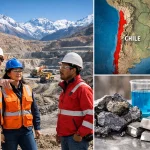
Here’s the thing nobody wants to admit: the era of easy copper is dead. If you want the metal that powers the “shiny AI revolution” and keeps the EV narrative alive, you don’t find it in stable, low-altitude jurisdictions with paved roads and existing power grids. You find it at 4,000 meters in the high Andes, straddling a volatile border between Argentina and Chile.

Lundin Mining isn’t just dipping a toe in the water here; they are diving headfirst into a $11 billion geological monster known as the Vicuña District.
The industry likes to talk about “tier-one” assets like they’re common. They aren’t. They are rare, frustratingly complex, and increasingly expensive to build. But with the recent consolidation of the Vicuña District: specifically the blockbuster 50/50 joint venture with BHP to acquire Filo Corp: Lundin has secured a seat at a table where the stakes are measured in decades, not fiscal quarters.
The Brutal Geometry of Scale
Let’s look at the numbers, because they are frankly staggering. The Vicuña District currently hosts an estimated 38 million tonnes of contained copper, 81 million ounces of gold, and 1.4 billion ounces of silver.
To put that in perspective: that is enough copper to build roughly 450 million electric vehicles. That’s not a typo. It’s the largest greenfield copper discovery in the last 30 years.
More Read


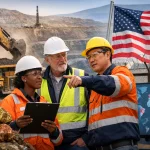
Caption: A diverse team of senior geologists and project engineers reviewing 3D geological models of the Vicuña District deposits.

The district isn’t just one mine. It’s a cluster of massive porphyry deposits: Josemaria, Filo del Sol, and Lunahuasi: that behave like a single, giant mineralized system. For Lundin, the strategic calculus isn’t subtle: by integrating these assets, they aren’t just mining ore; they are building a regional power center that could produce 400,000 tonnes of copper annually for the next 25 years. Peak production? Likely over 500,000 tonnes.
Why BHP Signed the Check
You don’t see BHP: the world’s largest miner: forming 50/50 JVs with mid-tier players every day. They usually prefer to buy the whole neighborhood or stay home. But the Vicuña District is so large and the capital requirements so intense ($7.1 billion for stage one alone) that even the “Big Australian” wanted a partner to share the load.
More Read

The partnership validates what the Lundin family has been saying for years: this is the next Escondida. By splitting the $11 billion total estimated development cost, Lundin gets to keep a massive chunk of a world-class asset without blowing up its balance sheet, while BHP gets a low-entry-cost pathway into a multi-generational copper hub.
This isn’t just about sharing costs. It’s about technical de-risking. Building a massive operation at high altitude in San Juan Province requires a level of engineering sophistication that most companies simply don’t possess.
The Argentina Gamble: RIGI and the Political Pivot
For years, Argentina was the place where mining dreams went to die in a sea of hyperinflation and shifting regulations. You can see the scars of this history in our recent analysis of Resource Nationalism in 2026.
But things have changed. The introduction of the RIGI (Large Investment Incentive Regime) framework in Argentina has fundamentally altered the math. RIGI provides the fiscal stability, tax certainties, and foreign exchange protections that make a $11 billion investment possible. Without it, the Vicuña District would remain a series of impressive drill holes and PowerPoint slides.

Caption: Field technicians from diverse backgrounds conducting geotechnical surveys at the Josemaria project site high in the Andes.
Lundin’s bet is that the current administration’s pro-mining stance isn’t a temporary blip but a structural shift. The San Juan Province is leading the charge, viewing copper as the key to its economic future. If this project reaches a Final Investment Decision (FID) by the end of 2026, it will represent the largest private investment in Argentina’s history.
The Grade Reality Check
Here’s where it gets uncomfortable for the skeptics: the grades. While the rest of the world is scrambling to figure out how to profitably mine 0.3% copper, the “Aurora” zone at Filo del Sol has been spitting out intercepts that look like they belong in a textbook from 1950.
We are talking about massive widths of high-grade copper-gold-silver mineralization. In a world where Chilean copper output is hitting five-month lows, the ability to bring a high-grade, long-life asset online is a massive competitive advantage.
Vicuña District Resource Snapshot (Consolidated)
| Metric | Josemaria | Filo del Sol | Lunahuasi | Total District Potential |
|---|---|---|---|---|
| Contained Copper (Mt) | 6.7 | 4.4* | TBD | ~38 |
| Contained Gold (Moz) | 7.0 | 4.4* | TBD | ~81 |
| Mine Life (Years) | 19 | 40+ | TBD | 70+ |
| Stage 1 Capex ($B) | $3.1 | $4.0 | N/A | $7.1 |
*Note: Filo resources are rapidly expanding following 2024-2025 drill programs.
The Infrastructure Stranglehold
You can’t talk about Vicuña without talking about logistics. You are 4,000 meters up. There is no water. There is no power. There are no people.
Lundin’s plan involves a massive infrastructure build-out that includes a dedicated power line from the Argentine grid and a water pipeline. But the real “secret sauce” is the potential for a cross-border integrated operation. While the deposits sit on both sides of the line, the bulk of the processing and infrastructure is slated for the San Juan side in Argentina.

Caption: A diverse group of logistics experts and civil engineers planning the 200km access road and pipeline corridor for the Vicuña projects.
This integrated approach is designed to crush the operating costs. By sharing a mill, a tailings facility, and a supply chain between Josemaria and Filo, the JV can achieve economies of scale that would be impossible as standalone projects. It’s the “cluster effect” in action, and it’s the only way to make the economics of the Andes work.
2026: The Inflection Point
The clock is ticking. Lundin and BHP have signaled that the next 18 months are about one thing: engineering. They are moving toward a Class 2 capital estimate: which is industry-speak for “we need to know exactly how many billions this will cost before we pull the trigger.”
Expect a flurry of news regarding:
- Provincial Agreements: Finalizing the local tax and royalty structures in San Juan.
- RIGI Certification: Official enrollment in the incentive regime to lock in fiscal terms.
- Water Permits: Securing the long-term rights needed for a 70-year mine life.
If they hit these milestones, 2026 will be the year the first shovels hit the ground for the main construction phase.
The Bottom Line
Lundin Mining isn’t just doubling down on copper; they are doubling down on the belief that scale wins. They are betting that the world’s desperate need for copper will outweigh the geopolitical risks of Argentina and the technical challenges of the Andes.

Caption: An ethnically diverse group of community relations officers meeting with local San Juan province leaders to discuss long-term regional development.
Critics will point to the $11 billion price tag and the history of Andean cost overruns. They aren’t wrong. Those risks are real, and they are nasty. But as we see in the Lithium AI demand outlook, the supply-demand gap for critical minerals is widening at a rate that geology simply cannot keep up with.
Those two clocks: demand and discovery: do not sync. Lundin has found a way to bridge that gap by securing one of the last truly great copper districts on the planet. It’s a bold move, it’s a high-stakes move, and in a decade, it will likely be seen as an inevitable one.
There simply isn’t enough copper to go around. Lundin just happens to be standing on the biggest pile of it.
Byline: Penny Laneford
Daily Performance Benchmark: 945 views / 577 active users.