People love to talk about the “risk” in West Africa. It’s the favorite hobby of analysts who haven’t left London or Toronto in a decade. But while the spreadsheets in the West scream caution, the actual operators on the ground are writing checks. Big ones.

Ghana just received a $1.2 billion endorsement. That’s not a rounding error. It’s a statement of intent from E&P (Exploration & Production) players who realize that the narrative of regional instability is being steamrolled by the reality of geological abundance and regulatory maturity. While the world’s eyes are glued to Freeport’s copper expansions in Chile, the real gold story is playing out in the Birimian Greenstone Belt.
This $1.2 billion investment isn’t just a “vote of confidence”: it’s a calculated bet that Ghana is the stable anchor in a region that is finally finding its feet after years of fluctuating sentiment.
The Disconnect Between Indices and Reality
If you look at the recent headlines, you’d think Ghana was in trouble. On March 18, 2026, the Global Mining Investment Attractiveness Index showed Ghana dropping seven places to 53rd. The pundits pointed to policy uncertainty and regulatory consistency.
But here’s the kicker: capital doesn’t always follow indices. Capital follows the ore and the ability to get it out of the ground.
More Read

E&P’s massive capital injection is the ultimate counter-signal. It says that despite the noise from the Fraser Institute or the occasional bureaucratic hiccup in Accra, the fundamentals of Ghana remain unmatched on the continent. We are seeing a “first come, first considered” licensing framework and a sliding-scale royalty regime that actually aligns with market conditions. It’s pragmatic. It’s business-like. And it’s why the major players aren’t leaving.


Heavy Metal: The Caterpillar Fleet
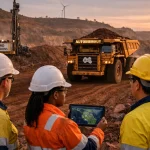
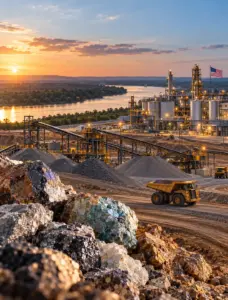
You can tell how serious a company is by the iron they put in the dirt. E&P isn’t just doing “exploratory drilling” with a few borrowed rigs. They are scaling up with a massive fleet of Caterpillar dump trucks: the heavy-duty workhorses that define large-scale open-pit success.
More Read

Deploying a fleet of this scale requires more than just money; it requires a belief in the long-term viability of the mine life. These trucks represent a commitment to moving millions of tonnes of earth over the next decade. They are a physical manifestation of the $1.2 billion capital expenditure.
In mining, hardware is truth. You don’t buy a fleet of Cat trucks if you’re worried about your mining lease being revoked in six months. You buy them when you’re planning to be the dominant producer for the next twenty years. This equipment is essential for the high-wear applications common in West Africa’s rugged terrain, where durability is the difference between profit and a maintenance-driven bankruptcy.

The Human Element: Mining’s Real Renaissance
There is a 50% rule in modern mining that people often forget: half of your success is geology, and the other half is the people who manage it. Ghana’s secret weapon isn’t just the gold: it’s the workforce.
Unlike frontier jurisdictions where every engineer has to be flown in from Perth or Vancouver, Ghana has a deeply entrenched, highly skilled local mining class. We are talking about generations of miners who understand the Birimian geology better than anyone else on the planet. This investment is fueling a domestic renaissance, where local engineers are taking the lead on complex E&P projects.
The impact on the local economy is brutal in its efficiency. The mining sector in Ghana already accounts for more than 50% of foreign direct investment. When you drop another $1.2 billion into that ecosystem, you aren’t just building a mine; you’re sustaining an entire middle class of technical professionals, from geologists to heavy equipment mechanics.

The Gold Price Catalyst: $5,200 and Beyond
We cannot talk about investment without talking about the price of the product. Gold recently topped $5,200 on US tariff plans and geopolitical jitters. For a long time, the $2,000 mark was the psychological ceiling. That ceiling is gone.
In a world where AI booms are sparking strategic metal supercycles, gold remains the ultimate hedge against the very volatility that makes investors nervous about West Africa. The irony is delicious: the riskier the world feels, the more valuable Ghana’s primary export becomes.
With gold at these levels, projects that were “marginal” at $1,800 are now absolute cash cows. This is why E&P is moving so aggressively. They aren’t just looking at today’s spot price; they are looking at a multi-year horizon where gold stays elevated due to persistent global instability.
Why Ghana? The Infrastructure Advantage
Infrastructure is where most African mining projects go to die. You can have the best ore body in the world, but if you can’t get power to your mills or trucks to your ports, you have a very expensive hole in the ground.
Ghana is different. It’s the exception to the rule. The country boasts reliable electricity, sophisticated telecommunications, and a transport network that actually works. Compare this to the logistical nightmares faced by companies in the Lithium space or those trying to navigate the nickel market supply gluts. Ghana’s infrastructure makes the $1.2 billion investment “de-risked” in a way that simply isn’t possible in neighboring frontier states.
Furthermore, the government is diversifying. They aren’t just sitting on their gold laurels. There is a concerted push into lithium and iron ore to tap into the global battery revolution. But gold remains the king, and this $1.2 billion is the crown.
The Exploration Upside: Looking for the Next “Big One”
Part of this capital is earmarked for aggressive exploration. The industry is currently obsessed with finding the next tier-one asset. We’ve seen this play out in Canada with projects like Denison Mines’ Phoenix update. In Ghana, the exploration potential is still massive. Much of the Birimian belt remains under-explored using modern, high-resolution techniques.
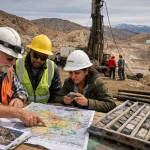
Mining geologists are now back in the field, examining rock core samples with a level of intensity we haven’t seen in a decade. They are looking for the structural traps and hydrothermal signatures that indicate another world-class deposit is hiding just below the surface.

The Staked Claim: A 2026 Outlook
So, what does this tell us about the rest of 2026?
First, expect production growth to accelerate. The large-scale gold mining sector in Ghana already generated nearly $300 million in royalties in the first nine months of 2025: a 40% increase. With the new $1.2 billion injection hitting the ground, those numbers are going to look like a rounding error by 2027.
Second, watch the M&A space. When a major player like E&P makes a move this big, it often signals a “buy” phase for the entire region. Smaller juniors with land packages adjacent to these massive capital spends are suddenly very attractive targets. We’ve seen how Teck Resources’ royalties can stymie spinoff plans; in Ghana, the focus is on consolidation and scale.
Finally, the “West Africa Risk” narrative needs a rewrite. You can’t call a region “uninvestable” when billion-dollar checks are being cleared.
The $1.2 billion confidence vote in Ghana isn’t just about gold. It’s about the professionalization of African mining. It’s about the intersection of high-grade geology, a sophisticated workforce, and the best-in-class equipment.
The renaissance is here. It’s being led by Ghana. And it’s being built with Caterpillar trucks and a lot of conviction.
The Bottom Line
While some investors are still licking their wounds from the gold price crash scares of early 2026, the smart money has already moved. They’ve moved to where the gold is, where the people know how to mine it, and where the government understands that a “true partner” is better than a tax-hungry adversary.
Ghana is once again proving that it is the undisputed heavyweight champion of African mining. If you’re waiting for the “perfect” time to enter the West African market, you’ve already missed the first billion-dollar wave. The clock isn’t just ticking; it’s being drowned out by the sound of diesel engines in the Ashanti region.

Ghana has stepped up. The question is, who else is brave enough to follow the lead?
The strategic calculus here isn’t subtle: get in now, or get left behind in the dust of a Cat 797. The choice is yours, but the opportunity won’t wait for another index update.