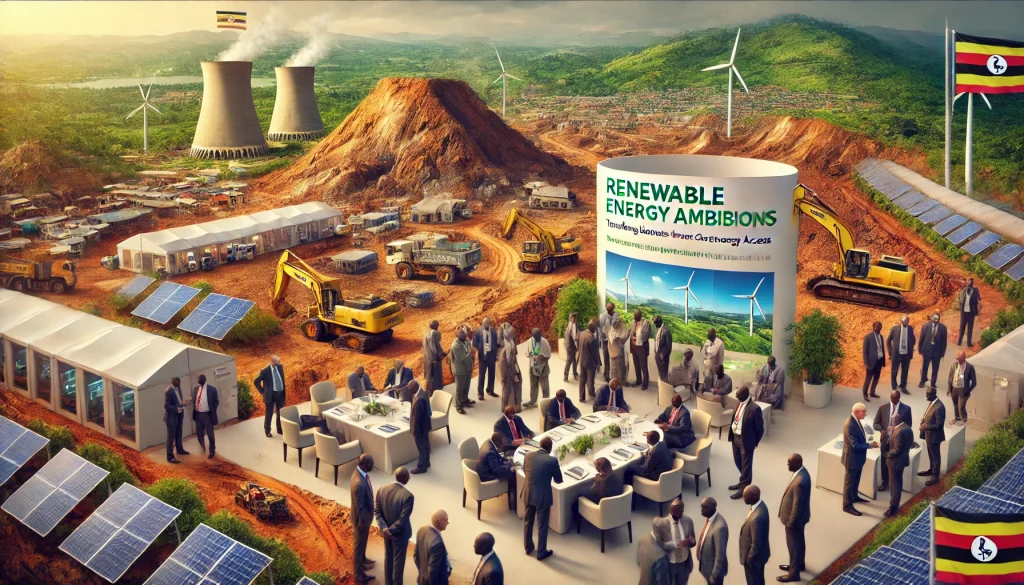
Uganda is inviting global mining giants to explore its rich reserves of critical minerals as the nation aims to establish itself as a significant player in the clean energy sector. At the Renewable Energy Conference & Expo 2024, government officials underscored the economic and environmental stakes of mining investments, calling for a balanced approach that fosters industrial growth while protecting the environment.

Held from October 31 to November 2 at Speke Resort Munyonyo, the conference brought together key industry players under the theme, “Transforming Livelihoods Through Clean Energy Access.” Hosted by Uganda’s Ministry of Energy and Mineral Development and the National Renewable Energy Platform (NREP), the event emphasized the role of critical minerals—such as lithium, cobalt, and rare earth elements—in driving Uganda’s clean energy transition.
Critical Minerals and the Clean Energy Drive
Dr. Luisa Moreno, an advisor on minerals to President Yoweri Museveni, highlighted the importance of attracting “large industrial mining companies” to tap Uganda’s mineral wealth. We need to become a significant player in the global supply of these essential minerals,” Dr. Moreno said, underscoring the government’s commitment to establishing Uganda as a stable, regulated hub for mining critical minerals vital to renewable energy technologies.
Uganda’s government faces a delicate balancing act: fostering economic growth through mining while enforcing environmental standards to avoid the ecological pitfalls associated with extraction. The nation’s 2022 Mining Act plays a pivotal role here, laying out guidelines to attract sustainable investments. Among its provisions, the Act mandates transparency in licensing, incentivizes local processing, and strengthens public-private partnerships—all with an eye toward long-term economic stability and responsible resource management.
EU’s €200 Million Pledge for Uganda’s Energy Goals
The conference also highlighted substantial international support for Uganda’s clean energy goals. European Union Ambassador Jan Sadek reaffirmed the EU’s commitment of €200 million to Uganda’s energy initiatives. This funding aims to expand clean energy projects, particularly in rural areas, aligning with Uganda’s ambition to phase out traditional biomass and prioritize accessible, sustainable energy for all.
More Read

Uganda’s Energy Minister, Ruth Nankabirwa, opened the conference with a promise to reduce biomass dependency, citing public health benefits and reduced carbon emissions. She emphasized Uganda’s dedication to a “Just and Equitable Energy Transition” in line with United Nations Sustainable Development Goal 7, which targets universal access to affordable and clean energy by 2030.

Uganda’s Mining Act 2022: A Roadmap for Sustainable Investments
The 2022 Mining Act was a focal point at the conference, with officials highlighting how it provides a solid foundation to attract responsible mining investments. The Act aims to make Uganda’s mineral sector more attractive to international stakeholders by ensuring transparency, ease of data access, and a stable framework for mineral exploitation.
The Act also seeks to integrate small-scale and artisanal miners into the formal economy. Small-scale miners, integral to Uganda’s mining sector, received particular attention, with government officials announcing plans to formalize their activities through training programs and resource allocation. These initiatives aim to increase their role within Uganda’s mineral supply chain and bring artisanal mining in line with national sustainability goals.
Clean Cooking Initiative Targets Indoor Air Pollution
Expanding on the theme of energy access, the East Africa Centre of Excellence for Renewable Energy and Energy Efficiency (EACREEE) announced a new regional initiative focused on clean cooking. The program aims to shift Ugandan households from traditional biomass-based cooking to electric solutions, which is expected to mitigate health risks linked to indoor air pollution. According to the World Health Organization, approximately 23,000 Ugandans—mainly women and children—suffer from severe health issues caused by biomass-related indoor air pollution each year.
This initiative complements Uganda’s broader clean energy agenda, with the goal of transitioning 20% of the population to electric cooking by 2030. EACREEE’s campaign underscores the government’s resolve to reduce reliance on biomass, improving both health and environmental outcomes.
National Development Plan IV: Charting a Path Toward Sustainable Growth
As Uganda prepares its National Development Plan IV (2025-2030), which emphasizes renewable energy and critical minerals as drivers of sustainable growth, the country is setting a clear course for an inclusive energy transition. Working closely with international partners, including the United Nations Development Program (UNDP), Uganda aims to strengthen local mineral processing, which would boost job creation, support skills transfer, and fortify the nation’s economic resilience.
Hope Kyarisiima Musinguzi from UNDP emphasized the role of collaborative investment in achieving Uganda’s vision. “Aligning policy, investment, and community support will enable Uganda to emerge as a leader in Africa’s critical minerals and renewable energy space,” she noted, adding that the integration of social and environmental responsibility will be essential to sustaining progress.
Uganda’s Ambitious Road Ahead
Uganda’s invitation to international mining giants is a high-stakes effort to establish itself as a linchpin in the global clean energy transition. By advancing policies that encourage sustainable mining, reducing biomass dependence, and channeling international support toward green initiatives, Uganda is positioning itself at the forefront of Africa’s renewable energy and critical minerals industry. As global demand for renewable technologies rises, Uganda’s commitment to environmentally responsible mining could shape its role as a preferred supplier, balancing economic ambitions with a commitment to protecting its people and land.