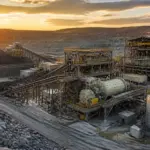
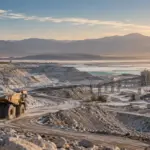
Pilbara iron ore operation in Western Australia.

China Baowu Steel Group is exploring an investment in a minority stake of between 15% and 25% in BHP’s Jimblebar iron ore mine in Western Australia, according to people familiar with the discussions.
The potential transaction would see the stake carved out of BHP’s existing 85% interest in the mine. No formal decision has been made, and there is no certainty that the talks will result in a deal.
BHP acknowledged the speculation, saying it regularly evaluates options to create long-term value for shareholders but remains fully committed to its Western Australian iron ore business.
The discussions put one of the Pilbara’s largest operating assets at the center of a potential transaction between the world’s largest steelmaker and one of the largest global iron ore producers. They also highlight the continuing dependence of China’s steel sector on Australian raw materials, despite broader political and trade tensions between Canberra and Beijing.

Jimblebar is a major BHP production hub
Jimblebar is part of BHP’s Western Australia Iron Ore system, which includes a network of mines, processing facilities, rail infrastructure and port operations in the Pilbara.

The operation produced approximately 62.5 million tonnes of iron ore attributable to BHP in fiscal 2026, according to figures cited by Reuters sources. That represents about one-quarter of BHP’s overall iron ore production.
BHP currently owns 85% of the Jimblebar operation. Japanese trading houses Itochu and Mitsui hold the remaining interests, with stakes of 8% and 7%, respectively.

| Jimblebar ownership and scale | Current position |
|---|---|
| BHP ownership | 85% |
| Itochu ownership | 8% |
| Mitsui ownership | 7% |
| Potential Baowu stake | 15%–25% |
| BHP-attributable production | About 62.5 million tonnes |
| Share of BHP iron ore output | Approximately 25% |
A 15% to 25% sale would therefore be material, although BHP would remain the dominant shareholder and operator. Depending on the final structure, Baowu could become one of the mine’s largest non-operating partners.
The asset also has a long operating history. BHP sold minority interests in the Jimblebar hub to Itochu and Mitsui in 2013, before the mine began producing at full scale. The proposed transaction would represent another change in the ownership structure of a mine designed to supply the global seaborne market.
What Baowu would gain
For Baowu, an equity position would provide direct upstream exposure to a large, established source of high-volume iron ore.
China remains the world’s largest steel producer and the largest consumer of seaborne iron ore. Its steel mills rely heavily on imports because domestic production does not fully meet the sector’s demand for raw materials. Australia is the dominant supplier to China, with the Pilbara forming the core of that trade relationship.
A minority stake would not remove Baowu’s exposure to iron ore price volatility. However, it could give the steelmaker a stronger role in the economics and governance of a producing mine, subject to the terms of any agreement. It could also support long-term supply planning and deepen the commercial relationship between one of China’s largest steel groups and BHP.
The investment would be different from a simple long-term purchasing agreement. An equity position could provide access to information about mine plans, production performance and operating costs, although the exact rights would depend on the shareholder and joint-venture arrangements.
For BHP, selling part of its stake could unlock value from a mature, cash-generating asset while retaining operational control. The company would also remain exposed to the mine’s production and pricing through its reduced ownership interest.
BHP has previously used minority ownership sales in Western Australia to bring in strategic partners and share capital requirements. The company’s response to the latest speculation did not confirm negotiations but emphasized its continuing commitment to the iron ore business.
Trade ties remain strong despite political friction
The possible investment comes against a complicated China-Australia relationship.
Iron ore has remained one of the most important pillars of bilateral trade, even during periods of diplomatic tension and trade restrictions affecting other Australian commodities. China’s steel industry continues to require large volumes of imported ore, while Australia’s mining sector remains deeply connected to Chinese demand.
A Baowu investment in Jimblebar would underscore that commercial interdependence. It would also test how both governments view Chinese participation in a major Australian resource asset.
Australia has tightened scrutiny of foreign investment in sectors considered strategically important, including critical infrastructure, energy and natural resources. A transaction involving a major Chinese state-owned steel group and a large Pilbara mine would likely attract regulatory and political attention.
That does not mean the transaction would necessarily be blocked. The outcome would depend on the ownership structure, governance rights, offtake arrangements, financing and the assessment of Australian authorities. The status of Baowu as a major state-owned enterprise could make the review more closely watched than a conventional private-sector investment.
A stake would not immediately change iron ore supply
The direct impact on the seaborne iron ore market would depend on what rights came with the stake.
A change in ownership would not automatically increase or reduce Jimblebar’s physical production. The mine would continue operating under BHP’s management, and the same ore would still move through the Western Australia Iron Ore supply chain.
The market implications could instead emerge through marketing and offtake arrangements. If Baowu received rights to purchase or market a portion of production, some cargoes could become more closely aligned with Chinese steel demand. That could improve supply visibility for Baowu while reducing the volume available to other buyers through the spot or broader seaborne market.
The effect would probably be incremental rather than disruptive. Jimblebar’s output is significant, but a 15% to 25% ownership interest would represent only part of global seaborne trade. The transaction would be more important as a signal of supply-chain strategy than as an immediate change to global availability.
It could also encourage other steelmakers to pursue direct investments in producing assets. Major mills have periodically explored ownership, offtake and partnership models as they seek greater control over raw material costs and supply security.

Bulk carrier loading iron ore at a Western Australian export terminal.
The valuation question
The parties have not disclosed a potential valuation. BHP valued its Jimblebar interest at roughly $3.2 billion when the mine was commissioned in 2014, but the asset’s value has since been shaped by production growth, iron ore prices, operating performance and long-term expectations for steel demand.
At current production levels, BHP’s attributable output from Jimblebar represents billions of dollars in annual gross revenue at prevailing iron ore prices. Revenue, however, should not be confused with free cash flow or transaction value. A buyer would also assess sustaining capital, operating costs, royalties, taxes, infrastructure commitments and the outlook for benchmark iron ore prices.
The valuation could also reflect strategic benefits. Baowu may place value on supply security and long-term access beyond the financial returns of the mine itself. BHP, meanwhile, would weigh any proceeds against the value of retaining a larger interest in a long-life operation.
Those considerations could make negotiations complex even before regulatory review begins.
What investors and operators will watch
Several issues will determine whether exploratory discussions progress:
- Ownership structure: Whether Baowu would receive a conventional minority interest or a stake with additional governance rights.
- Offtake arrangements: Whether the agreement would provide Baowu with dedicated access to Jimblebar production.
- Regulatory approval: How Australian authorities assess Chinese participation in a strategic bulk-commodity asset.
- Valuation: The price BHP would seek for a stake in a mature, high-volume mine.
- Operating control: Whether BHP would retain full operational authority and responsibility.
- Market conditions: Iron ore prices, Chinese steel demand and expectations for global supply growth.
For BHP, the talks could form part of a broader approach to portfolio management and shareholder returns. For Baowu, they reflect the continuing challenge facing Chinese steelmakers: securing reliable raw materials while managing exposure to international commodity markets.
The discussions also show why iron ore remains central to China-Australia economic ties. Even as both countries reassess strategic dependencies, the Pilbara continues to supply the steel industry that underpins China’s construction, manufacturing and infrastructure sectors.
Until the companies announce a formal agreement, Jimblebar’s ownership remains unchanged. But the possibility of Baowu joining BHP, Itochu and Mitsui at the mine has already drawn attention to the next phase of competition for control, access and influence across the seaborne iron ore market.

Iron ore processing and rail logistics across the Pilbara.
Related coverage
- Mining M&A deals: consolidation drivers and deal risk
- Critical minerals demand, energy transition and supply gaps
- Skillings Mining Intelligence: rate shock, royalty cash flow and the P/NAV discount