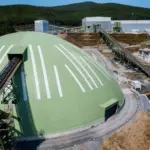
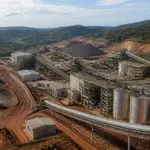
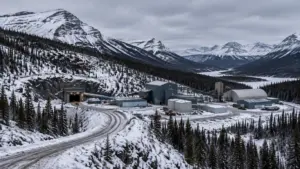
East Texas brine infrastructure in a documentary-style view.

By Penny Langford
Smackover Lithium said its Franklin Project in East Texas has an after-tax net present value of about $5.0 billion in a preliminary economic assessment that outlines annual production capacity of up to 70,000 tonnes of battery-quality lithium carbonate.
The project, located near Mount Vernon in northeast Texas, is the first defined East Texas development of the partnership between Standard Lithium and Equinor. The PEA gives the partners an economic basis to advance the project toward a preliminary feasibility study targeted for 2027, while highlighting the technical, permitting and financing work still required before construction.
The company’s release reported an after-tax internal rate of return of 24% and an after-tax payback period of 3.1 years, based on an 8% discount rate and an assumed lithium carbonate price of $22,400 per tonne.
Because the assessment is preliminary and includes Inferred Mineral Resources, the figures do not represent a feasibility-stage investment decision or Mineral Reserves. Smackover Lithium said there is no certainty the project will be developed as currently modeled.

Read the company’s Franklin Project announcement.
Project economics and production scale
The PEA contemplates a 20-year modeled operating life, with average lithium carbonate production of approximately 64,600 tonnes per year. Total modeled output would be about 1.29 million tonnes of lithium carbonate.
Production could begin in the early 2030s, according to the company. The timeline remains subject to further engineering, permitting, financing, construction and commissioning.
| Franklin Project PEA metric | Company estimate |
|---|---|
| Annual production capacity | 70,000 tonnes lithium carbonate |
| Average production | 64,600 tonnes per year |
| Modeled operating life | 20 years |
| Average lithium concentration | 515 mg/L |
| Initial capital cost | $3.496 billion |
| Capital intensity | $49,945 per tonne of annual capacity |
| Cash operating cost | $4,226 per tonne |
| All-in cost | $5,054 per tonne |
| After-tax NPV at 8% | $4.992 billion |
| After-tax IRR | 24.0% |
| After-tax payback | 3.1 years |
The initial capital estimate includes a 20% contingency and covers the wellfield and lithium processing facility. The PEA uses a cost estimate accuracy range of approximately minus 30% to plus 50%, which is typical of an early-stage study, according to the company release.
The all-in cost estimate includes cash operating costs, royalties, sustaining capital and closure costs. It also incorporates a representative 2.5% gross-revenue lithium royalty. Smackover Lithium said actual Texas royalties are negotiated on a lease-by-lease basis and that the exact terms of its leases are commercially confidential.

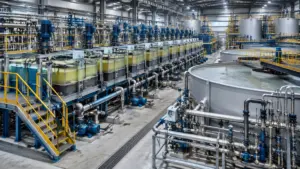
Direct lithium extraction and chemical-processing equipment in an industrial setting.
Brine grades support a large resource
The Franklin Project is based on lithium-bearing brine in the Smackover Formation, a geological basin with a long history of oil and gas development across parts of the southern United States.
Smackover Lithium’s updated resource estimate includes an Indicated Resource of 1.77 million tonnes of lithium carbonate equivalent, with an average lithium concentration of 562 milligrams per liter. The estimate covers approximately 0.59 cubic kilometers of brine.
The project also has an Inferred Resource of 2.13 million tonnes of lithium carbonate equivalent, with an average lithium concentration of 572 milligrams per liter and approximately 0.70 cubic kilometers of brine.
The company said the updated estimate is larger than its previous Maiden Inferred Resource Report and includes the conversion of a portion of the resource to the Indicated category. The resource is based on exploration and sampling work across the Upper and Middle Smackover intervals.
The resource is not a Mineral Reserve and does not demonstrate economic viability on its own. Additional drilling, aquifer characterization, brine-flow testing, metallurgical work and engineering will be needed to support a future feasibility study.
Smackover Lithium said the wider Franklin Project area covers 44,541 hectares, or about 110,064 acres, across parts of east Hopkins, Franklin and west Titus counties. The partnership has leased 30,994 gross hectares of brine mineral rights to support the current resource estimate.
The project center is approximately 4.5 kilometers south of Mount Vernon. Interstate 30 provides road access between Texas and Arkansas, while state highways and regional rail infrastructure connect the area with established industrial and logistics networks.
Direct lithium extraction is central to the plan
The Franklin PEA uses a processing approach based on direct lithium extraction, or DLE. The process is expected to draw lithium-bearing brine from production wells, selectively remove lithium at a processing facility and convert the recovered material into battery-quality lithium carbonate.
The company said Franklin’s brine is sufficiently similar to the brine at its South West Arkansas Project to allow key elements of that project’s process flowsheet and cost work to inform the East Texas assessment.
Standard Lithium filed a definitive feasibility study for the South West Arkansas Project in 2025. That project is designed around a smaller production profile of 22,500 tonnes per year and is further advanced in its development path. The company has said technical work on South West Arkansas can provide operating and design information for future projects across the Smackover Formation.
For Franklin, the PEA assumes average brine flow of approximately 455,000 barrels per day over the modeled operating life. Lithium concentration is expected to be 562 mg/L at the start of production, falling to an average of 515 mg/L across the modeled period.
A third-party treatability study, cited in the release, tested Franklin brine against the partnership’s lithium-selective sorption process. The company said the trials achieved target lithium retention and rejection levels for sodium, potassium, calcium and magnesium. Those results remain part of the technical basis for further testing rather than a guarantee of commercial-scale performance.
The South West Arkansas Project’s feasibility-stage development provides the closest public comparison for the partnership’s DLE strategy. Skillings has also examined how lithium project risk and processing capacity are becoming more important as new supply moves from exploration into development.
Bromine and potash are not included in the base case
The PEA’s headline economics are based on lithium production only. The assessment does not include revenue from bromine or potash.
Smackover Lithium said the project contains Indicated and Inferred bromide resources of approximately 2.66 million tonnes and 3.15 million tonnes, respectively. The company has considered a potential co-located bromine opportunity producing up to 50,000 tonnes per year, but that scenario is not part of the reported lithium-only economic case.
The project also contains an Inferred potash resource of approximately 15.06 million tonnes of potassium chloride. The company said no potash recovery, production or economic contribution is assumed in the PEA because the recovery process requires further development and has not yet been evaluated through a capital and operating cost study.
That leaves both materials as possible future additions rather than current sources of project value.

Road and utility infrastructure near an East Texas brine development area.
Next step is a preliminary feasibility study
Smackover Lithium said its main recommendation is to advance Franklin to a Preliminary Feasibility Study targeted for 2027.
The next phase is expected to focus on refining the characteristics of the Upper and Middle Smackover aquifers, improving the understanding of brine chemistry and continuing DLE testing. The partners also plan to assess the potential commercial roles of bromine and potash.
The company expects to file a technical report supporting the PEA within the time required under Canada’s NI 43-101 disclosure rules. It said the report is not expected to contain material differences from the PEA release, but readers will need to review the completed document for the study’s assumptions, qualifications and risk factors.
The partnership is owned 55% by Standard Lithium and 45% by Equinor, with Standard Lithium acting as developer and operator. Franklin is part of a broader East Texas strategy that targets more than 100,000 tonnes per year of lithium chemical production across multiple projects and phases.
For investors, operators and policymakers, the PEA establishes a large project concept with significant modeled value, but it also marks an early point in the development cycle. The key milestones will be resource conversion, sustained brine-flow performance, DLE recovery rates, permitting, capital availability and the partners’ ability to move the project from a preliminary study to a financeable construction plan.
The assumed lithium carbonate price is also a central sensitivity. The company said project economics are most sensitive to changes in the selling price and production schedule. As Skillings’ lithium market coverage has noted, future supply forecasts remain dependent on whether projects reach commercial production on schedule and deliver battery-grade material at their modeled recovery rates.
Smackover Lithium’s Franklin PEA therefore provides a substantial new data point for the U.S. lithium pipeline, but the $5.0 billion after-tax NPV remains a preliminary estimate tied to a specific price assumption, study scope and set of development conditions.
Sources: Smackover Lithium Franklin Project release; Franklin Project and East Texas project information.