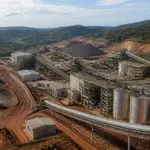
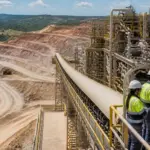
Open-pit lithium mining operations in the rugged terrain of Minas Gerais, Brazil.

A federal court in Brazil has ordered a suspension of operations and environmental licenses at Sigma Lithium’s Grota do Cirilo project in Minas Gerais, citing unresolved consultation requirements involving nearby Quilombola communities.
The ruling affects Sigma Mineração, the company’s Brazilian subsidiary, and includes a R$100,000 fine for noncompliance. Grota do Cirilo, in the Jequitinhonha Valley, is Sigma Lithium’s only producing asset and has about 330,000 tonnes per year of planned lithium output.
The decision adds a new legal and permitting risk to one of Brazil’s most closely watched lithium projects, as producers and investors assess the country’s role in the battery-materials supply chain.
Court cites consultation with Baú Quilombola community
The case was brought by the Federation of Quilombola Communities of Minas Gerais. The organization argued that the Baú Quilombola community lies within the area of influence of the Grota do Cirilo project and should have been consulted before the project’s environmental approvals were granted or renewed.

Quilombola communities are made up of descendants of Afro-Brazilian communities established by formerly enslaved people. Brazilian law provides specific protections for traditional communities, including consultation rights when industrial or infrastructure projects may affect their territories or way of life.

According to court documents described in reporting by Reuters, the Baú territory is approximately 2.7 kilometers from the directly affected area identified in the case. The court found that the location falls within an 8-kilometer threshold used to determine when consultation and a specific impact study may be required.
Judge Antonio Lúcio Túlio de Oliveira Barbosa said there was sufficient evidence that the community fell within the project’s area of influence. The ruling requires the consultation process to be addressed before the operation can proceed under the existing licenses.


A community consultation meeting near a mining region in Minas Gerais.
The court also suspended a prior agreement between Sigma and the Minas Gerais state government that had allowed activity at the project to resume following an earlier environmental embargo. The state government was barred from issuing new environmental permits for the project while the latest order remains in force.
Sigma says it had not been formally notified
Sigma Lithium said it continued to operate and had not been formally notified of the court order, according to the company’s response cited in news reports. The company characterized the ruling as a preliminary decision issued without due process.
The company’s position contrasts with the court’s formal instruction to suspend mining activities and environmental licenses. The difference leaves the immediate status of production dependent on notification, enforcement and any appeal or request to modify the injunction.
The latest decision follows other regulatory and operational interruptions at Grota do Cirilo. The project faced a July embargo related to environmental infractions and negotiations over fines and remedial measures. Earlier restrictions also involved waste-pile and safety concerns.
The succession of actions means the dispute is no longer limited to a single permitting question. For Sigma, it has become a broader test of how the company manages environmental compliance, community consultation and the expansion of a producing lithium operation.
Grota do Cirilo is central to Sigma’s production plans
Grota do Cirilo is a fully integrated hard-rock lithium mining and processing complex in Minas Gerais. The site produces spodumene concentrate through crushing and dense-media separation rather than chemical conversion into lithium carbonate or hydroxide.
Sigma’s operations overview says the project uses a three-stage crushing circuit, a dense-media separation plant and dry-stacking infrastructure. The company also says the plant uses recycled industrial water and renewable electricity.
The company’s published project information describes Phase 1 nameplate capacity of 270,000 tonnes per year of lithium concentrate, with a Phase 2 expansion designed to increase capacity to 520,000 tonnes per year. Current reporting on the court case describes approximately 330,000 tonnes per year of planned lithium output, reflecting the project’s evolving operating and expansion plans.
Whatever the final production configuration, the legal action affects the asset that currently supports Sigma’s commercial output. A prolonged interruption would therefore have a direct impact on the company’s production, shipments and ability to advance expansion work.
The company has previously reported a large mineral resource base at Grota do Cirilo. In a technical update, Sigma reported 94.3 million tonnes of measured and indicated resources at an average grade of 1.40% lithium oxide, alongside 14.6 million tonnes of inferred resources at 1.37% lithium oxide.
Those figures describe geological potential, not guaranteed production. The court action underscores the difference between resource scale and the ability to maintain licensed, socially accepted operations.
Environmental systems do not remove permitting risk
Sigma has promoted Grota do Cirilo as a lower-impact lithium operation, highlighting dry-stacked tailings, renewable electricity, industrial water treatment and the absence of hazardous chemicals in its beneficiation process.

Processing and beneficiation equipment at a hard-rock lithium facility.
Those operating features may reduce certain environmental risks, but they do not replace legal obligations related to land rights, community participation or impact assessment. The court’s decision focuses on whether the consultation process was properly completed, rather than solely on the plant’s water, energy or tailings systems.
That distinction is increasingly important across the critical-minerals sector. Lithium projects are under pressure to expand supply for electric vehicles and energy-storage systems, but approvals are increasingly shaped by community rights and the quality of engagement before construction or expansion begins.
For operators, the case illustrates how a project can face disruption even after substantial investment in environmental controls and processing technology. For investors, it adds a permitting and social-license variable to production forecasts that might otherwise rely mainly on resource size, processing capacity and lithium prices.
Skillings has tracked similar issues in its analysis of the lithium market outlook and the broader critical-minerals supply chain.
What happens next
The immediate questions are procedural and operational:
| Issue | Current position | Why it matters |
|---|---|---|
| Mining operations | Court-ordered suspension | Could interrupt output and shipments |
| Environmental licenses | Suspended under the ruling | Work cannot proceed normally while the order stands |
| Community consultation | Court says unresolved requirements remain | A consultation and impact-study process may be needed |
| Financial penalty | R$100,000 for noncompliance | Raises the cost of continuing activity under the order |
| State permitting | New environmental permits barred while order is in effect | Could delay expansion and related approvals |
| Company response | Sigma says it had not been formally notified and disputes the process | Notification and appeals will shape enforcement |
The court may be asked to reconsider or narrow the order, while Sigma and the relevant authorities could seek to complete the required consultation and technical studies. The timing will depend on the court process, regulatory agencies and the position of the affected communities.
The ruling also creates uncertainty around Phase 2 development. Sigma’s expansion plans depend not only on construction and processing performance but also on maintaining the permits and community relationships needed to operate across the project area.

Dry-stacked material and water-reclamation infrastructure at a hard-rock lithium operation.
A test for Brazil’s lithium ambitions
Brazil has positioned Minas Gerais as an important source of battery minerals, supported by established mining infrastructure and access to export routes. Grota do Cirilo has been a flagship example of the country’s effort to build a commercial lithium industry based on hard-rock resources.
The court’s intervention shows that supply-chain diversification depends on more than geology and processing capacity. Projects must also navigate environmental licensing, traditional-community rights and the legal standards governing consultation.
For Sigma Lithium, the focus now shifts from planned production growth to restoring the legal basis for operations. Until the suspension is lifted or modified, Grota do Cirilo faces uncertainty over current output, expansion work and the timing of future shipments.
For Brazil’s wider lithium sector, the case is a reminder that the credibility of new supply will be measured not only by tonnes produced, but also by whether projects can secure durable regulatory and community consent.
Sources: Reuters report on the court order; Sigma Lithium operations information; Sigma Lithium mineral-resource update.