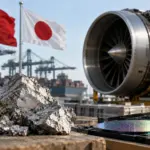
Rare earth separation and processing equipment at an industrial facility.

By Salini Krishnan
Chinese rare earth suppliers have halted or delayed some licensed shipments to U.S. and Japanese buyers, adding a new layer of uncertainty to already strained supply chains ahead of planned summit talks between Washington and Beijing.
The pullback is selective rather than a blanket export ban. Some shipments continue, and several U.S. companies have received export licenses after lengthy waits. But suppliers are increasingly reluctant to release material even after approvals, according to people familiar with the shipments cited by Reuters.
The development highlights a shift in how China’s rare earth controls are affecting global industry. Export risk is no longer limited to whether a license is granted. Companies must also assess whether Chinese suppliers are willing to complete the transaction, how end users will be screened and whether future regulatory action could expose them to penalties.

That uncertainty is reaching manufacturers of electric vehicles, defense systems, electronics, industrial motors and renewable-energy equipment.

Suppliers concerned about regulatory exposure
Several Chinese companies have reportedly declined U.S. shipment requests after licenses were approved, while other exporters have delayed deliveries or subjected them to additional scrutiny. Some U.S. buyers have waited more than six months for licenses covering certain materials.
The concerns intensified after China imposed sanctions on the Responsible Business Alliance, a supply-chain monitoring group, and raised objections to related due-diligence frameworks used by the Responsible Minerals Initiative. Chinese suppliers worry that participation in foreign compliance systems could conflict with domestic rules or expose them to enforcement action in China.

That has made end-user documentation a central issue. Suppliers must determine whether products could be resold to restricted entities or diverted into military-related applications, while U.S. and Japanese buyers must demonstrate that their procurement and downstream customers meet increasingly complex requirements.
The result is a system in which a license may permit an export but does not guarantee that the shipment will leave China.
China began requiring licenses in April 2025 for exports of seven rare earth elements and related products, including dysprosium, terbium and yttrium. These materials are particularly important for high-performance permanent magnets used in electric motors, aircraft systems, precision weapons, wind turbines and industrial automation.
China has also targeted several U.S. rare earth companies through its export-control framework. In June, China added MP Materials, USA Rare Earth and other U.S. entities to an export-control list, tightening restrictions on dual-use shipments.
Japan faces similar pressure
Japanese buyers are also encountering delays and shipment refusals. Industry sources told Reuters that Chinese suppliers have been broadly reluctant to ship rare earth materials to Japanese companies, even when the necessary licenses have been issued.
Japan has long sought to reduce its dependence on China through recycling, overseas investment and strategic stockpiles. However, the country remains deeply integrated with Chinese refining and magnet supply chains.
Japanese automakers, electronics manufacturers and industrial equipment producers rely on rare earth magnets for motors and other precision applications. Any interruption in the flow of dysprosium, terbium or related magnet materials can force companies to seek alternative suppliers, adjust product specifications or draw down inventories.
The impact may not appear immediately in consumer markets. Manufacturers commonly hold buffer stocks and may redirect material from other facilities. But prolonged uncertainty can raise procurement costs, extend delivery times and make production planning more difficult.
A shortage of separated rare earths can also affect magnet production even where raw ore is available elsewhere. Mining projects in the United States, Australia and other jurisdictions may produce concentrates, but those materials still require separation, refining and magnet-making capacity. China remains the dominant player across much of that midstream chain.

Permanent magnets and inspection equipment on a rare earth manufacturing line.
Shipments continue, but flows are less predictable
The current disruption should not be interpreted as a complete cutoff.
Chinese yttrium exports to the United States have continued, although reported volumes remain below previous levels. A shipment of 27 tonnes in July followed two months without deliveries, according to reporting summarized by Reuters. Overall U.S. yttrium imports were running at roughly half their 2024 level.
Other U.S. companies have received multiple approvals after extended waits, and industry participants expect licensing activity to increase around the Washington summit. That could temporarily ease pressure on buyers, but it would not remove the underlying risk.
For procurement managers, the key change is the loss of predictability. Buyers can no longer rely on historical shipping patterns or assume that an approved license will translate into a completed delivery. Companies must now monitor:
- License approval times and renewal requirements.
- End-user and end-use restrictions.
- The risk of third-country transfers being blocked.
- Supplier exposure to Chinese enforcement.
- Inventory levels for heavy rare earths and permanent magnets.
- Alternative processing and magnet-making capacity.
This is particularly important for defense contractors and manufacturers with long qualification cycles. A replacement material may exist technically but still require months or years of testing, certification and redesign before it can be used in a finished product.
Summit talks carry supply-chain implications
Rare earths are expected to feature in discussions around planned summit talks between U.S. and Chinese leaders. The issue sits at the intersection of trade, technology controls and national security.
Washington wants more reliable access to strategic minerals and less dependence on Chinese processing. Beijing, meanwhile, has used export licensing and targeted entity restrictions to preserve control over sensitive parts of the supply chain.
The possibility of a diplomatic understanding could improve near-term shipments, but companies are unlikely to treat a temporary easing as a permanent solution. The broader policy direction remains unsettled, particularly around end-use controls, technology transfers and the treatment of Chinese-origin materials in products manufactured outside China.
The 2025 expansion of China’s export-control regime also raised concerns about the future reach of restrictions involving rare earth mining, separation, magnet production and related technologies. Even where broader measures are suspended or delayed, manufacturers must account for the possibility that they could be reactivated.

Port and logistics infrastructure used to move critical mineral materials.
Europe faces a different bottleneck
The supply-chain pressure is not limited to the United States and Japan. In Europe, critical minerals developers are warning that projects intended to reduce dependence on China may not have enough liquidity to reach construction or production.
Twenty-three of the European Union’s designated strategic critical-minerals projects have raised concerns about financing, market access and immediate liquidity needs, according to Reuters reporting. The projects are intended to support supply of rare earths, lithium, nickel, copper and other materials needed for energy, industrial and defense applications.
The warning exposes a gap between policy recognition and project finance. Strategic designation can improve visibility and help with permitting, but it does not automatically provide construction capital, long-term offtake agreements or price protection.
The European Court of Auditors’ 2026 review said the EU’s Critical Raw Materials Act does not provide direct EU funding for strategic projects. It also found that financing for exploration, mining and processing remains difficult because of price volatility, high energy costs, environmental and social risks, long development timelines and uncertain supply arrangements.
The auditors noted that EU funding is spread across multiple programs and that the Commission has not fully tracked its effect on critical raw materials supply. Public support exists, including European Investment Bank and European Bank for Reconstruction and Development initiatives, but developers say the process remains fragmented and slow.

Technicians inspect equipment at a European critical minerals processing facility.
Diversification requires more than new mines
The parallel problems in China, Japan, the United States and Europe point to the same supply-chain conclusion: diversification must cover the entire value chain.
New mines can reduce dependence on a single source of ore, but they do not solve shortages in separation, refining, alloying or magnet manufacturing. Processing plants also need reliable feedstock, affordable power, skilled labor, permits and long-term buyers.
The European Commission says China supplies 100% of the EU’s heavy rare earth processing, according to its critical raw materials overview. The European Court of Auditors similarly found that rare earth processing is largely conducted outside the bloc.
That concentration leaves manufacturers exposed even when alternative mining projects advance. It also explains why supply disruptions can affect companies far removed from the original export transaction.
The near-term market response is likely to include higher inventory requirements, more detailed supplier audits and renewed efforts to qualify non-Chinese processing and magnet capacity. Longer term, the industry will need commercial structures that make those projects financeable, including credible offtake agreements, price-risk tools and coordinated public support.
For operators and investors, the central risk is no longer simply whether rare earths are available in the ground. It is whether material can move through a politically exposed chain of licenses, processors, manufacturers and end users without interruption.
China’s selective shipment halt shows how quickly that chain can tighten. Europe’s liquidity concerns show how difficult it remains to build an alternative.
Related reading: Critical minerals supply chain developments · Skillings rare earths coverage