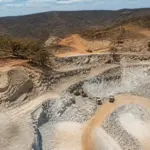
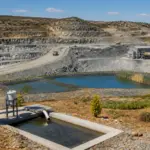
Brazilian critical-minerals mine and processing infrastructure in a cerrado setting.

By Charles Pitts
Brazil’s Senate has approved a bill creating a national policy for critical and strategic minerals, including a R$2 billion federal guarantee fund intended to support mining, processing and technology projects.
The legislation, known as Bill No. 2,780/2024, also establishes the National Council for the Industrialization of Critical and Strategic Minerals, or Cimce, and provides up to R$5 billion in incentives for mineral beneficiation and transformation inside Brazil. The package could direct as much as R$7 billion in government-backed support toward the sector.
The bill passed the Senate without substantive changes after clearing the Chamber of Deputies. It now goes to President Luiz Inácio Lula da Silva for sanction or veto.

The measure comes as governments and manufacturers seek alternatives to concentrated supply chains for rare earths and other minerals used in electric vehicles, renewable-energy equipment, electronics, aerospace and defense. Brazil is positioning its large mineral endowment as a platform for domestic industrial development rather than simply exporting raw materials.

What the bill creates
The legislation establishes the National Policy on Critical and Strategic Minerals, or PNMCE. It defines critical minerals as materials whose availability could be threatened by supply-chain constraints and whose shortage could affect priority sectors such as energy transition, food security and national sovereignty.
Strategic minerals are those considered important to Brazil because of the size and relevance of the country’s reserves, their contribution to trade or their potential role in technological development and emissions reduction.

The policy covers the full mineral value chain, including research, exploration, extraction, processing, recycling and transformation. It also places emphasis on traceability and the development of domestic industrial capacity.
According to the Federal Senate’s account of the legislation, the bill creates:
- The Cimce to coordinate industrialization policy and identify priority projects.
- The Mineral Activity Guarantee Fund, or FGAM, with a federal contribution of up to R$2 billion.
- Up to R$5 billion in incentives for domestic mineral processing and transformation.
- A national registry for eligible critical- and strategic-mineral projects.
- New requirements for research, development and innovation spending.
- Access to incentivized debentures for qualifying mineral exploration and research projects.
The federal government’s R$2 billion contribution is intended to provide guarantees for loans and other financing linked to eligible projects. The fund is not designed primarily as a direct lender. Instead, it is intended to reduce financing risk and improve access to capital for projects that may struggle to secure conventional debt during exploration, construction or processing-plant development.
The Senate said companies involved in the research, extraction, beneficiation or transformation of covered minerals would be required to direct 0.2% of gross operating revenue to the guarantee fund during the first six years. They would also allocate 0.3% of gross operating revenue to research, development and innovation during that period.
After six years, the required research and innovation allocation would rise to 0.5%, according to the Senate’s summary.

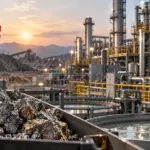
Industrial processing equipment illustrates the infrastructure needed to move from mineral extraction to higher-value products.
Processing is central to Brazil’s rare-earth strategy
The bill’s focus on processing reflects a persistent weakness in the global rare-earth supply chain. Geological resources alone do not create a complete supply chain. Producers also need separation, refining, chemical conversion, component manufacturing and reliable transport and energy infrastructure.
Brazil has some of the world’s largest rare-earth reserves, but its commercial production and processing capacity remains limited compared with China, which dominates global rare-earth supply chains. Rare earths are used in permanent magnets for electric vehicles and wind turbines, as well as in smartphones, advanced electronics, solar equipment, aerospace systems and military applications.
The Associated Press reported that Brazil has the world’s second-largest rare-earth reserves. The country has attracted increasing interest from companies and governments seeking to diversify supply after export controls and geopolitical tensions exposed the risks of relying on a small number of refining hubs.
The domestic-processing incentives are therefore significant. Under the bill, qualifying projects could receive tax credits against Brazil’s CSLL corporate income tax and access other financing mechanisms, provided they contribute to mineral processing and transformation in the country.
For mining companies, that condition could change project economics. A deposit that might previously have been developed as a concentrate or ore-export operation could now require a larger integrated plan involving chemical processing, waste management, water systems, power supply and downstream offtake agreements.
Those additional requirements could create opportunities for engineering firms, equipment suppliers, technology providers and project financiers. They could also increase development costs and extend permitting and construction timelines.
The policy’s success will depend partly on whether the R$2 billion guarantee fund can mobilize substantially more private capital without creating delays in project selection or approval.
Cimce expands the state’s role
Cimce will be linked to the Presidency and will be responsible for coordinating the industrialization agenda, maintaining the national project framework and identifying projects eligible for public support.
The council’s role has generated concern among parts of the mining and investment community. The bill requires certain transactions involving critical and strategic minerals to undergo government ratification, or homologação, under Brazilian administrative law.
Those transactions may include acquisitions or disposals of mineral rights, changes in corporate control and some offtake or supply agreements. The framework also provides for scrutiny of foreign investment and influence involving companies that hold critical- or strategic-mineral assets.
That could give the government a de facto veto over some corporate transactions, according to the AP’s reporting. Jaques Paes, a business professor at the Getulio Vargas Foundation, said the measure could place rare earths “in a political realm rather than a technical one.”
For investors, the issue is less the existence of government oversight than the scope and predictability of that oversight. A clear review process with defined timelines could provide certainty around strategic assets. A broad approval requirement without transparent criteria could make transactions harder to price and finance.
The legislation also raises questions about the division of authority between Cimce and Brazil’s National Mining Agency, or ANM. During the Senate debate, lawmakers expressed concern that the council’s powers could overlap with the agency’s regulatory and supervisory responsibilities.
A proposed amendment intended to clarify that Cimce would not exercise direct inspection powers was withdrawn after an appeal from the bill’s rapporteur, Senator Eduardo Braga.

Brazilian lawmakers review legislation affecting the mining and critical-minerals sector.
Mineral transfers and corporate control become policy issues
The new framework treats mineral rights as more than private commercial assets. It links ownership, control and supply agreements to national sovereignty and industrial policy.
That approach could affect how companies structure joint ventures, farm-in agreements and cross-border partnerships. It may also influence the terms of offtake contracts, particularly where foreign buyers seek long-term access to Brazilian rare earths, lithium, nickel or other minerals designated as strategic.
Transactions involving changes of control may require additional legal review. Companies could also need to demonstrate that proposed investments support domestic processing, technology development or supply-chain objectives.
For exploration companies, the national registry will be an important threshold. Access to the fund, tax incentives and other instruments will be limited to projects registered and approved under the new framework.
The Senate’s summary also states that areas with potential for critical and strategic minerals should receive priority in ANM auctions, including areas whose previous mineral rights have lapsed or been relinquished. Research authorizations for covered minerals would have a maximum nonrenewable term of 10 years.
These measures may improve the government’s ability to direct capital toward priority resources. They could also increase competition for designated areas and place greater importance on early geological data, permitting strategy and project alignment with national policy.
Environmental and community concerns remain
The bill’s financial and industrial incentives have advanced more quickly than some environmental and social safeguards, according to critics cited by the AP and the Socioenvironmental Institute, or ISA.
Environmental groups, Indigenous organizations and communities near potential mining areas have warned that a faster push to develop rare earths and other critical minerals could increase pressure on sensitive territories without equivalent protections for affected communities.
The concern is particularly relevant because some Brazilian mineral prospects are located near regions with high biodiversity or complex land-use disputes. Mining companies seeking access to public support will therefore face growing scrutiny over water use, tailings management, rehabilitation, Indigenous rights and supply-chain traceability.
The legislation includes a voluntary low-carbon mineral certificate, which could provide a basis for differentiating projects with lower emissions or stronger environmental performance. Its effectiveness will depend on the standards, verification requirements and market recognition established through regulation.

Mining, processing and water-management infrastructure form part of the integrated project model targeted by Brazil’s new policy.
What happens next
The immediate next step is presidential consideration. If sanctioned, the bill will require implementing regulations covering the composition and operation of Cimce, the eligibility rules for the FGAM, the tax-credit program, the national project registry and the treatment of corporate transactions.
For operators and investors, the most important questions will be:
- How quickly will the guarantee fund become operational?
- Which minerals will appear on the initial critical and strategic list?
- What qualifies as sufficient domestic processing or transformation?
- How will Cimce’s authority interact with the ANM?
- Which changes in ownership, mineral rights or offtake contracts will require approval?
- What environmental and community conditions will apply to supported projects?
Brazil’s policy creates a potentially important financing and industrial framework for rare earths, lithium, nickel and other critical minerals. It also introduces a stronger state role in the ownership and transfer of mineral assets.
The result will depend on implementation. If the government can combine predictable approvals, credible environmental safeguards and effective financing guarantees, the policy could help Brazil build more of the processing capacity that global manufacturers are seeking. If oversight becomes discretionary or duplicative, the same framework could increase uncertainty for the projects it is intended to support.
Related Skillings coverage: Critical minerals supply chains · Rare earths analysis · Lithium market outlook
Sources: Brazilian Senate · Senate bill record for PL 2.780/2024 · Associated Press · Brazil Chamber of Commerce