ACG Metals plans to use existing Gediktepe infrastructure to process oxide ore from the Keşkek licence.

By Charles Pitts | Mining & M&A
ACG Metals has agreed to acquire the Keşkek gold licence in Türkiye for US$7.85 million, securing a nearby source of oxide ore intended to extend the operating life of its existing gold-processing infrastructure at the Gediktepe mine.
The transaction gives ACG 100% ownership of mining licence 60926, which covers 666 hectares. Keşkek is located approximately 70 kilometres from Gediktepe and is expected to supply ore to Gediktepe’s heap-leach facility once the mine’s own recoverable oxide material has been processed.
The deal reflects a broader mining M&A strategy in which companies seek to add reserves around existing mines, processing plants and transport networks rather than develop entirely new operations. For ACG, the proposed acquisition could extend gold production for several years while limiting the need for new plant construction at Keşkek.

ACG announced the binding agreement with Meta Nikel Kobalt Madencilik Sanayi ve Ticaret A.Ş., a company associated with Türkiye’s Zorlu Holding. The company’s transaction announcement sets out an initial cash payment of US$4 million and a potential deferred payment of US$3.85 million.

Deal terms and payment structure
The total consideration of US$7.85 million is divided into two stages:
| Component | Amount | Trigger |
|---|---|---|
| Initial cash payment | US$4.0 million | Execution of the definitive agreement and approval of the licence transfer |
| Deferred cash payment | US$3.85 million | Linked to completion of the environmental permitting process and planned production start |
| Total cash consideration | US$7.85 million | Subject to transaction conditions |
ACG said approval for the transfer from Türkiye’s General Directorate of Mining and Petroleum Affairs, known as MAPEG, is expected around October 2026. Mining and gold production at Keşkek are targeted to begin in mid-2027, subject to permitting and the completion of residual leaching at Gediktepe.

Meta Nikel will also receive a 1% gross revenue royalty on gold produced from the licence area. In addition, ACG will pay US$60 per ounce for any additional gold discovered outside the defined Keşkek pit and subsequently converted into ore reserves.
ACG estimates total project acquisition, phased exploration and closure expenditure at approximately US$15 million over 10 years.
Keşkek is designed as a satellite ore source
The initial development plan is based on the Keşkek pit, which contains approximately 300,000 tonnes of oxide material grading 0.90 grams of gold per tonne. The estimated waste-to-ore strip ratio is 1:1, according to ACG.
The company’s technical team has also estimated an indicated mineral resource of approximately 1.5 million tonnes grading 0.65 grams of gold per tonne across the licence area. ACG said further exploration could target an additional 5 million to 10 million tonnes of mineralisation grading between 0.7 grams and 1.0 gram of gold per tonne.
That exploration potential remains unconfirmed. ACG said further drilling would be required before any additional mineralisation could be classified as a mineral resource or converted into reserves.

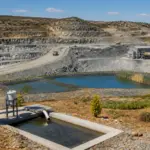
The initial Keşkek plan centres on a defined oxide pit with a 1:1 estimated waste-to-ore strip ratio.
The project’s commercial rationale depends on using Keşkek as a satellite source of feed for Gediktepe. Rather than constructing a new processing plant, ACG plans to transport higher-grade oxide ore to the existing heap-leach facility.
Lower-grade material is expected to be stockpiled for later treatment through ACG’s Enriched Ore plant. The company said the existing facility has sufficient capacity to handle additional oxide throughput if exploration identifies more mineable material within the licence.
Existing infrastructure lowers development requirements
ACG said Keşkek is already connected to Gediktepe by paved and gravel haulage routes. Its existing mining contractor, Uluova, is also established at the Meta Nikel site, which could reduce mobilisation requirements and support the planned trucking operation.
The location provides another potential logistical benefit. Keşkek lies along ACG’s existing concentrate offtake route, creating the possibility of combining some haulage movements with concentrate deliveries. The company did not provide a detailed transport-cost estimate in its announcement.

Existing roads and contractor presence are central to ACG’s plan to develop Keşkek as a satellite operation.
For mine planners and investors, the infrastructure connection is the central feature of the transaction. Keşkek’s value is not based solely on its standalone resource estimate. Its proximity to Gediktepe may allow ACG to use established roads, contractors, processing capacity and operating expertise.
That approach can reduce upfront capital requirements, but it does not remove project risks. The operation will still require environmental approvals, licence-transfer clearance, mine planning, haulage coordination and confirmation that the ore performs as expected at commercial scale.
Metallurgy supports Gediktepe processing route
ACG’s metallurgical testwork produced column-leach gold recoveries of 75% to 80%. Recoveries increased to approximately 85% when the company applied Gediktepe’s existing proprietary recovery process.
The testwork supports ACG’s decision to route Keşkek oxide ore through the Gediktepe heap-leach facility. However, laboratory and column results do not necessarily translate directly into full-scale operating performance. Recovery rates could be affected by ore variability, crushing performance, leach-cycle timing, reagent consumption and blending requirements.

ACG’s testwork indicates that Keşkek ore can be processed through Gediktepe’s existing recovery route.
ACG said production from Keşkek is expected to begin after the recoverable gold and silver in material currently on the Gediktepe heap have been recovered. The timing is therefore linked not only to permitting at Keşkek but also to the performance and depletion schedule of Gediktepe’s existing oxide circuit.
The company is also ramping up a separate sulphide operation at Gediktepe. ACG reported first copper concentrate production from the mine on Aug. 31 and said commissioning was progressing toward full production by the end of 2026. The company’s Gediktepe operations information describes the mine as transitioning from gold doré production toward copper and zinc concentrate output.
The Keşkek acquisition would allow ACG to maintain primary gold production alongside its sulphide processing activities, rather than allowing the gold circuit to wind down after Gediktepe’s own oxide inventory is exhausted.
Key risks are permitting, scheduling and resource conversion
The transaction is subject to the transfer of the mining licence and completion of the environmental permitting process. MAPEG approval is expected to be an early milestone, while the environmental impact assessment will be important for the planned mid-2027 production schedule.
Any delay could affect the timing of the deferred payment, mine development and the transition from Gediktepe’s current heap-leach feed to Keşkek ore.
The resource and exploration figures also require careful interpretation. The 1.5-million-tonne estimate is an internal estimate cited by ACG, while the additional 5-million-to-10-million-tonne exploration target is subject to drilling and may not result in a mineral resource. The initial defined pit provides the near-term operating basis, but the longer-term mine-life extension depends on successful resource conversion and permitting.
| Project factor | Current position | Implication |
|---|---|---|
| Licence area | 666 hectares | Provides exploration ground around the initial pit |
| Initial pit | 300 kt at 0.90 g/t Au | Intended first source of oxide feed |
| Internal resource estimate | 1.5 Mt at 0.65 g/t Au | Supports potential for broader mine development |
| Exploration target | 5–10 Mt at 0.7–1.0 g/t Au | Upside remains subject to drilling |
| Testwork recovery | 75–80%; approximately 85% with Gediktepe process | Supports use of existing heap-leach infrastructure |
| Target production start | Mid-2027 | Dependent on permitting and current heap depletion |
| Estimated total project expenditure | Approximately US$15 million | Includes acquisition, exploration and closure over 10 years |
ACG Chairman and Chief Executive Officer Artem Volynets said the acquisition would extend the company’s gold-production profile by securing nearby oxide ore that can be processed through existing infrastructure.
The transaction also fits the company’s wider focus on consolidation and infrastructure-led growth. ACG’s strategy has centred on expanding its operating base around Gediktepe, where the company is developing both gold and copper production streams.
For the Turkish mining sector, the deal illustrates how smaller licences can become more valuable when located within an established operating district. The key test will be whether Keşkek can move from licence acquisition to permitted production on schedule and deliver the recovery rates assumed in ACG’s development plan.
Further coverage of gold markets and mining transactions is available through Skillings’ gold mining coverage and mining M&A analysis.