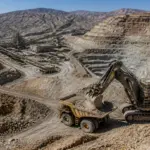
The Nevada North Lithium Project is located southeast of Jackpot, Nevada, in Elko County.

By Charles Pitts
Evolution Mining has completed a C$10 million funding commitment that gives it a 32.5% interest in the Nevada North Lithium Project in Elko County, Nevada, strengthening its exposure to a domestic U.S. lithium development at a time when battery-material supply chains remain a strategic priority.
The interest was earned through a joint venture with Surge Battery Metals rather than acquired through a conventional cash purchase. Evolution initially held 23% of Nevada North Lithium LLC, the joint-venture company formed to advance the project, and committed to fund up to C$10 million of preliminary feasibility work in exchange for an additional 9.5% ownership interest.
Surge said the final C$3.2 million advance completed that commitment. Surge now owns 67.5% of Nevada North Lithium LLC, while Evolution holds 32.5%.

The transaction gives Evolution, primarily a gold producer, a material position in a U.S.-based lithium project without taking on the full cost and execution risk of developing the asset independently. It also provides Surge with funding for technical work, drilling and mine planning as the project moves toward a bankable feasibility study.

Deal structure shifts ownership
The joint venture was established with Surge holding 77% and Evolution holding 23%. The companies contributed different assets and capabilities to the arrangement.
Surge contributed the mining claims and mineral rights that make up the Nevada North project. Evolution contributed its 75% mineral interest in 880 acres of private land within the project area, along with its 75% mineral rights in more than 21,000 acres of surrounding private land.

Evolution then agreed to sole-fund up to C$10 million of the project’s preliminary feasibility study. The staged funding was tied directly to the increase in its ownership interest.
| Item | Position |
|---|---|
| Initial Surge interest | 77% |
| Initial Evolution interest | 23% |
| Evolution’s total funding commitment | C$10 million |
| Additional interest earned by Evolution | 9.5 percentage points |
| Final Surge interest | 67.5% |
| Final Evolution interest | 32.5% |
| Project location | Elko County, Nevada |
Evolution had advanced C$4.7 million by April and provided a further C$2.1 million in April, taking total advances to C$6.8 million. The final C$3.2 million advance completed the earn-in.
The funding has supported the 2025 infill drilling program, mineral resource work, metallurgical testing, preliminary feasibility engineering and mine planning. Under the joint-venture terms, future spending after completion of the earn-in is expected to be funded by the partners in proportion to their ownership interests.
That means Evolution’s future share of approved project expenditures will be 32.5%, while Surge will remain responsible for 67.5%. Surge also remains the project manager and handles day-to-day joint-venture operations under the agreement.
A U.S. lithium project moving into engineering
Nevada North is a lithium claystone project southeast of Jackpot, Nevada, about 73 kilometers north-northeast of Wells. The project sits in a jurisdiction with an established mining industry and access to U.S. markets, although its development will still depend on permitting, water access, technical results and project economics.
Surge said the first four rounds of drilling identified a lithium-bearing clay zone extending more than 4,700 meters along strike and more than 2,000 meters in known width.
The company’s updated mineral resource estimate, filed June 30, reports a pit-constrained measured and indicated resource containing an estimated 10.51 million tonnes of lithium carbonate equivalent grading 3,007 parts per million lithium at a 1,250-parts-per-million cutoff.
Those figures describe a mineral resource, not a mineral reserve. Additional drilling, engineering, metallurgical testing and economic analysis will be required before the project can support a construction decision. The resource is also subject to the assumptions and limitations set out in the company’s technical disclosures.
Surge’s preliminary economic assessment, published in 2025, reported an after-tax net present value of US$9.17 billion and an after-tax internal rate of return of 22.8% based on a lithium carbonate price of US$24,000 per tonne and operating costs of US$5,243 per tonne. The assessment was preliminary and included inferred resources, which are considered too speculative for economic considerations to be applied in the same way as measured and indicated resources.
The project’s economics will therefore need to be reassessed as the resource model, processing flowsheet, capital requirements and lithium-market assumptions develop.

Exploration drilling and sampling will provide data for resource definition and project engineering.
Drilling is intended to accelerate the next study
The joint venture has finalized a 2026 drilling program designed to provide data for the next stage of development, the bankable feasibility study.
The program includes:
- Resource definition and upgrade drilling.
- Condemnation drilling to test areas where infrastructure may be built.
- Pit definition and mine-plan optimization.
- Water-supply and hydrogeological investigations.
- Geotechnical drilling.
- Collection of bulk-tonnage material for metallurgical testing.
- Additional information for flowsheet optimization and a planned pilot program.
Surge has submitted the necessary materials to the Bureau of Land Management under its 2025 Exploration Plan of Operations permit. Contractor mobilization was targeted for September, with field execution expected to continue through the fall and into the 2027 drilling season.
The schedule is important because claystone lithium projects require more than a conventional resource definition. Developers must establish how lithium can be liberated from the host material, determine reagent and water requirements, validate recoveries at scale and design a process that can operate consistently over the life of the mine.
That work can have a substantial effect on capital intensity and operating costs. It can also change the amount of material that is economically recoverable, even when the underlying geological resource remains stable.
Why the project matters to Evolution
Evolution’s entry reflects a broader effort by mining companies to secure exposure to critical minerals while drawing on their existing strengths in project development, financing and technical management.
The company operates gold mines in Australia and Canada, including Cowal, Ernest Henry, Mt Rawdon, Mungari, Red Lake and an 80% interest in Northparkes, according to Surge’s project announcement. Lithium is not Evolution’s core producing commodity, but the Nevada North investment gives it an option on a potentially large U.S. battery-material asset through staged funding.
The structure also limits the immediate financial commitment. Instead of committing the full cost of project development at the outset, Evolution funds defined technical milestones and earns a larger ownership position as the work advances.
For Surge, the arrangement reduces near-term funding pressure while retaining majority control of the project. It also brings a well-capitalized mining partner into a project that will require increasingly detailed engineering, permitting and infrastructure studies.
The strategic rationale extends beyond the partners. The United States continues to seek more resilient supply chains for lithium and other critical minerals used in electric vehicles, stationary energy storage and advanced manufacturing. A domestic project does not eliminate market or execution risks, but it can become more attractive to policymakers, lenders and potential downstream customers if it demonstrates credible production economics and permitting progress.
Skillings has previously examined how domestic lithium projects fit into the wider critical-minerals supply chain and the variables that shape the lithium market outlook.
The next risks are technical and permitting-related
The completion of the earn-in does not make Nevada North a producing mine. Several development milestones remain.
The bankable feasibility study must confirm the mine plan, processing route, infrastructure requirements, capital costs and operating assumptions. Metallurgical test work will be particularly important because lithium claystone projects may require complex processing circuits, including leaching and impurity management.
Water availability and permitting will also remain key issues. The 2026 program includes hydrogeological work because water access can influence both project design and the regulatory pathway in an arid region such as Nevada.
Lithium prices represent another major variable. The preliminary economic assessment used a price assumption that may not reflect future market conditions. Changes in battery chemistry, electric-vehicle demand, storage deployment, conversion capacity and new mine supply could affect project margins before a construction decision is reached. Skillings’ lithium price coverage provides broader context on those market drivers.
The joint venture will also need to manage the transition from exploration to development. That typically means larger capital requirements, more complex approvals and greater coordination among contractors, regulators, landholders and technical advisers.
For now, Evolution’s completed funding commitment gives Nevada North a clearer path through the feasibility stage. The project’s ability to convert its reported resource into a technically robust, permitted and financeable operation will determine whether the partnership can translate its lithium exposure into a producing asset.
Sources: Surge Battery Metals announcement on the completed funding and 2026 drill program; Surge Battery Metals announcement on the C$2.1 million advance; McCarthy joint-venture overview.