By Penny Langford

The completed combination of G Mining Ventures and G2 Goldfields has created a new reference point for mining M&A: a headline transaction worth approximately C$3 billion, or about US$2.2 billion, with analysts viewing the underlying resource value at roughly C$2 billion after expected synergies.
The deal is important because it shows how mining valuations are being reset around more than ounces, tonnes or current production. Buyers are paying for control of strategic districts, shared infrastructure, permitting advantages and the ability to convert adjacent deposits into a single operating complex.
The central question for investors is whether the premium reflects genuine value creation or simply transfers too much future execution risk to the acquiring company.
The $2 billion milestone is a net-value calculation
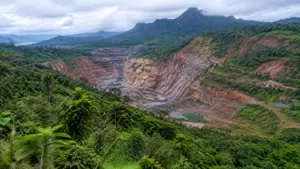
G Mining’s acquisition of G2 combines the Oko West and Oko-Ghanie projects in Guyana’s Cuyuni-Mazaruni region. The properties are adjacent and are being developed as a single district-scale gold project under G Mining’s ownership.

The headline transaction value was approximately C$3 billion, based primarily on an all-share exchange. G2 shareholders received 0.212 G Mining shares for each G2 share, implying approximately C$10.84 per G2 share at announcement.

The offer represented a premium of about 72% to G2’s 30-day volume-weighted average price. Other market commentary cited a premium closer to 80% against the pre-announcement closing price.
That headline premium is only part of the valuation story. The combined project is expected to generate more than C$1 billion in capital and operating synergies, principally through:

- Shared processing and camp infrastructure.
- Larger-scale throughput.
- More efficient mine sequencing.
- Consolidated permitting and operating systems.
- Reduced duplication of roads, power, water and site services.
Subtracting the expected synergies from the C$3 billion headline consideration produces an implied net value of roughly C$2 billion. Based on approximately 3.2 million recoverable ounces attributed to the relevant G2 technical studies, that equates to about C$600 per recoverable ounce.
That is a powerful benchmark, but it is not a universal price for gold in the ground. The value depends on the proximity of the assets, the credibility of the synergy case and the buyer’s ability to build the proposed operation.

Why the deal logic works
The strategic case rests on the fact that Oko West and Oko-Ghanie are not isolated exploration projects. They occupy a connected geological and operating district.
That distinction matters. A standalone project may need its own mill, access roads, power systems, camp and technical workforce. A consolidated district can potentially share those costs across a larger production base.
G Mining’s Oko West project was already positioned as a major development asset. The company has described Oko West as fully permitted and financed, with first gold targeted in the second half of 2027. The combined Oko project is expected to produce more than 500,000 ounces of gold per year on average over its life.
The original Oko West study outlined a 14-year mine life with average annual production of approximately 282,000 ounces and an all-in sustaining cost of about US$1,232 per ounce. The combined project could materially improve scale, although the final economics must wait for an updated feasibility study.
The operational logic is therefore more credible than a typical exploration acquisition. G Mining is not simply buying a land package and hoping that drilling will create value. It is combining one advanced development project with an adjacent resource base that may extend mine life, improve sequencing and raise processing utilization.
That is the part of the premium reset that deserves attention: buyers are willing to pay more when the acquired asset can improve the economics of an existing development plan.
Financing: low upfront cash, high execution exposure
The transaction is predominantly share-based. Existing G Mining shareholders retain approximately 80.1% of the combined company, while former G2 shareholders receive about 19.9%.
This structure limits immediate cash outflow and preserves balance-sheet flexibility. It also shares future risk between the two shareholder groups. If the combined project performs well, both benefit. If construction costs rise or permitting is delayed, the dilution remains visible to all shareholders.
G2 investors also received exposure to a new exploration company, G3 Goldfields, which holds certain non-core assets and launched with approximately C$45 million in cash. A contingent value right could provide up to US$200 million if defined resource-growth thresholds are achieved.
The structure shows how modern mining M&A is increasingly separating asset value into three layers:
- Core consideration: Shares in the operating or development company.
- Exploration optionality: A spinout with earlier-stage assets.
- Contingent value: Payments linked to future technical milestones.
This approach helps the buyer avoid paying the full value of uncertain exploration upside upfront. It also gives the seller a path to retain value if future drilling delivers more than the base transaction assumes.

What the valuation reset means
Recent mining transactions show that premiums vary sharply depending on asset quality and development stage.
| Asset type | Typical market trading range | Recent transaction reference | What drives the gap |
|---|---|---|---|
| Gold developers and juniors | 0.40–0.60x P/NAV | Approximately 0.65–0.75x P/NAV | Control, funding access and resource conversion |
| Senior gold producers | 0.75–0.90x P/NAV | Approximately 0.80–0.95x P/NAV | Reserve replacement and operating scale |
| Established copper producers | 1.10–1.20x P/NAV | Approximately 1.20–1.35x P/NAV | Supply security and infrastructure scarcity |
| Oko-related G2 value | Dependent on development assumptions | About C$2 billion net of synergies | District consolidation and shared infrastructure |
The G2 transaction is unusual because the premium is large, but the net valuation is supported by a visible consolidation case. That makes it different from a buyer paying a high multiple for a remote exploration project with no defined processing route.
Still, investors should avoid applying the C$600-per-ounce figure mechanically to other Guyana or Guiana Shield assets. A recoverable-ounce metric does not account for:
- Initial capital requirements.
- Metallurgical recovery.
- Mine sequencing.
- Tailings and water infrastructure.
- Permitting and community commitments.
- Financing dilution.
- Construction inflation.
- Political and logistical risk.
The market can use the transaction as a negotiation benchmark, but every project still requires its own discounted cash flow analysis.
Base, bull and bear cases
The combined Oko project has a substantial strategic rationale, but its value remains sensitive to execution.
| Scenario | Valuation implication | Main assumptions | Principal risk |
|---|---|---|---|
| Base case | Net value remains near C$2 billion | Synergies are partly realized; updated study confirms production scale; first gold arrives near schedule | Moderate capex inflation and slower ramp-up |
| Bull case | Value exceeds the transaction benchmark | Full infrastructure savings, resource growth and production above 500,000 ounces annually | Higher gold prices amplify free cash flow |
| Bear case | Net value falls materially below C$2 billion | Construction delays, cost overruns, lower recoveries or weaker resource conversion | Share dilution and delayed cash flow |
The base case requires the combined feasibility study to confirm that the two projects can share infrastructure without creating a more complex mine plan.
The bull case depends on resource growth and successful sequencing. A larger processing hub could raise output, but only if the mine can deliver consistent feed at the required grade and recovery.
The bear case is not difficult to imagine. Guyana offers important geological potential, but remote-site logistics, heavy rainfall, road construction and workforce requirements can raise development costs. A project can remain attractive on a resource basis while losing value through schedule slippage.

Company recommendations: who has the strongest exposure?
For investors assessing the named companies, the most defensible strategic exposure is G Mining Ventures, because it controls the combined district, owns the development platform and has the operating responsibility needed to capture the projected synergies.
That is not a low-risk position. G Mining shareholders carry construction, financing, permitting and Guyana execution risk. The company’s valuation should therefore be tested against the updated feasibility study rather than against the headline C$3 billion transaction value.
G3 Goldfields should be viewed as speculative exploration optionality rather than a core mining exposure. Its C$45 million starting cash balance provides runway, but the value of its assets depends on future drilling and resource conversion. The contingent value right may preserve upside for former G2 shareholders, but it does not remove exploration risk.
Omai Gold Mines is a useful regional watchlist company because its large resource base provides a potential comparison for the new Guyana valuation benchmark. However, transaction comparables alone are not sufficient to justify a recommendation. Omai still requires further technical work, permitting progress and a credible development pathway before it can be valued like a controlled, advanced district.
The broader recommendation is to favor companies that combine three characteristics: an advanced resource, existing infrastructure or a credible shared-infrastructure plan, and a balance sheet capable of funding the next development milestone.
Risks that could break the thesis
The premium reset will only hold if the deal produces measurable operating improvements.
The most important risks are:
- Synergy risk: The C$1 billion estimate may take longer to realize or require more capital than expected.
- Construction risk: Processing plants, roads, power and water systems can exceed original budgets.
- Geological risk: Resources may not convert into reserves at the expected grade or recovery.
- Jurisdictional risk: Regulatory changes, community opposition or logistical constraints could delay development.
- Financing risk: A prolonged construction period could require additional equity issuance.
- Commodity risk: Lower gold prices would reduce project margins and weaken the valuation case.
- Integration risk: Combining technical teams, mine plans and operating systems can create delays even when assets are geographically adjacent.
The deal therefore sets a benchmark, but not a floor. Its most important contribution to mining M&A is the demonstration that a high premium can be justified when the buyer can show how adjacency changes project economics.
The next test is execution. If G Mining converts the combined Oko district into a permitted, financed and producing operation, the C$2 billion net valuation could look disciplined. If the synergy case proves too optimistic, the premium will be remembered as a warning about paying for future integration before the mine is built.
Shareable insight: The G Mining–G2 transaction reset mining M&A expectations around a C$2 billion net valuation after synergies. The lesson is clear: buyers are paying for districts, infrastructure and execution capacity; not simply ounces in the ground.
Related Skillings analysis
- Mining M&A deals: valuation gaps, royalties and execution risk
- Mining M&A deals: premiums, risk and project value
- Copper price forecast: drivers, risks and the $15,000 bull case
- Critical minerals refining concentration
- Autonomous mining has a network problem
This article is for information and market analysis only. It is not financial advice or a recommendation to buy or sell any security. Mining investments involve substantial commodity, operational, financing, geological and jurisdictional risks.