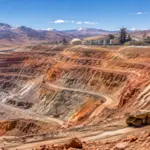
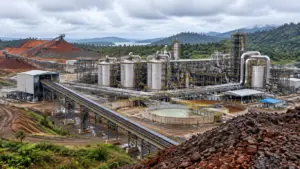
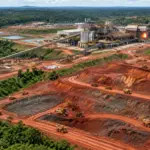
Dense rainforest surrounds the legacy Panguna copper mine site on Bougainville.

By Mo Shine
Armed men attacked and set fire to a project camp at the Panguna copper mine in Papua New Guinea’s Bougainville region, damaging heavy equipment and assaulting personnel as the autonomous government presses ahead with plans to reopen one of the world’s largest undeveloped copper deposits.
The incident, reported by The Star Malaysia and Discovery Alert, took place on Sept. 13 at the long-shuttered mine site. Reports said mining trucks and other machinery were set ablaze.
The attack raises immediate questions about security, landowner consent and the broader social licence for a project that has remained at the centre of Bougainville’s political and economic history for nearly four decades.

Bougainville President Ishmael Toroama condemned what his office described as “terroristic acts of violence” and said the government would not be intimidated or diverted from its effort to redevelop Panguna. Police and community leaders are investigating the incident, while authorities have yet to identify those responsible or establish a motive.

The extent of injuries and property damage was not immediately clear.
Attack exposes risks around restart
The equipment at the camp was reportedly linked to Lloyds Metals & Energy, the Indian company selected as a development partner for the proposed restart. Lloyds has been authorised to undertake preparatory works and feasibility activities, but the project has not entered construction or production.
The Autonomous Bougainville Government has said redevelopment will proceed in stages, with separate approvals required before construction and mining can begin. A report by The Edge Malaysia said Bougainville Minerals Ltd, a government-owned company, holds the mining lease and that Lloyds is its approved development partner.
The distinction is important. Equipment and preparatory works may signal a move from political discussion toward technical evaluation, but they do not mean that Panguna has formally restarted.
The mine’s status is also politically contested. The Bougainville government revoked an exploration licence held by Bougainville Copper Ltd earlier this year and granted a 25-year mining lease to Bougainville Minerals. BCL, the former operator, was once controlled by Rio Tinto and remains a focus of debate over ownership, environmental responsibility and the distribution of future benefits.
The latest attack highlights the gap between government policy and acceptance on the ground. Even if the administration maintains that the restart has broad support, rival landowner groups, former combatants and communities affected by the original mine have different views about whether, when and under what conditions large-scale mining should return.

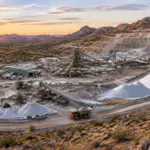
Security fencing and a weathered access route reflect the site’s long operational and political history.
Panguna’s legacy began with copper and conflict
Panguna began production in 1972 under Bougainville Copper Ltd, then associated with Conzinc Rio Tinto Australia. The open-pit mine quickly became one of Papua New Guinea’s most important industrial assets.
Over its operating life, it produced roughly 3 million tonnes of copper, along with hundreds of tonnes of gold and significant silver. At its peak, the mine accounted for a substantial share of Papua New Guinea’s exports and government revenue.
The financial contribution did not translate into equal benefits for the people living around the mine. Landowners and local leaders complained about limited compensation, environmental damage, loss of access to customary land and the concentration of revenues outside Bougainville.
Waste rock and tailings were discharged into the surrounding river system during the mine’s operating years, contributing to sedimentation and long-running concerns about water quality, agriculture and fisheries. The environmental legacy remains one of the central issues in current discussions.
In 1988 and 1989, protests and sabotage intensified. Power lines and mine infrastructure were attacked, and operations were halted in May 1989. The mine was subsequently abandoned as the conflict between the Bougainville Revolutionary Army and Papua New Guinea’s government escalated.
The Bougainville conflict lasted through the 1990s and cost thousands of lives. The mine closure and the grievances surrounding it were among the main drivers of the conflict, making Panguna more than a dormant resource asset. For many Bougainvilleans, it is also a symbol of failed benefit sharing, environmental harm and political exclusion.
Economic stakes for Bougainville
The case for reopening Panguna is tied closely to Bougainville’s economic and political ambitions.
Bougainville remains an autonomous region of Papua New Guinea and has pursued greater self-government, including a referendum in which voters overwhelmingly supported independence. The region’s leaders have argued that an operating mine could provide the revenue needed to build public institutions, improve infrastructure and support a future independent state.
Panguna is widely described as one of the largest undeveloped copper-gold deposits in the world. Estimates cited in recent reporting put the remaining resource at about 5.3 million tonnes of copper and 19.3 million ounces of gold, although the figures will need to be revalidated through further technical work.
The deposit’s potential value has grown as copper demand rises across electricity networks, renewable power, electric vehicles, data centres and industrial equipment. New mines are difficult to develop, and large deposits that can add future supply are drawing greater attention from governments, mining companies and investors.
A successful restart could therefore matter beyond Bougainville. It could add a significant future source of copper and gold while helping the region reduce its dependence on limited public revenue and external assistance.
But the economic argument also carries a warning. The original Panguna operation generated substantial revenue while leaving local communities with a much smaller share of the benefits and a lasting environmental burden. A restart that repeats that pattern would risk deepening opposition rather than resolving it.

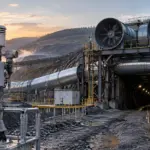
Legacy industrial structures remain visible beneath Bougainville’s dense tropical vegetation.
Social licence is the central project risk
For operators and investors, the attack is an immediate security event. More broadly, it is a reminder that social licence may be the decisive risk in any Panguna development timetable.
The term refers to the continuing acceptance of a project by affected communities. At Panguna, that acceptance cannot be secured solely through a government agreement or a development partnership. It will depend on the participation of customary landowners, transparent compensation, environmental safeguards and credible mechanisms for distributing revenues.
The Lowy Institute’s analysis of Panguna has described the project as the subject of a new political and social contest, with different groups seeking influence over its future. Human rights and environmental organisations have also continued to question how legacy pollution and corporate responsibility should be addressed.
The restart campaign will therefore be judged on several fronts:
- Whether all relevant landowner groups are included in negotiations.
- Whether environmental damage from the historic operation is assessed and addressed.
- Whether the Bougainville government and local communities receive a clearly defined share of future benefits.
- Whether security arrangements protect people without inflaming local tensions.
- Whether technical studies and approvals are made public.
- Whether the project aligns with Bougainville’s political aspirations and customary land rights.
These issues will affect the pace and cost of redevelopment. A technically attractive orebody can still face prolonged delays if the ownership structure, community consent or environmental liabilities remain unresolved.
What the attack means for the timeline
The Bougainville government has made clear that it intends to continue with the restart effort. The attack is unlikely, by itself, to end that policy. It may, however, force a more detailed review of security, camp access, local engagement and the sequencing of preparatory work.
The immediate priorities are likely to include identifying those responsible, determining whether the incident was isolated or part of a wider campaign, and assessing the condition of the damaged equipment. Authorities will also need to establish whether the attack reflects opposition to the project itself, a dispute between local factions or a broader breakdown in security.
For Lloyds Metals, Bougainville Minerals and the regional government, the incident comes at a sensitive stage. The project is still being assessed, and no production revenue is available to offset the cost of security, environmental work or infrastructure.

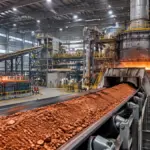
Industrial equipment at a remote tropical exploration camp illustrates the early stage of the proposed redevelopment.
Panguna remains one of the most consequential copper restart proposals in the Pacific. Its resource potential is substantial, but its history means that development cannot be separated from questions of justice, autonomy and trust.
The mine was closed after Bougainville communities concluded that the costs of mining were being imposed locally while the benefits flowed elsewhere. Any new project will need to demonstrate that those conditions have changed.
Until that happens, the burned-out camp will stand as both a security incident and a warning: the physical mine may be dormant, but the political and social conflict surrounding Panguna is not.
Related reading: Critical minerals supply chains and processing bottlenecks · Copper market analysis and mining developments