The world is looking for more critical minerals. It may not be looking hard enough at where those minerals are refined.

In 2024, the top three refining countries accounted for an average 86% of refined output across six key energy minerals: copper, lithium, nickel, cobalt, graphite and rare earths, according to the International Energy Agency’s Global Critical Minerals Outlook 2025. The figure was about 82% in 2020.
Even more striking, around 90% of the increase in refined supply came from the single largest supplier in each market — Indonesia for nickel and China for cobalt, graphite and rare earths.
That leaves governments facing a difficult reality: opening another mine does not automatically create another secure supply chain.
The bottleneck sits beyond the mine
Mining gets most of the attention in critical-minerals policy. Refining is harder to see, but it can be just as important.
More Read
Ore has to be processed and refined before it becomes material that manufacturers can use in batteries, magnets, power equipment and other industrial products. If those processing stages are concentrated in a handful of countries, a supply chain can remain vulnerable even after mining becomes more geographically diverse.

The contrast is significant. The top three mining countries accounted for 77% of production in 2024, compared with 86% for refining, according to the IEA.
In other words, the world has made more progress in spreading the location of mineral extraction than in spreading the capacity to turn those minerals into usable materials.
Nickel shows how concentration can deepen
Indonesia is the clearest example.
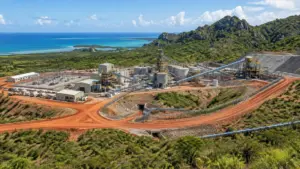
The country has become a dominant force in the global nickel supply chain, particularly in refining. The top three refining countries accounted for 78% of refined nickel production in 2024, up from 66% in 2021.
China presents a similar challenge across several other minerals. The IEA says China is the dominant refiner for 19 of 20 broader energy-related minerals in its analysis, with an average share of around 70%.
That concentration is not simply a geopolitical statistic. It affects how quickly manufacturers can find alternative suppliers when trade restrictions, technical problems or other disruptions hit the market.
Diversification has a price tag
For investors, this is where the story gets more complicated.
Building processing capacity outside established supply hubs can improve supply security, but it can also cost more. The IEA estimates that capital costs for mining and refining projects in more diversified regions are typically around 50% higher than those of projects in the leading producing country.
That creates an uncomfortable investment equation.
The projects that governments most want to see may be the projects facing the toughest commercial competition.
Investment growth is already slowing. Spending on critical-mineral development increased by only 5% in 2024, compared with 14% in 2023. In real terms, after adjusting for inflation, growth was just 2%. Exploration also plateaued.
That makes government-backed finance, strategic offtakes and partnerships increasingly important for projects trying to establish alternative processing capacity.
New supply chains are taking time
The concentration problem is unlikely to disappear quickly.
Based on projects already announced, the IEA expects the average share of the top three refined-material suppliers to fall only from 86% in 2024 to about 82% by 2035.
There are alternatives. Australia, Brazil and Vietnam have rare-earth resources. Madagascar, Mozambique and Tanzania are important graphite producers. The United States, Malaysia and European countries are also developing processing and separation capacity.
But building a refinery is not the same as building a mine. Projects need reliable power, infrastructure, technology, financing and customers willing to buy the output.
That is where diversification becomes difficult.
The next critical-minerals battle is downstream
For mining companies and investors, the implication is straightforward: the value of a mineral project increasingly depends on what happens after extraction.
A deposit can put tonnes on the map. It does not guarantee that those tonnes can reach a battery maker, magnet producer or industrial customer.
The vulnerability becomes clearer in the IEA’s longer-term scenario. If the largest supplier were removed from the equation, supply outside that producer would meet only about half of remaining 2035 demand for battery metals and rare earths.
That is why refining capacity is becoming a strategic asset in its own right.
The critical-minerals race is no longer just about finding new deposits. It is about building enough processing capacity, in enough places, to keep a disruption at one refinery from becoming a problem for the entire supply chain.