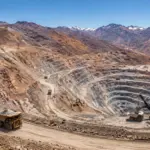
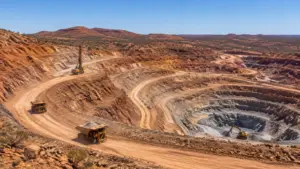
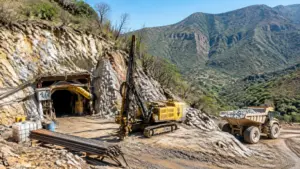
Autonomous battery-electric haul trucks operate on a terraced open-pit mine.

The commercial question around autonomous mining technology is changing. Operators are no longer asking only whether a driverless truck can complete a haul cycle. They are asking whether autonomy, electrification and fleet-management software can work together across an operating mine : and whether the economics justify scaling beyond a pilot.
Several developments point to a broader shift in haulage. EACON says its autonomous system is now deployed on more than 3,500 haulage trucks globally, including more than 1,500 battery-electric units. Caterpillar is expanding autonomous haulage to its Cat 775 truck with Luck Stone. Epiroc is extending autonomous truck operations between underground workings and surface haul roads using 3D LiDAR. In Canada, Canada Nickel has selected Komatsu and SMS Equipment for a planned autonomous, progressively electrified fleet at its Crawford nickel project.
Taken together, these projects suggest that electric autonomy is moving from a technology demonstration toward a fleet-planning decision.
The deployment data points to a change in scale
EACON’s reported fleet is the clearest numerical indicator. The company says its autonomous solution has been deployed on more than 3,500 trucks globally, which have travelled more than 150 million kilometres autonomously. More than 1,500 of those trucks are battery-electric, meaning electric units represent at least about 43% of the reported fleet based on the lower-bound figures.
The figures are company-reported rather than independently audited fleet statistics. Even so, they provide an important market signal: battery-electric haulage is no longer limited to a handful of demonstration vehicles.

EACON’s platform supports retrofit and factory-fit deployments across diesel, hybrid-electric and battery-electric trucks. That flexibility matters because most mines do not replace an entire haulage fleet at once. Retrofit capability can allow operators to introduce autonomy while preserving existing equipment, while factory-fit systems can be incorporated into new mine designs.
| Program or supplier | Reported deployment or commitment | Technology signal | Why it matters |
|---|---|---|---|
| EACON | More than 3,500 autonomous trucks globally | More than 1,500 battery-electric units; over 150 million autonomous kilometres | Shows autonomy and electric haulage operating at multi-site scale |
| Caterpillar and Luck Stone | Autonomous hauling expanded from Cat 777 trucks to Cat 775 fleets at two additional Virginia quarries | MineStar Command for hauling | Extends AHS into smaller quarry and aggregates truck classes |
| Epiroc Deep Automation | No customer fleet total disclosed | 3D LiDAR for localisation, mapping and obstacle detection | Enables autonomous movement from underground workings to surface roads |
| Canada Nickel, Komatsu and SMS Equipment | More than 300 machines planned over Crawford’s 40-year mine life; estimated value of about C$1.5 billion | AHS-ready fleet, DISPATCH and FrontRunner; pathway to electric haulage | Embeds autonomy and electrification into mine planning from the feasibility stage |
| EACON operating model | Company says autonomous trucks can operate about 22 hours per day, compared with roughly 20 hours for human-operated trucks | Automated shift changes, dispatch and cycle management | Illustrates the potential utilization benefit, subject to site conditions |
Sources: EACON, Caterpillar, Epiroc and Canadian Mining Journal. Deployment and performance figures are company-reported or announced project commitments.
Autonomy is becoming an electric-haulage multiplier
Electric trucks do not automatically produce lower costs. Their economics depend on battery capacity, charging infrastructure, haul distance, gradient, payload, climate, energy prices, maintenance practices and the availability of backup equipment.
Autonomy can improve that equation by making electric fleets more consistent.
A battery-electric truck operating under autonomous control can be dispatched according to a defined charging and haulage schedule. The fleet-management system can coordinate loading, travel, dumping and charging windows, reducing the risk that individual operators return trucks late or create uneven utilization across the fleet.
Autonomy may also improve regenerative braking and speed discipline. Consistent control on declines and ramps can help reduce unnecessary energy consumption, while smoother acceleration and braking may reduce wear on tires, driveline components and braking systems.
Those gains are operational rather than theoretical. But they must be measured against the cost of the supporting system: charging stations, substations, network coverage, control rooms, sensor maintenance, software integration and workforce training.
Skillings previously examined this infrastructure issue in “Autonomous Mining Has a Network Problem”. The central lesson applies directly to electric haulage: the truck is only one part of the autonomous system. Connectivity, mapping, traffic management and fallback procedures determine whether the equipment can operate reliably at scale.
Caterpillar tests whether autonomy can move beyond the largest mines
Caterpillar’s expansion with Luck Stone is significant because it moves autonomous haulage into quarrying and aggregates, where fleets are often smaller and truck classes differ from those used in the world’s largest metal mines.
Luck Stone’s Bull Run Quarry previously used autonomous Cat 777 trucks and had hauled more than 816,000 tonnes autonomously, according to Caterpillar. The next phase will extend MineStar Command for hauling to Cat 775 fleets at the Boscobel and Bealeton quarries in Virginia.
Caterpillar describes the Cat 775 deployment as the first use of its autonomous haulage solution on that model. The move tests whether an autonomy package developed through large-scale mining can be adapted to a more compact truck platform and a different operating environment.
For operators, this is an important commercial threshold. If autonomy can be deployed across a wider range of truck sizes, companies may be able to standardize the control architecture across mines, quarries and satellite operations rather than treating each project as a bespoke engineering exercise.
The economics will still depend on fleet density. A large open-pit mine can spread control-room, network and software costs across hundreds of trucks. A quarry must achieve value with fewer units, shorter haul cycles and potentially lower absolute labour savings. The Luck Stone program therefore offers a useful test of how widely autonomous haulage can travel across the mining and aggregates sector.
3D LiDAR removes a major boundary between underground and surface
Epiroc’s Deep Automation development addresses a different constraint: the transition between underground and surface operations.
Historically, an autonomous truck working underground could require a handover when it reached a portal or ramp. Underground positioning systems, surface navigation requirements, changing light conditions and different traffic patterns made continuous autonomy difficult.
Epiroc says its 3D LiDAR-based system allows underground mining trucks to continue onto surface haul roads. The sensors support localisation, map generation and obstacle detection, allowing the truck to complete an end-to-end cycle from underground loading through surface travel and dumping.

3D LiDAR can support autonomous truck movement across underground and surface environments.
The significance is not only technical. Removing a manual handover can reduce idle time and simplify dispatch. It also creates a more continuous production system, particularly for mines using ramps to move material from deep workings to surface stockpiles or processing facilities.
However, integrated autonomy places greater demands on mine design. Road geometry, berm condition, portal layouts, traffic segregation, lighting, dust control and communications must all support the sensor system. Epiroc has not disclosed customer fleet totals or pricing for the technology, so its commercial maturity remains less measurable than EACON’s reported deployment base.
Crawford shows how autonomy is entering mine design earlier
Canada Nickel’s Crawford project near Timmins, Ontario, offers a different type of milestone. The company selected Komatsu and SMS Equipment to supply its load-and-haul fleet, with more than 300 machines expected to be purchased over the project’s 40-year life at an estimated value of about C$1.5 billion.
The arrangement is intended to establish the foundation for an autonomous fleet using Komatsu’s DISPATCH fleet-management platform and FrontRunner autonomous haulage technology. Canada Nickel has also emphasized the suppliers’ experience with electrification, including the transition from diesel equipment toward battery-powered machines.
The company expects to finalize definitive fleet and support agreements in the next phase. That distinction matters: the announcement is a major supplier selection and planning commitment, not evidence that the full autonomous electric fleet is already operating.
Still, Crawford illustrates how autonomy and electrification are increasingly being considered before construction begins. Fleet choice affects pit design, haul-road geometry, charging infrastructure, power distribution, maintenance facilities and workforce requirements. Planning these systems early is generally less disruptive than retrofitting them after production starts.

Control-room systems coordinate autonomous equipment, production targets and site safety.
Base, bull and bear cases for adoption
The next phase of autonomous electric haulage will depend less on whether the technology works in controlled conditions and more on how consistently it performs across changing mine environments.
| Scenario | Adoption path | Economics and operational outcome | Main constraint |
|---|---|---|---|
| Base case | Large open-pit mines and selected quarries adopt autonomy in phases, beginning with defined haul zones and mixed fleets | Higher utilization, improved cycle consistency and lower exposure to high-risk operating areas; electric savings vary by site | Network readiness, charging capital and integration with legacy equipment |
| Bull case | Factory-fit autonomous electric trucks become standard in new mines, while retrofit systems expand across existing fleets | Lower energy and maintenance costs combine with longer operating hours and reduced personnel exposure | Battery supply, grid capacity and the need for reliable high-power charging |
| Bear case | Adoption remains concentrated in large, well-capitalized operations and technically simple haul routes | Pilot benefits fail to translate into fleet-wide returns; hybrid and diesel fleets remain dominant in difficult conditions | High upfront costs, weak connectivity, extreme weather, battery degradation and change-management delays |
The base case is the most defensible near-term view. Commercial scale does not mean every mine will become fully autonomous or battery-electric. It means the technologies are increasingly available as practical options within a broader fleet strategy.
The next performance metric is system availability
Production teams should evaluate more than the number of autonomous trucks delivered. The more useful metrics will include:
- Autonomous operating hours as a share of total fleet hours
- Fleet availability during charging and shift-change periods
- Energy consumed per tonne-kilometre
- Manual interventions per haul cycle
- Safety events and near misses inside autonomous operating zones
- Payload consistency and queue time at loaders and dumps
- Network availability across active haul routes
- Battery degradation and charging downtime
- Maintenance cost per operating hour
These measures connect technology performance to mine economics. A truck that operates autonomously but waits for charging, loses network coverage or requires frequent manual intervention may not deliver the same value as a less advanced system with higher availability.
Electric autonomy is therefore reaching commercial scale, but the competitive advantage will belong to operators that treat it as an integrated production architecture rather than a truck purchase.
The direction of travel is clear. EACON’s reported fleet shows the installed base expanding. Caterpillar is broadening the equipment classes that can operate autonomously. Epiroc is working to remove the underground-surface boundary. Canada Nickel is incorporating autonomous and electric fleet concepts into a new critical-minerals project before construction.
The next test is execution: whether mines can align equipment, power, networks, software and people well enough to turn those milestones into repeatable production gains.
LinkedIn snippet
Autonomous electric haulage is moving beyond pilot projects. EACON reports more than 3,500 autonomous trucks globally, including over 1,500 battery-electric units. Caterpillar, Epiroc and Canada Nickel are extending the model across quarries, underground-to-surface operations and new nickel mine development. Our analysis examines what commercial scale means for fleet economics, safety, productivity and mine design.
X snippet
Autonomous electric haulage is reaching commercial scale. EACON reports 3,500+ autonomous trucks globally, including 1,500+ battery-electric units. Caterpillar, Epiroc and Canada Nickel are pushing the technology into quarries, underground-to-surface haulage and new nickel projects. We examine the base, bull and bear cases.