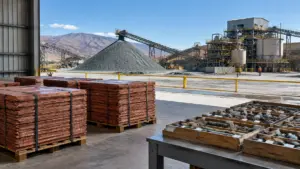
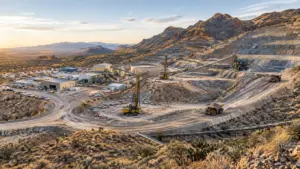
Exploration equipment at a hard-rock mineral project in the western United States.

By Penny Langford
Krait Critical Minerals has signed a definitive agreement to acquire Nevada Hills Antimony LLC, a transaction that would give the Canadian explorer control of contractual rights to the Bales Antimony Project in Washington state and exposure to additional antimony claims in the region.
The deal comes as the United States seeks to build more resilient domestic supply chains for antimony, a critical mineral used in ammunition, military alloys, flame retardants, batteries and other industrial applications. China has historically dominated global antimony supply and imposed export restrictions on the mineral in 2024, increasing pressure on U.S. companies to develop local resources and processing capacity.
Krait said completion of the transaction would provide ownership of Nevada Hills and, indirectly, its rights under the Bales Mineral Property Purchase Agreement, nine additional contiguous mineral claims and four claims comprising the nearby Antimony Bell Project.
The company cautioned, however, that it would not acquire direct ownership of the eight Bales claims at closing. Nevada Hills currently holds the contractual right to acquire those claims from Cannonbridge Capital Corp. under the Bales agreement.

Deal terms and project exposure
Under the definitive securities exchange agreement, Krait will issue 2.5 million common shares to the members of Nevada Hills at a deemed price of US$0.87 per share. It will also pay US$100,000 in cash.
Krait previously paid a US$25,000 non-refundable exclusivity fee. That payment will be credited against the cash consideration, leaving US$75,000 payable when the transaction closes.
| Deal component | Term |
|---|---|
| Target | Nevada Hills Antimony LLC |
| Equity consideration | 2.5 million Krait common shares |
| Deemed share price | US$0.87 per share |
| Cash consideration | US$100,000 |
| Cash remaining at closing | US$75,000 after US$25,000 exclusivity fee credit |
| Bales claims under contract | Eight unpatented lode claims, BA1–BA8 |
| Additional claims | Nine contiguous claims |
| Antimony Bell claims | Four claims |
| Bales purchase obligation | US$225,000 plus a 2% net smelter return royalty |
| Financing announced alongside deal | Up to US$1.5 million through 2 million shares at US$0.75 each |
The transaction remains subject to customary closing conditions, including Canadian Securities Exchange filings, required regulatory and third-party approvals, satisfactory due diligence, title verification and confirmation that the Bales agreement remains in good standing.
Krait also announced a non-brokered private placement of up to 2 million shares at US$0.75 per share for gross proceeds of up to US$1.5 million. The company said proceeds would support exploration, property investigations, general corporate costs and potential work at Bales and Antimony Bell, subject to completion of the acquisition and further technical and legal review.
Bales sits in a historic Washington antimony district
The Bales Project is located approximately two miles northeast of Carlton in the Methow Valley, Okanogan County. The eight Bales claims cover about 162 acres. Together with nine additional contiguous claims held by Nevada Hills, the broader land position is reported to cover approximately 310 acres.
The Bales agreement, effective April 29, gives Nevada Hills the right to acquire Cannonbridge’s interest in the eight claims for US$225,000 and a 2% net smelter return royalty. Until those terms are satisfied, Krait’s exposure will remain indirect through its ownership of Nevada Hills.
According to historical descriptions summarized by Krait and its Bales Project disclosure, mineralization occurs in altered and silicified shear zones hosted by hornblende-quartz diorite. The main reported structure trends northeast and dips steeply to the southeast.
Historical records describe stibnite, the principal ore mineral for antimony, as occurring in veinlets and irregular masses. The company said earlier work included surface trenching, bulldozing and underground development, although the extent and timing of that work are not fully consistent across available records.

Underground hard-rock equipment at an early-stage mineral exploration site.
Historical grades require verification
Krait’s announcement cited several historical results associated with Bales. These include a reported 10.9% antimony assay from vein material and historical sorted material totaling 37.82 tons that reportedly assayed 14.4% antimony.
Historical records also describe approximately five tons of lump stibnite removed from a discovery trench and about 100 tons of mineralized material mined during 1951 and 1952.
Those figures are not current exploration results and do not represent a mineral resource or mineral reserve. Krait said the historical sampling methods, sample locations, analytical procedures, laboratory controls and quality assurance records are either unavailable or inadequately documented.
The company’s qualified person has not independently verified the historical results through field inspection, resampling or laboratory analysis. Selected vein samples and sorted material may not represent the broader mineralized zone.
That distinction is important for investors and project stakeholders. The historical data provide a basis for exploration, but they do not establish grade continuity, tonnage, recoverability or economic viability.
Krait’s proposed first-stage work would focus on confirming title, claim boundaries, access, environmental obligations and historical records. Subject to those reviews and the receipt of required permits, the company may proceed with mapping, systematic rock-chip and soil sampling, independent verification of historic workings and targeted geophysical surveys.

Core handling and sampling equipment at a hard-rock exploration camp.
Why antimony matters to U.S. supply security
Antimony is included on the U.S. Geological Survey’s 2025 list of critical minerals. The mineral has defense applications in ammunition primers, lead hardening and armor-piercing rounds. It is also used in antimony trisulfide, flame-retardant compounds, glass production, batteries and specialized electronics.
The U.S. International Trade Commission has highlighted the concentration of the antimony supply chain and the United States’ reliance on imports. China has been a major source of antimony ore, concentrates and processed products, making the mineral part of a wider debate about strategic supply-chain exposure.
Washington’s effort to secure more domestic critical minerals has increasingly moved beyond mining. As Skillings has reported in its analysis of critical minerals refining concentration, a new mine does not automatically create a secure supply chain if processing remains concentrated elsewhere.
For antimony, that issue is particularly relevant because a viable project would need to demonstrate more than mineralization. It would need reliable extraction, concentration, refining and access to customers that require specific antimony products, including defense-grade materials.
Krait’s acquisition would therefore represent an early-stage exploration bet within a broader U.S. supply-security effort, rather than an immediate source of domestic production.
Additional portfolio opportunity
The transaction also includes four mineral claims comprising the Antimony Bell Project. Historical records cited by Krait describe a 32-foot shaft, several adits and a shipment of 1,300 pounds of stibnite-bearing material from the occurrence in 1940.
Krait said it is reviewing Antimony Bell separately and has not approved an exploration budget or program for the property. The company also said it is continuing to assess other mineral opportunities brought forward by Nevada Hills, but those opportunities will not be treated as acquired assets unless definitive documents are signed and required approvals are received.
The company’s immediate task will be to reconcile the project’s legal and technical position. That includes reviewing claim status, chain of title, access, surface rights, land-management requirements, permitting, environmental liabilities, reclamation obligations and the enforceability of the underlying Bales agreement.

Material-handling and processing infrastructure at a hard-rock mineral project.
What comes next
If the acquisition closes, Krait will need to complete the Bales claim purchase obligations before Nevada Hills can receive direct title to the eight claims. The company will then face the technical challenge of determining whether historic antimony occurrences form a continuous, mineable system.
The proposed exploration sequence is expected to begin with data compilation and field verification. Follow-up work could include trenching, geophysics and drilling to test the reported northeast-trending structure along strike and at depth.
For U.S. policymakers and industrial buyers, the project reflects the expanding pipeline of domestic antimony prospects. For Krait, the transaction adds a critical-minerals asset in a U.S. jurisdiction but also introduces the normal risks associated with early-stage exploration, contractual property rights and historical data.
The strategic rationale is clear: domestic antimony resources are receiving greater attention as governments and defense manufacturers look to reduce exposure to concentrated overseas supply chains. Whether the Bales Project can contribute meaningfully to that goal will depend on title confirmation, modern exploration results, metallurgy, permitting and the eventual economics of processing the mineral.
Sources: Krait Critical Minerals’ definitive agreement announcement, Bales Antimony Project, U.S. Geological Survey critical minerals list, and U.S. International Trade Commission antimony brief.