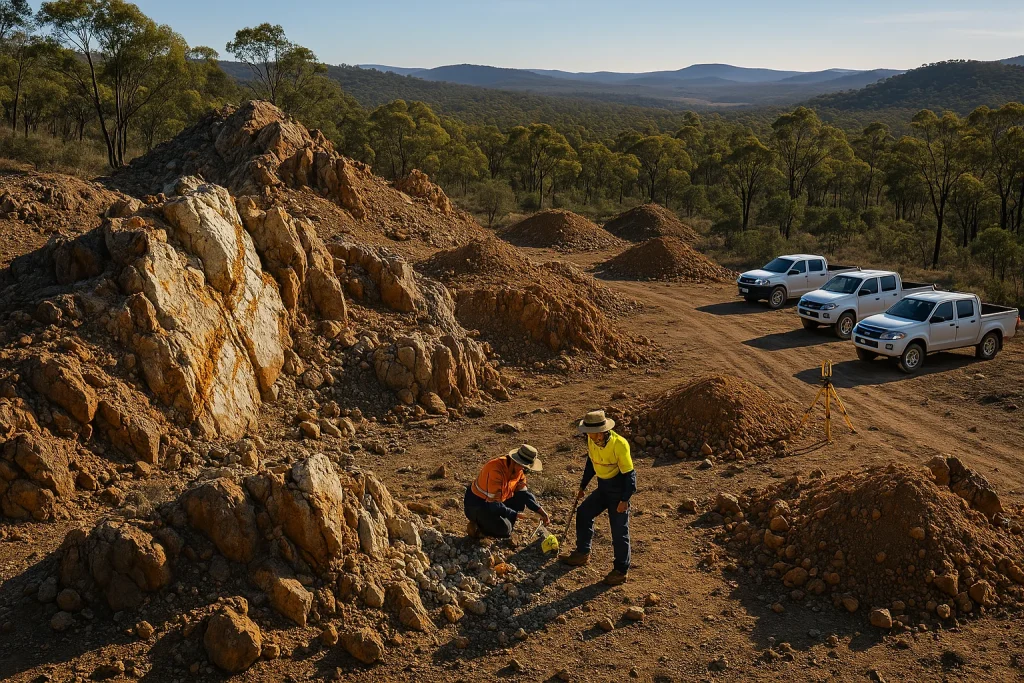
Argent Minerals finds bonanza-grade samples, with assays reaching 1930 g/t gold at Trunkey Creek project

High-Grade Gold Uncovered at Trunkey Creek Project
Argent Minerals has confirmed an exceptionally high-grade Trunkey Creek gold discovery in New South Wales, Australia, following a February reconnaissance program. The company reported rock chip samples with gold grades as high as 1930 grams per tonne (g/t), equivalent to approximately 62 ounces per tonne—among the highest grades reported from surface sampling in recent years.
The discovery was made at Argent’s Trunkey Creek project, located within the Lachlan Fold Belt, a region known for its mineral potential but historically underexplored for high-grade gold systems.
Reconnaissance Program Validates Historic Gold Workings
The company collected 177 rock chip samples across a 2-kilometer strike zone within the broader 5.5-kilometer Trunkey Creek mineral field. Of these, 57 samples returned results above 1g/t, including multiple high-grade assays such as 82.7g/t (2.7 oz/t).
“We are extremely pleased to observe visible gold in rock chips at the Trunkey Creek project,” said Pedro Kastellorizos, managing director of Argent Minerals. “This confirms the extremely high-grade nature of the gold mineralisation previously mined.”
More Read

Argent highlighted that even waste dumps left behind from historic operations—known as mullock dumps—contained gold grades exceeding 82g/t, suggesting significant recoverable gold may still be present at or near surface.

Geophysical Survey Reveals Drill Targets Linked to Gold Trends
In conjunction with rock sampling, Argent conducted a ground-based induced polarisation (IP) survey. The results revealed six high-priority drill targets, aligning closely with historic gold workings and structural resistivity zones that could indicate quartz veins and sulphide mineralisation.
“The detailed ground IP interpretation has clearly defined extensive high resistivity zones and chargeability zones,” said Kastellorizos. “These features have excellent potential for hosting gold mineralisation.”
More Read

The company believes the correlation between historical production, resistivity trends, and high-grade surface samples points to a potentially larger system at depth—one that has never been fully explored using modern techniques.
Trunkey Creek Gold Discovery Positioned Within a Strategic Region
While the Trunkey Creek gold discovery is still in its early stages, its location within the Lachlan Fold Belt adds strategic value. This region is home to major deposits, including Newcrest’s Cadia-Ridgeway mine, and is increasingly targeted by juniors seeking high-margin ounces.
The Trunkey Creek field has previously produced an estimated 2,900 ounces of gold, but was never systematically drilled or mapped beyond shallow workings. Argent’s new data suggests the site could host economic gold mineralisation over a broader area.
Analysts Urge Caution but Note Potential Upside
“1930g/t is an extraordinary number,” said Ian Chalmers, a veteran geologist and former managing director of Alkane Resources. “But one rock chip doesn’t define a resource. The key will be consistency and scale, which only drilling can confirm.”
Argent has yet to announce a formal drilling schedule but is expected to move quickly given the definition of six high-priority targets.
A Potential Turning Point for Argent Minerals
The Trunkey Creek gold discovery now positions the project as the company’s flagship asset, ahead of other prospects like Mount Dudley and Pine Ridge in New South Wales. With visible gold already observed and high-grade assays in hand, Argent is poised to accelerate exploration.
If drilling confirms the presence of high-grade, continuous gold structures at depth, Trunkey Creek could shift from historical footnote to one of Australia’s most compelling emerging gold plays.