Key Takeaways

- China has discovered a 1,000-ton gold deposit in Hunan Province valued at €78 billion.
- The Wangu gold field could surpass South Africa’s South Deep as the world’s largest known gold reserve.
- Advanced 3D geological modeling was pivotal to the find, revealing over 40 gold veins.
- The deposit’s high-grade ore—138 grams per ton—suggests lower extraction costs and higher profit margins.
- China’s strategic gold accumulation may shift geopolitical leverage in global reserves and currency stability.
A major China gold discovery is set to redefine the global gold market, with geologists confirming a 1,000-ton deposit beneath Hunan Province. Valued at more than €78 billion, the Wangu gold field stands as one of the richest finds in recent history—driven by advanced geological modeling and featuring exceptionally high ore purity.
The discovery positions China to deepen its dominance as the world’s top gold producer while reshaping bullion supply chains and reserve strategies.
China Gold Discovery Backed by Rare Ore Grade
What distinguishes the Wangu deposit is its remarkable concentration: 138 grams of gold per ton of ore—nearly 14 times the global average. That high-grade mineralization drastically reduces extraction costs, enhancing the commercial value of the site.
“This is as close as it gets to geological perfection,” said Zhao Li, lead geologist on the China gold discovery project. “We are talking about ultra-rich ore bodies almost tailor-made for industrial recovery.”
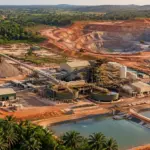
More than 40 gold veins have been mapped at depth using 3D geological modeling, a first for such a large-scale operation in this part of China.

Precision Technology Drove the China Gold Discovery
The breakthrough was enabled by state-of-the-art 3D subsurface imaging. Chinese geologists mapped formations beneath Pingjiang County with precision, targeting high-density veins and minimizing environmental disruption.
“Without this modeling technology, the Wangu gold field would have remained hidden,” Zhao added.
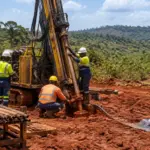
The technological leap could set a precedent for future China gold discoveries, particularly in deeper or more geologically complex regions.
Comparison of Major Global Gold Deposits by Size and Ore Grade (2025)
| Deposit | Location | Estimated Gold (tons) | Avg. Ore Grade (g/t) |
|---|---|---|---|
| Wangu | China | 1,000 | 138 |
| South Deep | South Africa | 930 | 6 |
| Muruntau | Uzbekistan | 1,500 | 2 |
| Grasberg | Indonesia | 600 | 1.5 |
Strategic and Economic Stakes of the China Gold Discovery
For Beijing, the China gold discovery enhances economic resilience and reserve flexibility. With official gold holdings already approaching 2,500 tons, the new reserve supports China’s move to diversify away from U.S. dollar exposure.
“This gives China enormous leverage—not just in the gold market but in broader reserve strategy,” said Natalie Bussey, a metals analyst at Westcroft Commodities.
The site may rival or exceed South Africa’s South Deep mine, which has long held the record for largest known gold deposit. Wangu could yield 30 tons per year at full production—roughly 7% of global annual output.
Domestic Transformation and Global Market Impact
The China gold discovery is expected to spur regional development across Hunan. Infrastructure buildout, mining logistics, and job creation will follow, drawing both state and private investment.
Global gold prices rose modestly after the announcement, while investor focus shifted to bullion equities and reserve currency implications.
But some analysts urge restraint. “This won’t solve structural supply gaps, but it’s a psychological and strategic shift,” said Mark Linton of the International Gold Council.
Environmental Watchdogs and the Future of Mining
While state media has hailed the China gold discovery as a national achievement, environmental groups have flagged concerns over the scale and speed of development. Water systems and biodiversity in Hunan face potential risk.
“Large-scale mining always comes with ecological tradeoffs,” said Yue Mei of China Environmental Forum. “Oversight must match ambition.”
Production could begin by 2027, with preliminary infrastructure construction already under review.