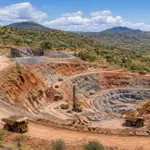
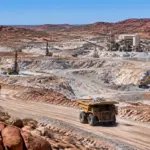
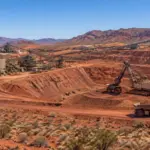
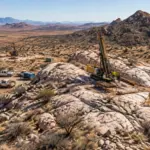
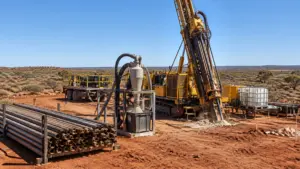
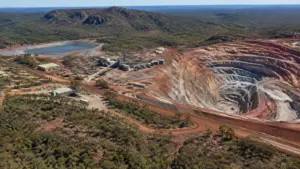
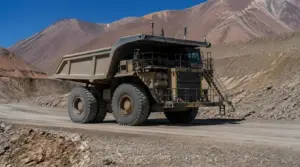
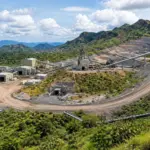
Artisanal gold workings and weathered laterite in Suriname’s Gonini district.

Critical Resources’ shares rose as much as 29% after the Australian-listed explorer announced an exclusive agreement to acquire a 90% interest in the 164-square-kilometre Gonini Gold Project in Suriname, adding exposure to one of South America’s established but lightly explored gold provinces.
The company’s stock climbed to 0.9 Australian cents in early trading, with turnover reaching its highest level in more than three months, according to reporting by the Sydney Morning Herald.
The reaction reflects the combination of existing exploitation rights, the project’s location in the Marowijne greenstone belt and its proximity to two producing gold operations. But Gonini remains an exploration-stage asset. Critical Resources has not reported a modern mineral resource for the project, and the company must still demonstrate that historical artisanal workings can be converted into a coherent, economically viable deposit.
Critical Resources deal terms
The agreement gives Critical Resources the exclusive right to acquire a 90% interest in Gonini from N.V. Gonini Company. The vendor will retain a 10% free-carried interest until a decision to mine.
The transaction includes an upfront signing payment, completion consideration, deferred cash payments and an exploration commitment.

| Deal component | Term |
|---|---|
| Project area | 164 km² |
| Critical Resources interest | 90% |
| Vendor retained interest | 10%, free-carried to a decision to mine |
| Signing fee | US$50,000 |
| Completion cash payment | US$200,000 |
| Shares issued to vendor | 10 million Critical Resources shares |
| Deferred cash payments | US$1.75 million over four years |
| Minimum exploration expenditure | US$2.5 million over five years |
| Vendor royalty | 2% net smelter return, subject to buyback rights |
The cash acquisition payments total US$2 million, while the minimum exploration commitment brings the stated cash obligations to US$4.5 million over the relevant payment and work periods. The agreement also includes a 2% net smelter return royalty that Critical Resources can repurchase, although the company has not publicly detailed the buyback terms in the reporting reviewed for this article.
Critical Resources said the transaction is expected to be finalised within about 90 days. Fieldwork is planned to begin after completion.
Shares surged, but dilution remains a question
The market’s initial response focused on the project’s scale and tenure rather than near-term production. The issue of 10 million shares to the vendor will dilute existing shareholders, with the eventual percentage impact dependent on Critical Resources’ total shares on issue at completion.
The company will also need to fund the US$2.5 million exploration commitment, staged acquisition payments and ordinary corporate expenses. The agreement does not, by itself, establish how the company will finance those obligations.
For a junior explorer, the likely funding routes include existing cash, a future equity raising, a strategic investment or a joint venture. Each option carries trade-offs. New equity could increase the share count, while a farm-in or joint venture could reduce Critical Resources’ funding burden but also dilute its project-level exposure.
The immediate question for shareholders is therefore not only whether Gonini has geological potential, but whether Critical Resources can advance the project without placing excessive pressure on its balance sheet or issuing a material number of additional shares.
Gonini sits in a productive Suriname gold belt
Gonini is located in the historic Sara Creek gold district within Suriname’s Marowijne greenstone belt. The project includes two granted exploitation rights and has a reported 150-year history of artisanal and small-scale gold mining.
Critical Resources said the project is approximately 66 kilometres from Newmont’s Merian mine and 88 kilometres from Zijin Mining’s Rosebel operation. The two mines provide important regional evidence of gold endowment, although their production and resource characteristics cannot be assumed to apply to Gonini.
Suriname’s gold deposits are concentrated largely in the Marowijne Greenstone Belt, part of the broader Guiana Shield. Academic research published in the Netherlands Journal of Geosciences describes the region as having a long history of artisanal mining, major open-pit operations and significant gaps in modern geological understanding.
The same research identifies several styles of mineralisation in Suriname, including primary gold associated with quartz and quartz-carbonate veins, lithological contacts, folds and shear corridors. Secondary gold can also occur in laterite, saprolite and alluvial deposits formed by tropical weathering and erosion.

Field examination of weathered rock and quartz veining in a tropical greenstone setting.
Geology points to an exploration opportunity, not a resource
Critical Resources says Gonini straddles the contact between the Paramaka greenstone belt and a tonalite-granodiorite intrusion, a geological setting associated with orogenic gold mineralisation elsewhere in the region.
The Sara Creek area has been described as containing metavolcanic and metasedimentary rocks, mafic volcanics and intrusives near a tonalitic batholith. Historical geological work indicates that primary mineralisation may be concentrated along lithological contacts, sheared zones and areas affected by pyrite and carbonate alteration.
That setting is relevant because gold in the wider Suriname belt is commonly controlled by structures formed during regional deformation. Quartz veining, altered wall rock and sulphide minerals can provide useful exploration vectors, particularly where exposed bedrock has been opened by previous artisanal mining.
However, artisanal activity is an indicator, not proof of a commercially recoverable deposit. Small-scale workings often target high-grade pockets, shallow alluvial material or weathered zones. They may not reveal the continuity, depth or average grade required for a modern open-pit or underground operation.
The company’s first technical task will be to connect these historical indications into a district-scale geological model.
Suriname offers access advantages, but permitting is not automatic
Critical Resources is placing emphasis on the project’s two granted exploitation rights. The company said the rights provide access for exploration, mining, processing and mineral sales, potentially avoiding the lengthy process of converting an exploration permit into an exploitation right.
That is a meaningful distinction for a junior explorer. It may reduce one layer of tenure risk and give the company a clearer path to fieldwork than an early-stage project held only under an exploration application.
It does not remove the need to comply with Suriname’s mining, environmental, social and operational requirements. The country’s mining sector is governed principally by the Mining Decree of 1986, with the Ministry of Natural Resources and the Geological Mining Service responsible for important parts of the licensing and oversight framework.
Suriname’s artisanal and small-scale gold sector also creates an additional operating consideration. The EITI report says small-scale mining remains important to livelihoods in the country’s interior, while much activity is informal. The sector has been associated with mercury use, deforestation, river siltation and competing claims involving communities and larger right holders.

Remote access and field logistics are central considerations for exploration in Suriname’s interior.
For Gonini, Critical Resources will need to establish how historical workings overlap with its tenure, how local operators and communities are engaged, and how future exploration and any development activity will be managed. Existing rights may improve tenure certainty, but they do not eliminate the need for environmental management, stakeholder consultation and regulatory approvals for specific activities.
Near-term catalysts will come from fieldwork
The first catalysts are likely to be operational rather than financial.
After the transaction is finalised, Critical Resources plans to begin fieldwork involving:
- Channel sampling of exposed pit walls and weathered bedrock.
- Soil and rock-chip geochemistry.
- Trenching across priority structures.
- Auger drilling through the tropical weathering profile.
- Targeted geophysical surveys.
- Follow-up drilling of priority anomalies.
The company has indicated that initial soil lines will focus on the interpreted greenstone-batholith contact. Sampling exposed by artisanal workings could help identify mineralised trends before the company commits to a larger drilling campaign.
The most significant technical catalyst would be a first drilling program that demonstrates consistent gold grades over meaningful widths and confirms continuity below the weathered zone. A maiden mineral resource would represent a later milestone, provided drilling results justify resource definition work under an accepted reporting code.

Quartz veining, sulphide mineralisation and alteration are among the features explorers will test at Gonini.
What to watch in gold mining news 2026
The Gonini agreement gives Critical Resources a large land position in a recognised gold district, but the project’s investment case will depend on execution.
The main points to monitor are:
- Transaction completion: Whether the agreement is finalised within the expected 90-day period.
- Tenure verification: Confirmation of the scope, status and enforceability of the two exploitation rights.
- Field access: Evidence that the company can operate effectively in an area with historical artisanal activity.
- Early sampling: Results from channel, soil, rock-chip and auger programs.
- Funding: How Critical Resources meets its payment and exploration commitments.
- Share issuance: The final number of shares issued and the resulting dilution.
- Drilling: The first test of grade, thickness and continuity beneath surface workings.
- Social and environmental controls: The company’s approach to mercury, water, land disturbance and engagement with affected communities.
The initial share-price rise signals market interest in Critical Resources’ entry into Suriname. It does not establish the size or economic value of the Gonini deposit. For now, the project remains a high-priority exploration story whose next test will come from field evidence rather than market sentiment.
This article is for information only and does not constitute investment advice or a recommendation to buy or sell securities.
Sources: Critical Resources Gonini transaction reporting; EITI Suriname contextual report; Gold deposits of Suriname: geological context, production and economic significance.