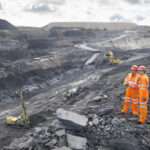
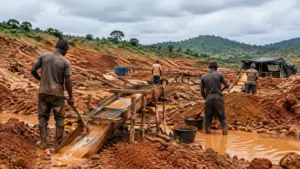
Gold exploration drilling at the Enchi project in Ghana.
By Sonny Rollins

Gold trading near US$4,400 an ounce is changing the economics of West African exploration. In Ghana, Newcore Gold’s latest drilling at the Boin deposit has added a wide, higher-grade zone to the Enchi project. In Côte d’Ivoire, Many Peaks Minerals is advancing a 1.32 million-ounce resource at Ouarigue while deeper drilling tests the potential for further growth.
Those developments are unfolding as Côte d’Ivoire’s production pipeline expands, regional M&A accelerates and investors place a higher value on jurisdictions that can move discoveries toward production faster than mature mining markets.
Côte d’Ivoire is expected to overtake Mali as Africa’s fourth-largest gold producer by 2028, according to regional production outlooks. Ghana remains the region’s largest established producer, supported by major operations, processing infrastructure and a long history of gold mining. Together, the two countries are becoming the centre of gravity for West African gold supply growth.
Ghana’s Boin drilling adds mine-plan flexibility
Newcore Gold (TSXV: NCAU) reported one of its widest and strongest zones yet at the Boin deposit, part of the Enchi Gold Project in southwest Ghana.
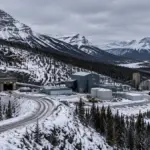
Reverse-circulation hole KBRC411 intersected:

- 69 metres at 2.59 grams per tonne gold from 58 metres
- Including 24 metres at 6.41 g/t gold from 59 metres
The reported interval includes oxidised and upper fresh mineralisation. Newcore describes it as one of the widest and highest grade-thickness intercepts drilled at Boin. The company has said that reported intervals are downhole lengths and that true widths are expected to be lower.
The significance is not limited to the headline grade. A broad zone can affect how an open-pit operation is designed, particularly when it improves continuity between existing resource blocks or reduces the amount of waste required to access mineralised material.
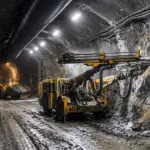
That could give Newcore more flexibility in future mine planning at Enchi. The project has been evaluated around open-pit and heap-leach potential, making the distribution of oxide, transitional and fresh material important to recovery assumptions, sequencing and capital requirements.
Further drilling, including deeper diamond holes, is expected to support future resource updates and economic studies. The central question for the project is whether the Boin intercept represents a local improvement or part of a broader, continuous higher-grade corridor.

Drill core logging at the Ouarigue prospect within the Ferké Gold Project.
Ouarigue moves from discovery to development test
Many Peaks Minerals (ASX: MPK) has established an interim 1.32Moz resource at the Ouarigue deposit within its Ferké Gold Project in northern Côte d’Ivoire.
The resource comprises approximately 26.7 million tonnes at 1.54 g/t gold. Many Peaks has reported a discovery cost of about A$11 per ounce, a figure that stands out in an exploration market where capital efficiency is becoming an increasingly important valuation measure.
The resource is already substantial enough to attract development attention, but the next phase will determine whether Ouarigue can support a larger and more robust mine plan.
Deep drilling has returned a notable result from hole FNDC135:
- 36 metres at 2.64 g/t gold from 600 metres
- Including 4.2 metres at 5.39 g/t gold from 628 metres
The intercept extended interpreted mineralisation approximately 100 metres down dip and 160 metres along strike from earlier drilling at depth. Other drilling has also returned mineralised intervals beneath the current resource shell.
Many Peaks expects an updated resource in the fourth quarter, followed by a pre-feasibility study. Those milestones should provide a clearer view of the project’s scale, mining method, strip ratio, processing assumptions and capital intensity.
Ouarigue’s development case will depend on more than resource ounces. The company will need to demonstrate grade continuity, metallurgical performance, infrastructure access and a mine schedule capable of converting the resource into economically recoverable gold.
Project comparison: resource, cost and development stage
The table below brings together selected West African projects relevant to the current supply and consolidation cycle. Discovery costs are not reported consistently, so unavailable figures should not be interpreted as zero.
| Project | Owner | Jurisdiction | Reported resource | Discovery cost | Timeline or current gate |
|---|---|---|---|---|---|
| Boin, Enchi | Newcore Gold | Ghana | Boin is part of the wider Enchi resource inventory | Not disclosed | Drilling and resource work; higher-grade zones may influence the mine plan |
| Ouarigue, Ferké | Many Peaks Minerals | Côte d’Ivoire | 1.32Moz; 26.7Mt at 1.54 g/t Au | About A$11/oz | Updated resource expected in Q4; pre-feasibility study to follow |
| Afema | Turaco Gold | Côte d’Ivoire | 4.65Moz | Not disclosed | Large resource-stage project; development and valuation case under review |
| Didievi | African Gold / Montage Gold | Côte d’Ivoire | Resource-stage asset | Not disclosed | Consolidated through Montage’s acquisition of African Gold |
| Koné | Montage Gold | Côte d’Ivoire | Multi-million-ounce development platform | Not disclosed | Advancing toward production and regional-scale development |
Resource classifications, cut-off grades and reporting standards differ between projects. The figures are not directly comparable without reviewing each technical report.
The comparison shows why Côte d’Ivoire is attracting attention. The country now has several projects with resources above one million ounces, including assets large enough to support standalone development or regional consolidation.
M&A confirms the strategic shift
Exploration success is being reinforced by a steady flow of transactions. Zhaojin Mining’s takeover of Tietto Minerals valued the Abujar producer in Côte d’Ivoire at approximately A$768 million. The deal gave Zhaojin control of a producing asset and strengthened Chinese participation in the country’s gold sector.
Montage Gold’s acquisition of African Gold was valued at about A$260 million, adding the Didievi project to Montage’s Côte d’Ivoire portfolio. The transaction demonstrated how resource-stage projects can be consolidated around a larger development platform.
Other reported regional moves include the merger of Mako Gold with Aurum Resources, creating a company with more than 4Moz of reported resources and exploration inventory. Turaco Gold has also cited an approximately $870 million valuation for its 4.65Moz Afema project, illustrating the premium that large, district-scale discoveries can command in a strong gold market.
Skillings’ analysis of the wider mining M&A cycle identifies three recurring themes: portfolio consolidation, geopolitical repositioning and a preference for assets with clear operating or infrastructure advantages.
For West African gold, the emerging model is increasingly regional. A producer may acquire a resource-stage project near an existing operation, while an explorer may combine multiple discoveries into a larger development platform. That can reduce duplicated infrastructure, technical overhead and permitting work.
Why the timeline matters
West African greenfield-to-production timelines average about seven years, compared with roughly 10 to 20 years in many other mining jurisdictions.
The advantage is not universal. Security conditions, permitting, community relations, power supply and transport infrastructure can still delay projects. However, established gold belts, existing processing capacity and shorter construction schedules can make a meaningful difference.
A shorter development cycle also matters when gold prices are high. At around US$4,400 an ounce, projects that can move through resource definition, feasibility, permitting and construction in a reasonable timeframe have a better chance of capturing strong operating margins than projects exposed to prolonged approval and capital delays.

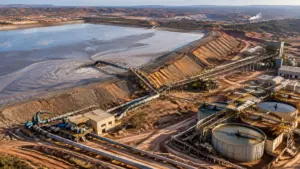
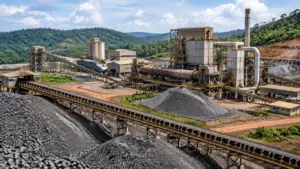
Processing infrastructure and stockpiles at a West African gold operation.
Gold outlook: base, bull and bear cases
The following framework is intended to test operating outcomes rather than provide an investment recommendation.
| Scenario | Gold market | West Africa outcome | Key indicators |
|---|---|---|---|
| Base case | Gold remains elevated but volatile around current levels | Ghana maintains its production base while Côte d’Ivoire adds ounces through expansions and new projects | Resource upgrades, permitting progress, stable costs and continued selective M&A |
| Bull case | Gold holds above US$4,400/oz or moves higher | Higher-grade discoveries are accelerated into feasibility and strategic buyers compete for development-stage assets | Strong resource conversion, fast approvals, construction funding and deeper extensions |
| Bear case | Gold retreats materially and costs rise | Exploration budgets tighten, marginal resources are deferred and transaction premiums narrow | Delayed studies, weaker recoveries, security disruptions or cost inflation |
Under the base case, Boin and Ouarigue remain important because they represent different stages of the supply pipeline. Boin is focused on improving the quality and mineability of an existing project. Ouarigue is moving from resource definition toward development testing.
The bull case would require more than a high gold price. Newcore would need to convert Boin’s wide zones into mineable continuity, while Many Peaks would need its updated resource and pre-feasibility work to validate the scale suggested by deep drilling.
The bear case would expose the risks behind the headline ounces. Resource-stage projects can lose value if grades prove discontinuous, metallurgical recoveries disappoint or infrastructure costs rise faster than gold prices.
The next test is execution
Ghana offers scale, established infrastructure and a mature operating ecosystem. Côte d’Ivoire offers a rapidly expanding project pipeline, competitive exploration results and a growing record of successful mine development.
That combination is reshaping the West African gold market. Newcore’s Boin drilling could improve the quality of the Enchi mine plan, while Many Peaks’ Ouarigue resource and deep drilling provide a potential new development platform in Côte d’Ivoire.
The next phase will be measured less by discovery headlines than by conversion: resources into reserves, studies into permits, and projects into production. In a market where gold remains near historic highs and development timelines are strategically important, those conversion milestones will determine which West African ounces reach the market first.
For ongoing coverage, see Skillings’ gold mining section and market intelligence coverage.