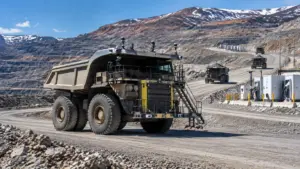
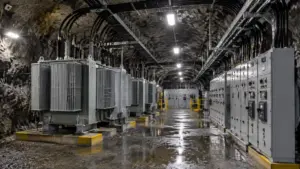
An arid open-pit gold project landscape in northern Chile.

Tesoro Gold has established a maiden Ore Reserve of 1.28 million ounces of gold at its Ternera deposit in Chile, giving the El Zorro project a defined mine plan as the company advances toward a Definitive Feasibility Study targeted for completion by the end of 2026.
The reserve totals 42.8 million tonnes at 0.93 grams per tonne gold, according to an announcement released to the Australian Securities Exchange. It is contained within a single open pit and supports more than 13 years of mining and processing at a planned throughput of 3.0 million tonnes per year.
Tesoro said the reserve represents an 87% conversion of the Measured and Indicated portion of the Ternera Mineral Resource. The result provides a higher-confidence technical base for mine scheduling, infrastructure design, permitting and further economic assessment at El Zorro.
| Ternera maiden Ore Reserve | Reported figure |
|---|---|
| Total Ore Reserve | 42.8 million tonnes |
| Average gold grade | 0.93 g/t |
| Contained gold | 1.28 million ounces |
| Mining method | Single open pit |
| Planned processing rate | 3.0 Mtpa |
| Mine life | More than 13 years |
| Reserve conversion | 87% of Measured and Indicated gold |
| Next major study | DFS targeted by end of 2026 |
The announcement was also reported by Small Caps. Tesoro’s project background and earlier resource and processing information are available on the company’s Ternera Gold Deposit page.

Reserve converts higher-confidence resource
The Ternera reserve is derived solely from Measured and Indicated material. No Inferred Mineral Resources are included, an important distinction as the project moves from resource definition into feasibility-level mine planning.

Tesoro’s August 2026 resource update outlined a larger pit-constrained Mineral Resource of approximately 1.82 million ounces. The portion classified as Measured and Indicated contained about 1.47 million ounces, against which the 1.28-million-ounce reserve represents an 87% conversion.
That conversion reflects the application of modifying factors to the resource, including mine design, geotechnical assumptions, mining dilution, recovery, processing, operating costs and economic parameters. In practical terms, the reserve is the part of the resource that Tesoro currently considers mineable under the stated technical and economic assumptions.

The reserve comprises 2.8 million tonnes of Proved material at 1.05 g/t gold for about 93,000 ounces, and 40.1 million tonnes of Probable material at 0.92 g/t gold for approximately 1.19 million ounces, according to the reported breakdown.
The company said the reserve pit was selected from an optimisation process using a US$3,000-per-ounce gold price. The mine schedule is based on conventional open-pit mining and a 3.0 Mtpa processing operation.

Terraced rock formations and access tracks in a Chilean gold development setting.
Single-pit plan provides development framework
The reserve establishes a defined production base for Ternera rather than relying on a series of undeveloped satellite deposits or an underground mining concept.
A single open-pit operation can simplify the initial development plan, although the final configuration will depend on detailed geotechnical, environmental, infrastructure and scheduling work. The mine plan will need to balance waste movement, pit sequencing, ore access, stockpiling and the timing of plant feed over the operating period.
At the planned 3.0 Mtpa throughput, the reserve supports more than 13 years of mine life. Tesoro has previously described Ternera as a conventional development concept with a standard crushing, grinding, gravity and carbon-in-pulp processing route.
The company’s earlier technical work indicated strong metallurgical performance across representative samples. Reported test work produced gold extractions generally ranging from 92.4% to 97.4%, while testing at a selected 125-micrometre grind size produced recoveries of roughly 95% or higher in several composite samples.
Tesoro has adopted a design recovery of 94.5% for reserve calculations. The company has also reported no identified deleterious elements or preg-robbing tendencies in the material tested to date.

A conventional carbon-in-pulp processing circuit similar to the route planned for Ternera.
DFS becomes the next major project test
With the reserve now established, Tesoro’s focus shifts to completing the DFS and converting the current mine plan into a more detailed development case.
The study is expected to refine the major capital and operating assumptions, including:
- Final pit design and mine schedule
- Waste-rock movement and stockpile requirements
- Processing plant configuration and equipment selection
- Water supply and power infrastructure
- Tailings and waste-management arrangements
- Access roads, workshops and site facilities
- Environmental approvals and closure planning
- Construction schedule and procurement strategy
Tesoro has said the DFS is targeted for completion by the end of 2026. The study will also need to test the robustness of the project against changes in gold prices, construction costs, operating costs, metallurgical recovery and permitting timelines.
The reserve announcement does not remove those development risks. A maiden Ore Reserve is an important technical milestone, but it does not constitute a construction decision or guarantee that production will proceed. The project remains subject to further engineering, permitting, financing and corporate approvals.
Exploration continues beyond the reserve
The reserve covers the current Ternera mine plan, while Tesoro continues to assess exploration potential across the wider El Zorro Gold Project.
The company has previously reported that the Ternera deposit remains open in several directions and that additional mineralised zones have been identified near the current resource. It has also highlighted regional targets, including La Brea, located north of Ternera along the broader El Zorro gold corridor.
Further drilling could affect the project in two ways. Near-mine drilling may add material to the existing pit plan or improve the classification of resources outside the current reserve. Regional exploration could identify additional deposits that may support later expansion, although those targets remain separate from the maiden Ore Reserve.
For now, the significance of the announcement lies in the defined initial operation: 42.8 million tonnes, 1.28 million ounces, one open pit and more than 13 years of planned processing at 3.0 Mtpa.
What the milestone means for Ternera
The maiden reserve gives Tesoro a clearer basis for progressing El Zorro from an advanced resource project toward a development decision. Its high conversion from Measured and Indicated resources also reduces the proportion of the initial mine plan dependent on lower-confidence material.
The next stage will be measured less by the headline ounce count than by how the reserve performs under detailed engineering and economic review. Investors, operators and policymakers will be watching the DFS for greater clarity on capital intensity, operating costs, water and power arrangements, permitting and the construction timetable.
Tesoro’s immediate objective is therefore straightforward: incorporate the reserve into a definitive mine and processing plan, complete the DFS by the end of 2026 and continue testing whether additional exploration can extend or improve the initial Ternera operation.

Mine-planning personnel monitor operational data and pit development scenarios.
The announcement strengthens Ternera’s position as a proposed open-pit gold development in Chile, but the project remains on the path to development rather than in production. Its next critical milestones will be the DFS, permitting progress, detailed infrastructure design and the decisions that follow those studies.
For broader coverage of resource development, commodities and project execution, see Skillings’ minerals and metals coverage.